
Wendy and Lucy
Kelly Reichardt's amazing film about a woman looking for her dog.

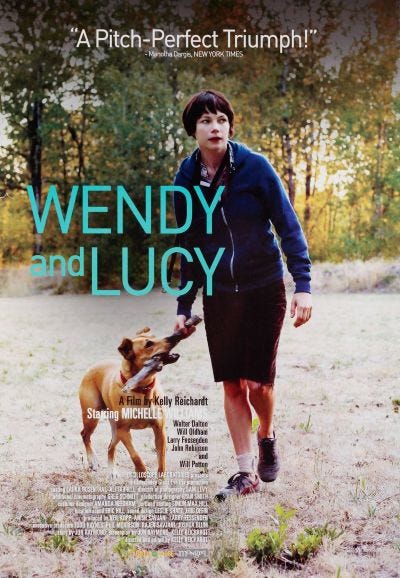
Wendy and Lucy (2008). Grade: B+
Sometimes, it’s hard to find anything to write about a movie. Maybe it’s been talked to death. Or maybe I found it dull for no interesting reason (there can be interesting reasons a movie is dull; like if censors took out all the good parts).
Well, this one’s easy to write about.1 First off: the young woman comes to no harm in the movie, and she does find her dog, and it’s safe.
And, next off: Kelly Reichardt is the best director in America, nobody else is remotely close, and Wendy and Lucy was the first Reichardt movie I’d seen. It quickly made me want to see the others. They’re all good.
Reichardt was raised in Miami, where her dad was a crime scene investigator; her first love of film came from pictures she took with his crime scene camera. By age 30 Reichardt had written/directed her first feature, River of Grass. While River received some critical acclaim and awards, and the 90s were a good time for some independent filmmakers, it wasn’t a good time for women directors. Reichardt said “‘I had 10 years from the mid-1990s when I couldn’t get a movie made. It had a lot to do with being a woman. That’s definitely a factor in raising money. During that time, it was impossible to get anything going, so I just said, “F**k you!” and did Super 8 shorts instead.’”
Finally, in 2006 she was able to get Old Joy made (on money she earned from being an assistant on America’s Next Top Model). It’s a halfway dialogue-free movie about two old friends who go on a camping trip and realize that an unspoken sense of “who’s more successful than who” has poisoned their friendship a little. It’s not dead, but it will never be the same. It’s a gentle and incredibly sensitive story, and has what drives some people strictly nuts about Kelly Reichardt’s movies; they are rarely in a hurry. Sometimes, we are simply watching a character on screen as they silently show us what they are feeling.
Old Joy was based on a short story by Jonathan Raymond, published in his book Livability (I haven’t read it). Wendy and Lucy is another story from the same collection; she and Raymond wrote the script together (he’s worked on six of her movies). It stars Michelle Williams, who was willing to appear in the film for peanuts because she liked Old Joy so much; she and Reichardt have now worked on four films together. Williams plays a woman who’s traveling with her dog, Lucy, to Alaska; she’s got very little money, and they’re living in her car. And now the car won’t start.
A series of unfortunate events leads to Williams being separated from Lucy for several hours; by the time she returns to fetch her, Lucy is gone. She spends most of the rest of the movie looking for Lucy, or contacting the pound to see if they’ve found her. While her dream of reaching Alaska feels dicier and dicier.
If the “person barely getting by goes looking for their beloved dog” plot sounds a little like the incredible film Umberto D, well that’s something Reichardt herself acknowledges in this Slant interview (which is a hoot to read; Reichardt takes no B.S. from the press). That she and Raymond went back and looked at Italian neorealism, and German post-war movies, and English “kitchen sink” movies, stories where there characters are struggling and feeling down on themselves because they’re struggling (I’ve barely been there, Reichardt’s been there much worse.) That constant gnawing of fear which comes with being desperately poor, where one stroke of bad luck can really ruin a person; the situation a lot more people would be facing after the 2008 economic collapse and will be facing after the coming, dumb-dictator-created collapse.
But while this story might have something in common with neorealism, the style of filmmaking’s a little different. Neorealist films generally used non-professional actors (as Iran’s Jafar Panahi does today); most of the characters here are played by actors with some TV/film background. Having non-professional actors can be a real challenge in the best of circumstances; when you’re making a movie like this, where you have a budget of $300,000 and an 18 day shooting schedule, it really helps to have people who can remember their lines.
The performances here are quite decent, and a surprising number of them are by other filmmakers, or people who would become filmmakers; John Breen as a by-the-books grocery store manager, and Larry Fessenden as a spooky mentally-ill guy Williams meets while alone in the woods. Again, as I said, she’s not attacked or anything during this scene, but she is scared out of her wits; a woman without a safe place to sleep at night is always under an extra level of danger.
Williams, who first gained public attention for Dawson’s Creek, of all things, was 28 when this movie was made, and looks even younger; there’s a real fragility about her. (It’s not because she’s a wuss, just how her plans are so sketchy that you know everything’s hanging by a frayed thread, including her sanity.) Williams slept in the character’s car and didn’t wash her hair for the duration of the shoot; she sure looks authentically grungy. She's outstanding here. (I mean, no big surprise, right? She's always pretty darn good.)
TV character actor Walter Dalton has the other main role, as a gruff-but-kind security guard at a Walgreen’s who takes pity on Williams and eventually does what he can to help her out. It may be an accident that Reichardt chose Walgreen’s as the location, but it also makes it so every viewer knows the logo and the type of semi-low-rent store Walgreen’s is; if it had been a regional chain like G.I. Joe’s or Fred Meyer, people would be a little more confused. Everywhere I’ve lived has a Walgreen’s. (This was shot around the Portland, OR area.)
At one point, a simple act of kindness by Dalton might start you feeling the tears well up, and you will not have expected that to happen; you thought you were just watching a simple low-budget story, you didn’t expect it to get to you this way. And the same with the ending, which isn’t tragic, yet it’s bittersweet; Williams is promising herself something that you know in your heart of hearts is never going to happen. Like in Smithereens, while the desperate protagonist is shown as scraping by at the end of the movie… you have no idea what might happen to her the next day. It might be bad.
The story’s basically about a desperately lonely person without a human in the world she can rely on; and about her despair when she worries that she’s going to lose the only soul in the world who loves her. Whose name was actually “Lucy,” by the way; Kelly Reichardt’s own dog, who she would take with her as she cris-crossed the country. (Reichardt taught at Bard College in New York, and most of her early films were set in Oregon or Montana.) Funny, she told Slant that she wasn’t a “dog person.” “I just got hung up on this one dog that I found, but I wasn’t intending to get a dog. I never saw myself as a dog person.” Lucy the dog also appeared in Old Joy; she died before Reichardt made Certain Women, and the movie was dedicated to her. You can watch a three minute film about Lucy here; it has spoilers for the end of this film, showing the bittersweet ending. And yep, I cried again.
I think every film fan should try a Kelly Reichardt movie at least once, and see if it’s the type of thing you can get into; I think she has more mastery of image composition and how to use a big screen than anybody working today. (The fine cinematographer here is Sam Levy; musician Will Oldham composed the tune Williams hums to herself, and it’s movingly reprised in the end credits. He also appears as a harmless weirdo who's worked in Alaska before.)
Plus Reichardt brings intelligence and compassion to boot. I can only think of one “bad guy” in any of her movies; the rest, while they may act thoughtlessly (an overeager grocery worker here, Bruce Greenwood as the world’s most haplessly lost trail boss in Meek’s Cutoff), they’re not intentionally malevolent. Their actions just harm others, that’s all.
By the way, Meek’s Cutoff is NOT the way to start watching Reichardt’s films. It’s intentionally frustrating; it’s trying to show you how much being an old-time pioneer woman sucked. But this one is a good entryway; it’s only 80 minutes long, and it moves at a reasonable pace. Night Moves is good, too, with an excellent performance by Jesse Eisenberg; or Certain Women, where Laura Dern and Jared Harris and Lily Gladstone (and Kristen Stewart!) are all terrific.
Yes, this has a sad story. But the movie’s not The Florida Project; it’s not trying to blow you away with misery so that you worship the director’s noble intentions. It’s simply the story of this woman and this dog. And how people treat a vulnerable individual; some with compassion, some not. How would you treat this woman if you found her loitering outside your workplace? I think we all tell ourselves we’d be kind, as Walter Dalton is here; yet in real life, would we? Would I, would you? It’s hard to say. I don’t know.
Curse Of Death, that phrase! It ended up taking a long time to write this pretty short post. Serves me right for jinxing it!