
Offside
Girls in Iran try to sneak into a soccer game, when only men are supposed to attend. It's a lot of fun to watch.

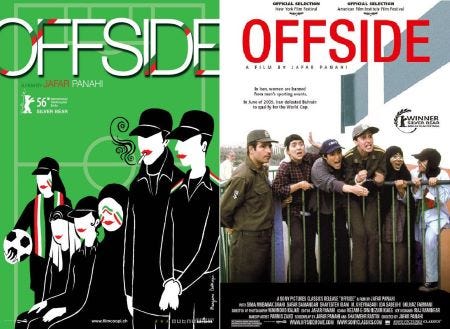
Offside (2006). Grade: B+
One regret about mortality is that I’ll never have the chance to catch up with all the great work done by so many talented people around the world. Heck, I’ll never catch up with all the great stuff done in America. The question posed by every vampire movie — what would you do if you lived forever and never got old and had your body hurt all the time — is a pretty simple one to answer. I’d read everything I’d ever wanted to read! And watch everything, and listen to everything. That’d easily fill up a couple of millennia. Especially if Guillermo does all the housekeeping for me.
I’ve seen Asghar Farhadi’s powerful 2011 A Separation; for some reason, that didn’t make me go find more excellent Iranian films. Maybe because A Separation’s frightening depiction of life under theocracy hit too close to home (it’s the way I grew up, and the way the US has been drifting in my lifetime.)
Well, Offside is about life under theocracy, too — but it’s easier to take. It has a funny, subversive spirit. Amazingly, it’s banned in Iran, even though it doesn’t depict Iranian authorities in a harsh light. Apparently even a funny depiction of mild resistance to theocracy is too much for the censors. (And I think director Jafar Panahi had poked at the censors before.)1
The story’s about kid girls who want to watch a World Cup qualifying match; in Iran, women are banned from such things. While I am not familiar with the Koran and hadith, I’ll make a pretty safe bet that “thou shalt not let women attend professional sports games which sell tickets and make money for FIFA” isn’t in the holy writings. So, theoretically, the ban is to prevent women from hearing naughty language, as sports fans sometimes cuss. (I’m sure people in Iran also cuss when they drop heavy objects on their toes, just like anyone else, so women have heard these words before.)
There’s basically just a few scenes. We see a young girl buying her ticket from a scalper. (Right after a guy in a Miller High Life hat; which goes to show how arbitrary theocracy can be!) She makes her way through the crowd, looking very terrified — it’s probably looking terrified that gives her away as someone who isn't allowed there.
Then she’s placed in a stadium concourse holding area with other girls caught trying to sneak in. Then the girls ride a bus headed for the downtown police station. (And that bus scene’s amazing.)
That’s it; that’s the movie. Those three scenes, really. (And an interruption when one girl has to use the bathroom, so a guard has to take her.) But you’d be surprised how much liveliness director Panahi finds in these simple setups. The girls are constantly funny as they yell at guards just to let them kinda watch the game. They're not rebels against society’s wrongs, they're soccer fans.
The movie suggests something like comic neorealism; for those who don’t know, “neorealism” is a term referring to a type of Italian film made just after WWII. The filmmakers didn’t have much of a budget, so they’d use existing locations and mostly non-professional actors. And they’d make movies about everyday Italian life, rather than the Hollywood imitations which were popular before the war.
Those neorealist movies were pretty grim; Offside isn’t, even though the subject is a frustrating one. But Panahi uses some similar techniques as those postwar Italians. The stadium here is the actual stadium, and inside there’s an actual game going on. Almost none of the actors had any prior film experience, although some have, since — especially Shayesteh Irani, who makes an impression as “Smoking girl” (per the sad, measly Sony Pictures Classics official website).
How Panahi gets such vivid, likeable, believable performances from non-actors here is anybody’s guess. Maybe he just cast very nice kids who interacted well together, and nice adults as the guards? Who knows. It sure ain’t just as simple as that!
Despite the amateur actors, this isn’t an amateurish-looking film. It looks terrific. The cinematography is credited to Rami Agami and Mahmoud Kalari — guess what, Kalari shot A Separation. Beyond the concourse, we see the city, the mountains, in gorgeous fading light.
There’s a shot on the bus which is really wonderful. A guard gets off at a neighborhood store to pick up water for all the girls; at the store, a television’s showing the end of the game. We hear the girls laughing and chatting among themselves, some watching the game, some not; we watch the guard getting water and the passers-by doing what they do. That’s an entire mini-world created in one shot where the camera doesn’t even move. Where the main characters aren't even onscreen, only heard. Wowza, that's good.
What most viewers will appreciate, I think, is how Offside gives us a peek inside this small part of Iranian society, without feeling like it’s smashing the 1000-lb Message Hammer on our heads. And while being generous to its characters. Yep, the guards are enforcing a stupid law; but aside from their officious boss, they’re just doing a job, they’re not mean people. The guard who corrals that girl in the first scene? He borrows her cellphone to talk with his gal, and it's clear her family doesn't approve of their relationship. Everyone’s breaking the rules, a little.
In the end, after the game, the city’s going nuts with glee. The guards are, the girls are. (Spoiler alert: one of the teams wins!) Even if you sure wouldn’t want to live under Iranian theocracy, this kind of community joy is a blast to see. You wish you were there for that. This is the kind of thing I can’t imagine an American filmmaker showing if they did a movie about life in Iran. They’d be busy reminding us (like in Argo) how bad and nasty and bad Iran’s government is, boo Iran. (And we are kinda sorta somewhat responsible for that government… read Steven Kinzer’s All The Shah’s Men for further details.)
Every now and then, I see a movie that’s critically admired, and think to myself, “I’m glad I saw this; now I know never to watch another movie by this dingus.” Offside was the opposite. I want to see more films by Jafar Panahi.
On the disc’s special features, Panahi talks about how the story was inspired by his kid daughter. She begged him to take her to a big game; he told her she’d be caught. She promised to head straight home with Mom if that happened. Well, she was caught, and headed off… and a few minutes later, she showed up inside the stadium to surprise Panahi. He asked how she’d managed it, and she told him “there’s always a way.”
I don’t know how Panahi managed to get material this good out of non-actors while shooting with a real game going on. But for him, in this case, there was always a way.
Yup, he sure had! This article has a section written by Panahi about making the film; it’s a neat read. Five days before shooting was supposed to end, the military tried to shut him down! But the remaining scenes were ones he could finish away from where the military would be hovering.
Your opening reminds me of taking Intro to Film History. It was so powerful to watch films from their invention onward. I had seen parts of Birth of a Nation before that. But seeing it after watching dozens of silent films leading up to it was very different. It provides so much insight. Did people love that film because they were racists or because it was revolutionary? Well, both!
You might not expect it, but I love neorealism. De Sica is probably my favorite. Umberto D is such a great film. I identify with the main character so much. And, of course, The Bicycle Thieves (also with non-pro actors) is almost a propaganda film. "You think stealing is wrong? Here! Let me put you in a position where you steal!" Both films are heartbreaking. And they are so different from modern America. The first things Trump did was to "fix" a bunch of "problems" that didn't actually exist. It's really amazing to think. a bunch of fat and comfortable people have been convinced that they are the real victims by people who have most of the power in society. They are mostly the same Christians who are convinced that despite being 80% of the country, they are being oppressed.
What I find fascinating about this story is how it interacts with the way that American Christian nationalists think of Islam. They absolutely hate this kind of thing. But they are exactly the same! If they get the kind of power that the conservative Muslims have in Iran, they will do the same thing. I listen to these people all the time. There really is no bottom. Ultimately, they will support any terrible behavior because "it ain't wrong if God says so!"
I don't mean to trivialize, the films like this work because they show that people are just people. Religion isn't the only thing that causes people to stop others from enjoying the simple joys in life. But it's one of the biggest.