
River of Grass
Kelly Reichardt's first, flawed-but-worthwhile feature.

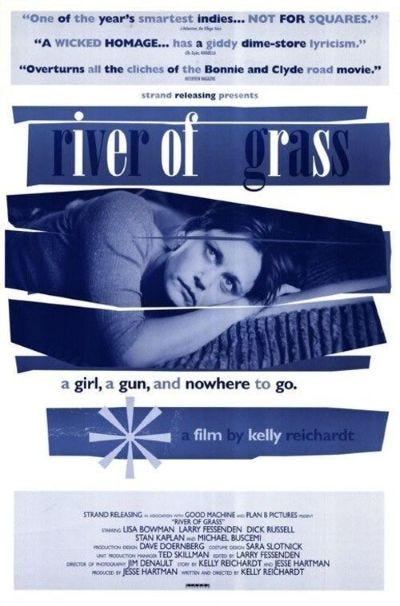
River of Grass (1994). Grade: C+
The supposed golden age of indie movies in the 1990s wasn’t all it was cracked up to be. Generally, most of the vaunted indie movies being well-publicized and somewhat widely-seen were either British imports or Quentin Tarantino wannabes (Things to Do in Denver When You’re Dead, etc.) While few of the indie directors being given attention were women.
Kelly Reichardt was no exception. Despite the friendly blurbs you can see on the poster above, this decent first feature went largely unnoticed. I never even heard Reichardt’s name until Wendy and Lucy came out (and most of the attention for that went to the excellent performer of star Michelle Williams). After River of Grass, it took twelve years for Reichardt’s second feature, Old Joy, to get funding.
And now she’s unquestionably the most interesting fiction filmmaker in America, and critics have FINALLY started noticing her work since around 2019 or so. (While claiming they had been all along. They hadn’t.)
River of Grass is set in south Florida, where Reichardt grew up, and where her dad was a crime scene investigator (her mom was a narcotics agent). It’s not a crime story, but it’s very much about the kind of people frequently caught up in crime stories; not necessarily evil so much as they’re f**kups.
Lisa Donaldson (a restaurant server and artist Reichardt knew) plays a mom of about 30 or so, one who got married to a guy she didn’t love because it was “the thing to do,” and assumed she’d grow to love him eventually (he is, at least, harmless). Well, she didn’t ever fall in love with him. Or, really, even with her kids.
One night she abandons the kids at home and goes out to a local bar. At the bar she meets the eager and not too intellectually intimidating Larry Fessenden (a fixture in the New York indie film scene). Fessenden tells her his next door neighbor has a pool he can use any time he wants. Donaldson’s buzzed enough that the idea of a swim sounds interesting.
When they get there, Fessenden was lying; his neighbor DOES have a pool, but Fessenden doesn’t know the guy, or have permission to use the pool. They have to scale the neighbor’s fence. At one point, the neighbor asks what the hell’s going on, and, frightened, Donaldson fires off a shot. Down goes the neighbor.
So off go Donaldson and Fessenden; they think they’ve killed a guy, and they think going on the run will help them get away with it. (They didn’t kill the guy, he wasn’t even grazed, and if they HAD killed him, they’d have been enormously easy to catch.)
But going on the run transforms Donaldson a bit. At one point, in a convenience store, Fessenden picks out a wig for Donaldson, and she enjoys wearing it. She’s imagining being a new person. One who isn’t married and doesn’t have kids. And the movie isn’t shocked at a mom running out on her family; it’s not judgmental about it. (You may find yourself thinking “that’s a rotten thing to do!”, but the movie doesn’t; and Donaldson isn’t shown as anyone who hates her children, she just wishes she never had any.)
There’s obviously some similarities to other “women on the run” movies, like the way Geena Davis is freed by escaping her boring husband in Thelma & Louise, or Shelley Duvall freed by going on the run in Thieves Like Us. Although those movies forced their characters into doomed endings, and this one doesn’t exactly. It simply ends with Donaldson having no good options available. Maybe after the movie ends, there’s a dramatic shootout a few days later, or maybe Donaldson eventually drifts back to her kids out of habit. You don’t know.
Those who know Reichardt’s later films will be surprised by how much wry humor there is in this one. There’s generally not a lot of joking around in her movies. (She’s said that’s partially because “we moved into the Bush era, and it got f**king depressing.”) The humor here isn’t from anyone telling a funny joke, it’s from how grungy and lowdown the settings are. Everyone knows the term “Florida man,” right? Where the joke is that so many of the weirdest headlines start with the words “Florida man”? (As in “Florida man eaten by alligator he was trying to get drunk.”) Well, these characters, especially Fessenden, are the epitome of “Florida man.”
Fessenden’s appearance in this one might be a little hard for some viewers to take; he’s certainly not a vain actor here. (This was his first role outside of his own indie films, but he’s done a TON of acting work since, including small roles in Scorsese and Jim Jarmusch movies.) Fessenden’s hair’s done up in the most unattractive way imaginable, and he’s usually wearing a slack-jawed expression and a shirt in various stages of unbuttonment. It’s a physically repulsive appearance. But keep in mind he was also the editor and the sound designer on this movie as well, and does the DVD commentary with Reichardt (where he jokes about the sound design being subpar); clearly, Fessenden worked with Reichardt to create this off-putting look for his character. (The character himself isn’t offputting so much as utterly clueless.)
Donaldson’s look isn’t the most flattering, either, although it’s a little better when she’s wearing the wig. If anything, the appearance of the two characters reminded me of myself and others I knew when we were working the most white-trashy jobs imaginable. It’s not that poor white trash don’t know they look rather unpleasant, it’s just that they can’t pull off the look which more upwardly-mobile people can. It would feel fraudulent to wear the cool clothes that hipsters wear on the weekends. (Eventually the secret way out of this pattern is to find a look/style of clothing that’s not hip but doesn’t look trashy either, and that look will be different for every poor person, there’s no hard and fast rules to this.)
The other major performer is Dick Russell as Jimmy Rider, the cop whose misplaced gun sets the whole plot in motion and who ends up leading the investigation of sorts. Russell doesn’t have a ton to do, but he really fits in this setting (so much so that’s you’ll be surprised he doesn’t have any more acting credits in IMDb; he looks like someone who’s been in a trillion cop shows and movies). You wouldn’t be surprised if Russell popped out his false teeth, like Fred Ward in Miami Blues. Instead, he’s unwinding by playing jazz drums at small clubs. (The mostly-jazz score by John Hill suits the setting, too.)
The biggest flaw here, as Reichardt acknowledges in the commentary, is that she’s not a good enough story writer; her later films are usually done in collaboration with fiction authors or based on works by fiction authors (except her most recent, The Mastermind, which hasn’t made it to DVD yet, so I haven’t seen it). The ideas are there for who her characters are, yet they’re not given quite enough interesting things to do. In a Reichardt movie, the characters don’t have do be doing anything fascinating to be fascinating; we watch Lily Gladstone tending to animals in Certain Women and it gives us insight into the person she is, even without dialogue. We just don’t have quite enough of that here.
There’s glimpses of Reichardt’s great eye for imagery, though, like languid shots of Donaldson swimming in a pool, or the endless array of overpasses and freeway bridges over Donaldson’s car1 in one scene. (This could easily be called River of Asphalt; the title here refers to a Native name for The Everglades.) Or just the run-down liquor stores and laundromats and convenience stores which make up the settings here. This is like the stores and roadside motels in Something Wild, except those are filmed with affection; here, it’s more distanced irony. Reichardt told interviewer Todd Haynes that doing a movie set in Florida was Fessenden’s idea; her thought was “it took me 19 years to get out of Miami; I didn’t want to go back.”
Wait, is that Todd Haynes THE Todd Haynes, the acclaimed (read, vastly overrated) director of such movies as Carol and May December? Yes it is; he and Reichardt have been friends since she worked as a prop/set design person on his 1991 movie Poison. He’s produced several of Reichardt’s films since. That friendship baffles me, since the primary thing I think of with Reichardt is how she doesn’t fit characters into neat little boxes, while that’s something Haynes always does. There isn’t a single person in his movies who isn’t defined by shallow character traits; I find every note of his films to ring utterly false. Well, maybe he’s just a really nice guy in real life? (Someone who notices and respects the set/prop people on their crew IS probably a really nice guy.) It’s just an odd friendship. It’s like if Truffaut was friends with Stanley Kramer.
That Haynes interview is interesting for the details about this shoot. Donaldson could only get a week off from her restaurant job, and so that’s why much of her story is told in voiceover; it was written and recorded later. Much of the crew were sexist jerks to Reichardt and acted like she didn’t know what she was doing, even though she’d raised all the money herself that she was paying them with. (It led to Reichardt changing the ending here and adding in a little female revenge fantasy.) And the filmmakers were always running into trouble with Florida cops threatening to arrest Donaldson (who’s credited as “Lisa Bowman” here). Although, Reichardt admits, “to be fair she was driving around Dade County waving a prop gun.”2
Critics (the ones who write for fashionable outlets) started noticing Reichardt’s movies with 2019’s First Cow, which to me wasn't among her strongest films; that is to say it’s quite good, it just didn’t grab me. (It has the closest thing to a “bad guy” in any of Reichardt’s movies; although, even then, Toby Jones is less “bad” than “supremely arrogant and unconcerned about who he hurts by being so.”) I suppose by then critics had placed Reichardt in the “auteur” category; moviemakers who repeat the same themes and stylistic mannerisms so many times that dense critics can get the point and call them geniuses.
There are certain things common to most of Reichardt’s films, like a generally unhurried pace, and frequently the presence of male characters who think they know what they’re doing when they’re actually clueless (Bruce Greenwood in Meek’s Cutoff, Jared Harris in Certain Women, Fessenden here). But there’s no character like that in Wendy and Lucy or Showing Up. While some of the pacing in Night Moves and the Harris scenes in Certain Women are quite tense and tight. Reichardt’s interesting because she’s NOT like the “auteur” directors critics love today; you don’t have to force yourself to see deep meanings in her movies which aren’t there. The compassion for the characters is enough.
Now, this movie isn’t for the general film fan; it’s for people who already know and admire Reichardt’s other work. It’s a little like listening to the first EPs put out by your favorite bands. That’s not necessarily a place for an outsider to start! For a newbie, I’d suggest Wendy and Lucy or Night Moves instead; and if you like what you see, move onto Certain Women. It’s a great film, really wonderful, but it’s also an anthology film and one of the anthology pieces falls a bit flat. But I promise you; the ending which returns to one of the earlier stories is absolutely satisfying.
Reichardt called this “a road movie without the road, a love story without the love, and a crime story without the crime.” It’s also a Kelly Reichardt film without the budget to have those wonderful compositions and nuanced performances which make up the best of her movies. But already she was well above a lot of what was getting lauded on the indie scene in the 1990s. Come back to this one once you’ve seen some of Reichardt’s other films (preferably, all of ‘em!), and see how she started out. It’s not as excellent as those later works. But it won’t disappoint you, either.
There's a late shot of that car zooming through backcountry roads, from an impressively-high following angle; was it shot from the cab of a semi? The commentary doesn't say. It does say they didn’t have anybody making sure there weren’t any strange cars approaching at the street crossings! So I suppose it was on the drivers to be heads-up!
On Day Two of a nineteen-day shoot, one of the gaffers was arrested and all the equipment confiscated. It’s a miracle this got finished, then! That kind of delay can be catastrophic on a tight-scheduled and even tighter-budgeted project.