
Thieves Like Us
Altman's emotional, evocative Depression-era crime story.

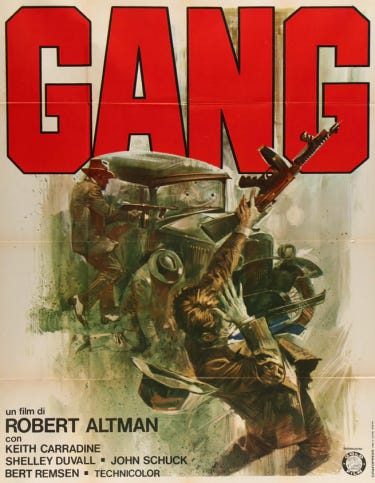
Thieves Like Us (1974). Grade: B-
I’m no crazier about nepotism than anyone else is. But there’s times when the children of famous people are actually quite talented. John Huston (Walter’s son) was a very good director, and his daughter Angelica a very good actor. (So’s Danny Huston, too). You could make a very good case for Jared Harris being a better actor than his dad, Richard (he certainly drank less, which helps). And gaunt-faced John Carradine had TWO sons who were quite good in their own right, David and Keith. (And John was a heavy drinker, like Richard Harris.)
Keith Carradine had a small role in director Robert Altman’s McCabe & Mrs. Miller, and would have one of the more memorable roles in Altman’s Nashville.
When David Milch, the creator of Deadwood, needed an actor to introduce viewers to a large cast speaking strange dialogue — very like the feel of Altman movies — Milch cast Keith Carradine as Wild Bill Hickock. And it was brilliant casting — Carradine’s not around long, but he gives the audience an entryway into the series. An old fashioned movie star turn to introduce a very new kind of revisionist Western without any other established stars. (Not that Carradine was ever a big name star, but he has the presence of one; he’s so memorable as Hickock that you understand why Robin Weigert and Dayton Callie mourn their dead friend for so long afterwards.)
He plays a Depression-era bank robber here, and one who eventually wins the affections of country gal Shelley Duvall. They’re a great fit together, and they were in Mrs. Miller, too — they’re both lanky and long-faced, unconventionally compelling to look at. These characters aren’t brainiacs, but they’re not idiots, either. Their emotions feel good and real. You want them to make it, although you’re a little dubious that they will — this IS a kind of variation on the Bonnie & Clyde story, after all. (Except in that one, Bonnie robbed the banks along with the men.)
This is based on the same novel as the 1948 They Live by Night, featuring Farley Granger and Cathy O’Donnell as the lovers. It’s by a competent-enough director, Nicholas Ray, but the two leads are pretty darn blah and too darn noble (that’s the script’s fault). This is supposedly much closer to the book, which I haven’t read.
In They Live by Night, the Granger character kept trying to break away from crime, but his loser crime buddies kept dragging him back into it, since Granger is the bestest of all bank robbers. (We sure don’t see why.) Here, the Carradine character doesn’t see anything particularly wrong with robbing banks. He likes the money. It’s just that Duvall really wants him to stop. And because her emotions are so raw, you want him to stop, too. You just know that he probably won’t.
When Duvall died last year, at the age of 75, many writers noted that her best performances were in Altman movies (with the biggest roles being this one, Popeye’s Olive Oyl, and 3 Women’s determined, isolated oddball). That’s certainly got a lot of truth to it.
What’s also certain is that the absolute worst director for Duvall to work with was the power-mad Stanley Kubrick, in The Shining. Duvall said that Kubrick was sometimes quite nice, especially when they weren’t filming, yet his constant demands for retakes upon retakes of the most difficult scenes represented a “cruel and abusive” side — maybe because others had been that way to him. It’s impossible to watch her baseball bat scene without feeling like the director is enjoying making the actor miserable, that it’s sadistic.
There’s other things Duvall was good in besides just the Altman parts. There’s a fine short (45 m) adaptation of the Fitzgerald story “Bernice Bobs Her Hair,” written/directed by the underrated Joan Micklin Silver (Crossing Delancey); it’s available on YouTube for now. And there was the gentle Faerie Tale Theatre program on Showtime, which had Duvall entirely in charge. She’s not in most of the episodes, but her basic decency is there in the whole thing. And it’s full of the people who’d float in and out of Altman movies — Bud Cort, for example (who’s also in Bernice).
She was a good fit in the Altman movies because he had a kind of decency, too, at least with actors. And that’s what was needed for Duvall to thrive. Her characters in the Altman films, like in this one, are flawed people, with illusions about who they are and how others see them. Most of the time, that’s going to mean a little condescension towards the character, either from the actor, writer, or director. Yet not when Altman and Duvall do it. These women are a little unrealistic, sure, but that’s just who they are. They’re not much more unrealistic than anybody else.
The opposite of unrealistic is Louise Fletcher here, as a toughie who runs a motel full of small cabins, where the robbers hole up after one of their heists. She’s completely no-nonsense, towards her own kid and towards the crooks. Writer Stephen Bjork noted how, at the end, the Duvall character seems destined to become more like the Fletcher one, that, during the Depression, it’s what you needed to do to survive.
Altman said that this period had “the beginning of communications, radio was just coming into its own. Advertising was coming in. People were starting to behave the way they were told to behave, and yet there was no way out from poverty for those people, who were poor and uneducated.”
The only soundtrack music is what’s played on the radio; characters are often listening to programs the way later audiences would watch television, as a primary form of entertainment. Many of the radio shows are crime shows, silly and glamorized versions of the same crimes that the characters are carrying out, themselves. You’ve got bank robbers listening to shows where the heroes are fearless crimefighters catching the bankrobbers. And they read the stories about themselves in the newspapers, too.
The other robbers aren’t as likable, or as memorable, as Carradine’s. Bert Remsen is the oldest of the group, and a bit dim; John Schuck (the well-hung barber from M*A*S*H*) isn’t just dim, he’s close to psychotic. Then IS psychotic. He’s a little like the Mouse character played by Don Cheadle in Devil in a Blue Dress, but Denzel Washington could (barely) keep control of that guy; Carradine can’t control Schuck here. I suppose it makes sense to show that violent robbers are frequently psychotic — Bonnie and Clyde, in real life, sure were — but you’ll be perplexed why gentle Carradine keeps Schuck around. He doesn’t seem to be good at anything besides ramping up the urgency of the cops to stop these guys.
And the climax is shot in a disappointing way, which I won’t blame on the French cinematographer Jean Boffety (who otherwise does excellent work throughout the movie). I’ll blame that one strictly on Altman. The scene’s staged almost perfectly in terms of where the actors are and what’s NOT shown, but Altman has to get in a few seconds of slow-motion shots of Duvall’s face that ruins the mood and a good performance moment. Because Bonnie & Clyde had slow motion shots, and the Peckinpah movies? Who knows. It’s a glaring error in what’s otherwise a very strong scene.
Ultimately this is one I like despite its flaws, it’s something where you appreciate the good and sigh over the bad. What’s good here are Duvall and Carradine (and Fletcher, and her pyro fireworks kid), and the no-frills Depression setting, the feel for the location. This was almost entirely shot on location in Mississippi, with locals as the extras, but it’s not sneering at the South (the way John Huston’s Wise Blood was). It could be set in North Dakota, too. The accents and the scenery would change, but not the approach. Altman will poke at a character for being cruel, but not for being poor. The movie feels like it’s in a place, and in a time. Without being snickery about that place or time. It's more interested in showing it than slagging on it.
This probably isn’t a good introduction to Altman’s 70s movies — where McCabe & Mrs. Miller and The Long Goodbye are the great ones. But it’s a good enough companion piece to those two, like California Split is (minus one terrible scene in that one, which is quite cruel to Bert Remsen in drag). And Duvall / Carradine really are terrific together here. You kind of wish that they’d gotten a chance to do it again. Twas not to be.
Incidentally, since we mentioned nepotism in the lead? Carradine’s daughter is Martha Plimpton. Who's ALSO a good actor! Talented family.