
La Strada
"Cinema" buffs will tell you Fellini is great. They are WRONG.

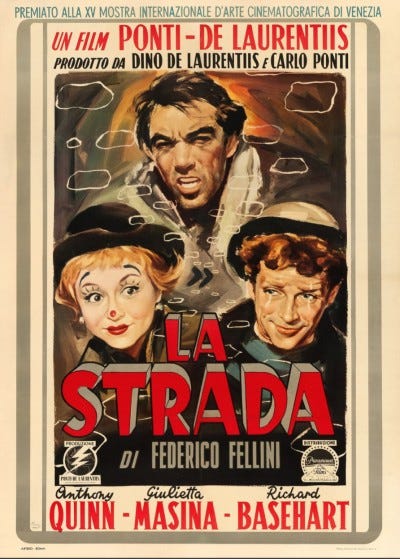
La Strada (1954). Grade: C-
I grumble about modern critics for their worship of trendy directors who are pretentious and shallow (I’ll pick Chris Nolan’s name out at random, I could pick 10 more). You can be shallow and entertaining, like Busby Berkeley. You can be pretentious and have a compelling vision even so, like some (not all!) of David Lynch. But if you’re pretentious and shallow, your work is of absolutely no use to anyone.
Except modern critics, who are themselves pretentious and shallow, so they’ll gobble it up and salivate for more.
Older critics wouldn’t do that, right? They might overpraise some filmmakers like Hitchcock or John Ford, but both of those guys made some decent movies. Older critics wouldn’t take a foolish, egotistical, misanthropic, manipulative, total piece of worthless s**t writer/director and make him into a god, would they?
Well, ya, sometimes they did. And boy did they ever with Frederico Fellini.
I saw Fellini’s 8½ ages and ages past, at least 35 years ago. It’s universally acclaimed as one of the greatest accomplishments in movie history. Even now, after so many decades, I vividly remember 8½. I remember how much I fuggin’ hated that worthless s**theap of a movie.
8½ has that title because, to that point, Fellini had made (by his count) seven-and-a-half movies. It’s about a big, famous director who has “director’s block.” He’s just so full of IDEAS and VISIONS and ART, you see, that he’s having trouble expressing them with CINEMA.
If this sounds like the crummy POETRY of an especially self-obsessed 13 YEAR OLD, well, that’s because Fellini never matured as an artist, or, I imagine, as a frigging human being. But critics sure gobble gobble gobbled it right up! (Not the smarter ones.)
Because Fellini was a international film director rock star, of sorts. Being able to say you’d seen the latest chic Fellini masterpiece was a major pseudo-intellectual middle class signifier of the day. Fellini’s 1960 La Dolce Vita was all about how fancy rich beautiful people having a wonderful time were really all dead inside, and that plot’s ALWAYS been a winner among pseudo-intellectual morons, plus it was Foreign, so Art. It was a huge cultural phenomenon among the Right sorts of people.
Those people waited for Fellini’s next masterpiece like a youngster might wait for a new album by their favorite band. And when the movie turned out to be about how all those expectations were just so HARD on Fellini, critics and chic audiences were wowed. (Plus maybe some younger film fans who weren’t chic and weren’t morons, they just enjoyed that 8½ was kinda “weird” and different, which it is. It’s boring to me, but not to everyone, and that’s fine. Just don’t call it a “masterpiece” when we’re having beers, OK? I want to enjoy my beer.)
In any case, I hated 8½ so dang much all those years ago that I’ve avoided anything else Fellini ever did. And, c’mon! I had good reason to. When I walked by the Criterion section in the old Tower Video store where I used to hang out, the titles on the covers were things like Fellini’s Roma or Fellini’s Satyricon. If your movie is essentially titled You, then it really can’t be anything but ego-fluffing crap.
Still, lotsa directors who turned into giant bigheaded dolts had some good early stuff, right? The Killing and Lolita are good, even if latter-day Kubrick sucks. So maybe early Fellini is actually not that bad?
Lemme give you the plot of La Strada. Let’s see how appealing this sounds.
A vicious cruel brute of a large man buys a kindly petite younger woman from a poor family. She’s cognitively-challenged, so he makes her his sex slave and punching bag. Eventually she kinda befriends an annoying guy, and the brute kills him. Then the brute leaves the kindly woman to die in the cold. A few years later, he’s reminded about her, then he eats ice cream and gets Sad and has a drunken cry on the beach. Because, that’s what bullies do, right? They feel really bad about it later.
Not really a plot that sounds appealing, is it?
You could, conceivably, make a good movie with this plot — you could make a good movie with almost any plot. But if you’re going to make a good movie with a plot as nasty and vicious as this one, you’ve got to have a really incredible level of empathy and insight into human nature. You’ve got to be able to show the audience WHY the brute is the way he is. Otherwise, what you’re doing is making a pretentious exploitation film.
“Incredible level of empathy”… that’s not Fellini, folks.
In Christina Newland’s Criterion essay, she mentions how La Strada received some criticism in Italy, coming after such “neorealist” classics as Shoeshine and Bicycle Thieves. (Don’t be afraid of the scary term “neorealist,” those movies are actually terrific.) In Bicycle Thieves, we see exactly what drives the protagonist to a selfish, hurtful act; it’s his desperation. The point is how desperation and poverty tend to turn us against each other in fighting over crumbs.
Fellini’s response? That there are “more Zampanòs in the world than bicycle thieves.” (Zampanò is the name of the cruel brute here.)
Even if you accept this assessment of the world — and I don’t — you still have a responsibility, as an artist, to show us more than just the surface of human behavior. When we see the vicious character in Something Wild, and he is a definite, no-good, scary total bast**d, we still at least have some sense of where he’s coming from. How, in his mind, he’s getting his own back on a world that cheated him out of what he deserves.
This character’s just a thug, and we know nothing about him except that he’s a thug. Who abuses a character we like and feel for.
Tell me again, critic André Bazin, how this expresses “the phenomenology of the soul.” That might be badly translated from the original French, so I’ll give the absolute idiocy of it a pass. We’ll take another opinion.
Tell me again, Federico Fellini, how thug mistreats nice woman is “a complete catalogue of my entire mythological world, a dangerous representation of my identity that was undertaken with no precedent whatsoever.”
No precedent whatsoever? These characters are circus-adjacent, and there have been LOTS of movies about people mistreating others in circus-adjacent settings. To mention one that’s 1000% more humane than Fellini’s head-up-his-a** bulls**t, Tod Browning’s 1932 Freaks.
Folks, if somebody you read or watch or hear tells you you really need to appreciate Fellini to Know Great Cinema, make a mental note that “this person is not helping” and go watch Freaks. Then go watch Bicycle Thieves. Then come back to Fellini, take every movie on your watch list by Fellini, and delete it and make a happy sigh of contentment that you never have to sit through this crap ever, not for one minute of your life.
Is there anything to be said for La Strada? Sure. I will tell you what those things are, so you won’t need to see the movie.
First (we’ll just take them in the order they appear in the film), there’s the score, by Nino Rota. I won’t call it good, but it does have its moments. The “haunting trumpet” theme isn’t exactly gonna haunt me — I’ve already forgotten it and I just watched the movie — but it serves its purpose. The characters are supposed to be moved by it, and it’s good enough for that. The opening credits theme was heavily referenced by Danny Elfman in Pee Wee’s Big Adventure. Nino Rota was hugely important in Italian cinema, he scored both The Godfather movies, and that’s what I know about him. Might be worth getting a “best of” CD by the guy.
Second, this actually does look pretty good at times. The cinematography’s by Otello Martelli, a longtime veteran of Italian films, who also shot the (much better) Paisan and Stromboli. (We’ll come back to those.) Either Martelli or Fellini has a good compositional eye, and I know Martelli does. I’d have to watch more Fellini films with other cinematographers to know if Fellini has an eye or not. So, I will never know.
Third, Giulietta Masina. Masina was a successful radio actor when she met Fellini, then a radio scriptwriter; they married in 1943 and stayed married until his death in 1993. Fellini cast Masina in several of his movies.
Despite being given a rather inconsistent character to play here (sometimes talking normally, sometimes seeming like she’s half-nonverbal), Masina is pretty remarkable here. Her wonderful, expressive face does pretty much all the movie’s heavy lifting. I promise y’all, the awards and the acclaim given this movie should all be considered Masina’s, ‘cause the directing’s nothing special and the writing is feeble. Masina gives us someone whose sense of self-worth is so low that she can’t even accept the offers of help she gets; once from nice carny/circus people, once more from a convent, and in both cases you wish she’d gone with them.
If Fellini was any kind of writer at all, instead of a pompous bore, the movie would have been all about Masina. As she meets nasty people and nice ones. You don’t have to give us a happy ending where she makes wonderful friends, you can still have the character be very vulnerable and facing an uncertain future — that’s what Kelly Reichardt does in Wendy and Lucy. A real director, a real writer, would know what he has here, and adjust accordingly. But Fellini’s just a fool, so he doesn’t.
Masina’s performance almost — almost — makes this worth watching. Because you’ve heard other competent scores before, and seen decent cinematography before. You’ve never seen a performance quite like this one, though.
So I put together a quick collage of images from the movie, taken from this website.
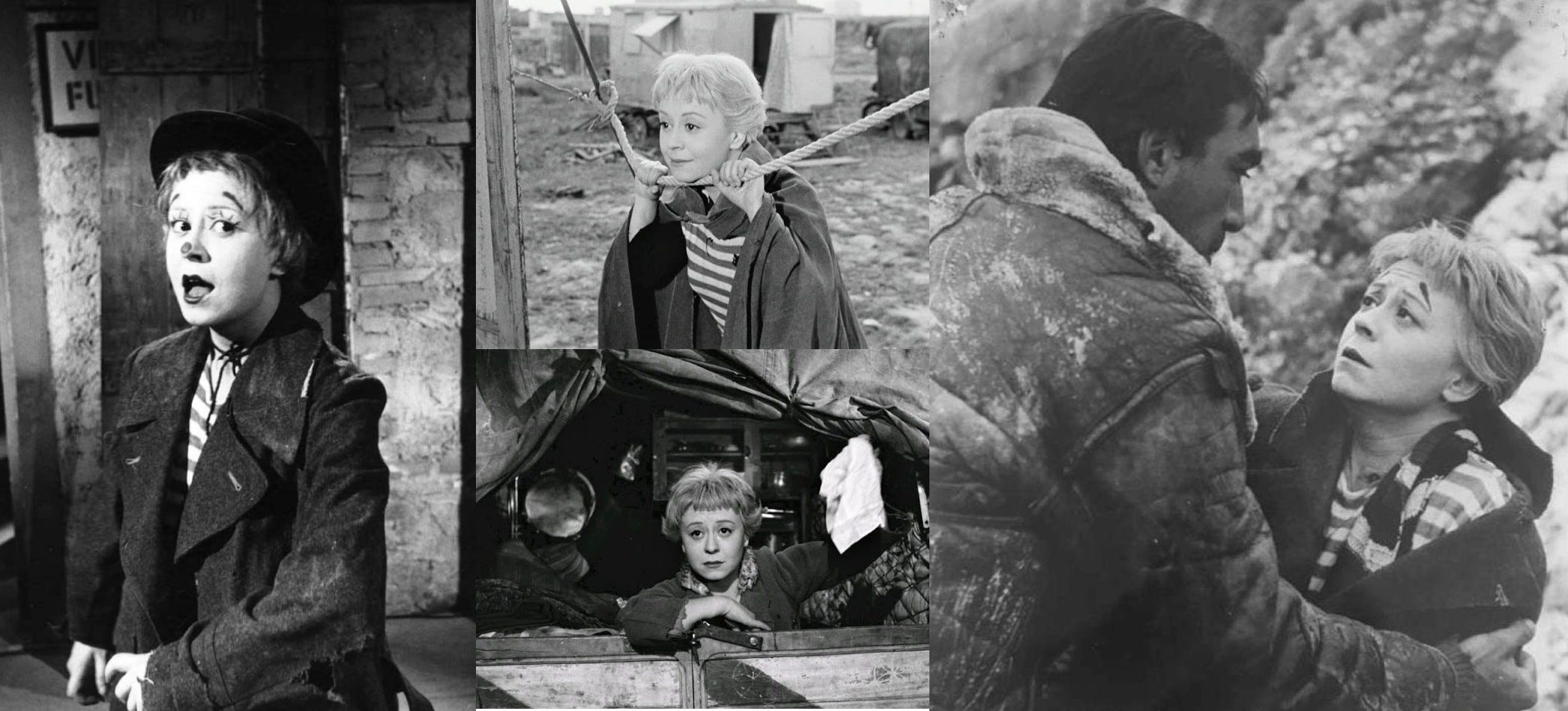
That is an amazing, versatile face. Do you want to see it mostly in pain for 100 minutes? Up to you. Roger Ebert later wrote about Masina how “Fellini lore has it that the master made Juliet of the Spirits as a gift for his wife.” Bulls**t. Fellini lucked out and married someone 100x more talented than himself.
The hulking goon is Anthony Quinn, later of Zorba the Greek. As befits someone playing Italians, Greeks and (in Lawrence of Arabia) a Bedouin, Quinn was born in Chihuahua City, Mexico. His career was largely an exercise in Overdoing It; he could be fine in smaller roles, like in The Ox-Bow Incident, but most of the time he was directed to go all-out, and all-out he went. It could sometimes be fun. It ain’t fun here. That’s not his fault, it’s the idiot director who didn’t create a real human character to play. It’s still no fun.
Quinn’s voice is dubbed extremely well (Italian films of the era frequently used foreign actors and dubbed their voices); I don’t know if Richard Basehart’s is dubbed well or not, I’ve never seen him in anything else. But whoever did the voice gave it the most grating irritating laugh I think I’ve heard at the movies in a long time. And the character’s supposed to be a semi-likable one, or at least less loathsome than Quinn. Well, he’s less loathsome than Quinn. Congrats, Richard Basehart. You’ll still an irritatingly elfin pest. If you’ve seen L’Atalante, remember Gilles Margaritis as the peddler / one-man band guy? Who you know he’s a flake, but he’s a super-charming one? Basehart is that guy’s Satanic twin. He’s a flake and you want pigeons to s**t on his horrible face.
Basehart’s playing a comic/acrobat here, one who can walk a high wire. Well, of course Basehart (a standard Hollywood actor) couldn’t walk a high wire. A real acrobat did, and in fact refused to do it until the local fire department had removed the safety net. That’s from the Wiki “production” section of its La Strada page, featuring more details which confirm my suspicions that Fellini was as useless a person as he was a filmmaker.1 (He was a s**t to Masina during shooting.)
Fellini would become so associated with offbeat, quirky characters like stubborn acrobats and odd-looking individuals that the presence of them in his films was referred to as “Felliniesque,” as if it was genius to pack your movies with oddballs more interesting than your empty-headed self. Again; see Freaks. At least there the performers are allowed to have some personality.
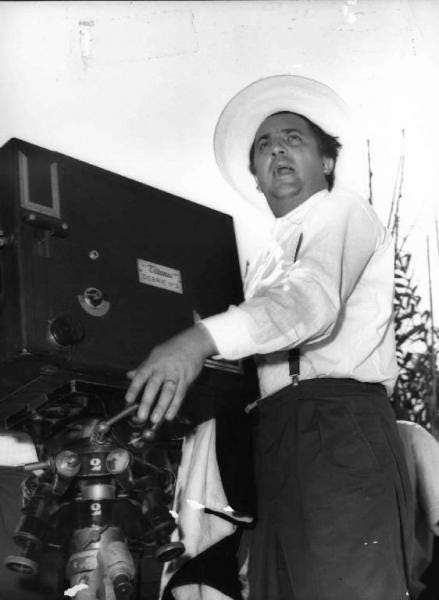
Well, I think I’ve typed as much as I can about this worthless Classic Cinema twerp. I’ll give you one photo from Wiki:

And I’ll wrap up by harping back to Paisan and Stromboli, two earlier films by Roberto Rossellini. I didn’t exactly LIKE those movies, but I respected a lot of what Rossellini was going after. When Ingrid Bergman married a village oaf in Stromboli, and he was mean to her, you realized it was just the backwards way that guy had been brought up; you felt like you were watching something that was trying to show you what you didn’t know, for good or mostly ill, about rural Italian fishing life. Rossellini may have been an anthropologist in that film, but he wasn’t heartless, the way Fellini is here.
There was something, though, about Paisan and Rome, Open City (another good, if tough to watch, Rossellini film) that just felt off to me. Not always, just at times. A little forced; a little “movie-world” phony. And now I have a pretty good idea what it was.
Both movies had multiple screenwriters; Paisan had six, Open City two. And in both cases, one of the screenwriters was Federico Fellini. (The story for Open City, the best thing about it, was by Sergio Amidei.)
When we finished La Strada, Mrs. twinsbrewer said “please tell me you’re never going to get another movie by this guy.” Not to worry!
Now, I might have to get to the early films of Michelangelo Antonioni, another Revered Cinema Master whose later s**t I’ve seen, and it sucks… but I haven’t done anything to deserve that just lately.
To be fair to Fellini; most bigshot directors in ANY country were half-d**ks. At LEAST half. Latter-day Kubrick was a complete d**k.
It's interesting how our tastes are so different but we are tightly bound together in our hatred of critics!
And you bring up something I noted in response to your comment on my site (before my reading this): art directors tend not to be good at telling stories! Regardless, the characters they render don't behave the way I know humans to behave. Are these filmmakers psychopaths? Is that why they don't know about the emotional lives of human beings?!
Looking back, it's hard to understand why the Neorealists were loved by critics. After all, those films are all about humans acting like humans in human situations! Where's the art in that?!
Over the past couple of years, I've come to a conclusion about happy endings. They should be the default. If you provide me with a sad or uncomfortable ending, there'd better be a reason beyond the director cackling behind the camera. My favorites tend to be unclear endings that provide me with a "make your own adventure" ending. But those almost always imply a positive or negative ending. Regardless, the best example that comes to mind is "Night Moves." That ending is perfect because it encapsulates the theme of the film. It doesn't matter if Moseby bleeds out or not. Up to that point, his life has been going in a circle and it will continue to, if he lives. (Sorry! I got excited there!)
When I was a teen, I saw "Amarcord" and "And the Ship Sails On" in a double feature. And I thought they were great! Then I watched others of his films. And I didn't much care for them. And then, I saw "8.5." And I wanted to get a baseball bat, if you know what I mean. It really does seem that critics love art films about terrible people. They think it is the height of artistry.
I used to think that the Italians did dubbing well because they mastered the technology. And they did! But that's not why they are so good. They care! I recently saw a French action film that was technically dubbed well. But the English voice acting was worse than you'd hear at a high school play. And the writing was awful! The subtitle writing was fine! The main thing is that they were clearly doing it for American audiences and they think we are idiots. I have never seen a dubbed Italian film done poorly. My advice: if you don't care enough to do it well, don't do it at all! Subtitles are fine.
You might want to check out Pasolini. Don't watch Salo! But "The Gospel According to St Matthew" is one of the best religious films I've ever seen. It's up there with Calvary, although it couldn't be more different. As I recall, we share an admiration for Calvary.