
Stromboli
So-so Ingrid Bergman Italian film that caused a huge scandal, for the wrong reasons.

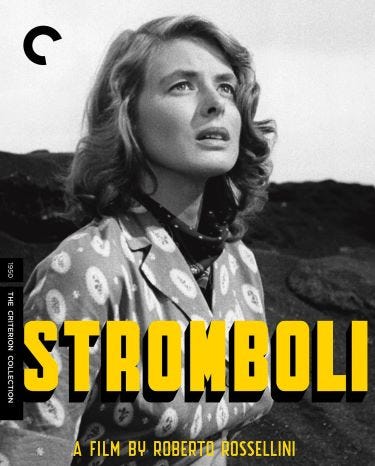
Stromboli (1950). Grade: C+
Looking at the Criterion cover, Mrs. twinsbrewer asked “that’s can't be Isabella Rossellini, is it?” Nope. It’s her mom, Ingrid Bergman. But this movie was directed by Roberto Rossellini — Isabella’s dad. He and Bergman would marry soon after this movie came out.
There’s some promotional material that Roberto Rossellini did for the film on the Criterion disc, and he doesn’t look one bit like his daughter. Leading Mrs. twinsbrewer to say, “then Isabella wasn’t Bergman’s kid — she was Bergman’s CLONE.”
Betcha thought that cloning didn’t exist in the 1950s, didn’t you? Well, that’s what they want you to think, sheeple.
This was savaged by critics when it came out, and they’re not entirely wrong. It’s since been heralded by some as a classic, and I’m just not seeing it. It’s not a dishonorable effort, but it drags a lot in spots, and has some self-imposed limitations that get in the way.
Rosselini filmed it on the actual island of Stromboli, and used actual island residents for almost all the supporting roles, and their acting is Not Good. It’s terrible. We’ve been spoiled watching things like Jafar Panahi’s movies, which also use non-actors, and do so successfully. But Pahahi has a wider range of non-actors to choose from. He made Offside, for example, in Tehran, which has nine million people living there; the island of Stromboli has only a few hundred.
The story here is simple (yet still effective). Bergman is a Lithuanian woman in a displaced persons camp in Italy at the end of WWII. Through the camp wire, she meets a handsome Italian man who proposes marriage to her. Since he is cute, and that’s a way to get out of the camp, she accepts. But then they move back to his hometown.
It’s on the remote volcanic island of Stromboli, which has been losing residents over the years. Anybody with enough money to leave the island, does. It’s an incredibly boring place with nothing whatsoever for a person to do except fish, farm, or phuck. And the residents are enormously suspicious of outsiders.
When Bergman shows up pretty — she can’t help it — they think she’s haughty for being beautiful. When she paints on the walls of their drab little stone house, they think she’s haughty for fancying up the place. Everyone assumes she must be sleeping around, since gorgeous gals are all loose women, by definition.
What’s worse, her husband’s a clod. His idea of fun is catching a rabbit and a weasel and watching the weasel kill the rabbit. (Which very much looks like a real rabbit getting killed here.) She doesn’t speak much Italian, he doesn’t speak much English, and it doesn’t seem like there’d be much going on in his head to begin with. And when she gets angry about her situation, he beats her.
So she’s gotta get the hell outta there. But how? She has no money. There aren’t any jobs. The only work involves fishing and selling the fish on the mainland, and only men can do that. Bergman’s position is well and truly screwed. At this point you could almost call it Moonstruck: One Year Later.
This isn’t a bad idea for a plot, not at all. It’s happened to many real women many times over the years. It’s kinda close to the plot of Ride The High Country, although in that one the woman’s fate is far worse (until some courtly old gunslingers save her). And it’s probably intended as a counterpoint to the way Fascist governments always present rural values as “real,” as truer to the heat & soul of a nation.
It’d be a better plot for a short film, though. There’s a lot of Bergman just wandering around looking dazed. This effectively shows how boring life on the island is, but it does so by boring you. And again, the supporting acting is pretty lousy. The locals are fine at giving withering glances, it’s when they talk that they seem amateurish (because they’re amateurs).
It picks up a little steam as Bergman gets more desperate, and willing to try anything to leave the island. The kindly village priest knows of a program that raises money for islanders hoping to get a visa and emigrate; Bergman basically tries to seduce him to get him to help. (The priest’s played by Renzo Cesna, a friend of Rossellini’s, who did have some radio performing experience; he’s not bad.)
Then Bergman considers seducing a local who says he’ll take her to the mainland. Then she tries crossing the island, on foot, to get to the only other village, hiking over the volcano as she does so. The fumes overpower her, and she loses her one suitcase, and eventually collapses in despair, begging God for help. Then the movie just ends. Happy happy joy joy!
What’s the ending mean? Why did I just explain it in detail?
To answer the second part first, because I think this is a lousy ending, one that’s emptily symbolic of “something.” And it’s part of why I found the movie disappointing (along with the misued nonprofessional acting and the drawn-out story),
To answer the first part, I dunno. Rossellini said, years later, about how “‘he didn't know what she did when the film ended, that he simply wanted to take her to a "turning point’” (from this review by Fred Camper). Earlier, when the movie first came out, he said “‘God [forces] her to invoke the light of Grace.’” At exactly the same time he was, he believed, “helping her escape a stultifying marriage.”
So, when he was in love with Bergman, and she was pregnant with their first child, the ending meant embracing “the light of Grace.” Once their relationship wasn’t going so great, he doesn’t know what happens to her at the end of the film. Maybe she makes it to the other village, maybe she turns back, maybe she dies from heat exhaustion or gets eaten by Volcano Trolls. It’s all a divine mystery.
I’m sorry, I don’t think that somebody dating you instead of another guy necessarily implies the hand of the Lawd decreed you to be their savior. And then to change your mind later and basically say the ending means whatever the viewer wants it to mean, or means nothing at all, is pretty feeble.
At the Criterion website, Richard Brody writes that Rossellini’s Italian films with Bergman impressed influential French critics, who were impressed by how Rossellini mixed the realism of an actual location with the personal statement of being in love with Bergman. OK, but these same critics also thought that Hitchcock frequently putting cute blondes in peril meant he was “deep,” since it obviously symbolized his obsession with cute blondes.
I like Hitchcock just fine, when he had a good script and good actors. Marnie does not magically become a good movie because there’s a cute blonde in peril. Stromboli does not magically become a masterpiece because Rossellini thought he was God’s gift to Bergman.
Are there good things here? Sure. Bergman, to me, was even more impossibly beautiful as she aged beyond her 20s; she’s a good actor, and does some heavy lifting here in a slightly-underwritten role. The real island setting is appropriately stark, if a little repetitive. There’s a long sequence where Bergman surprise-visits her husband while he’s on a fishing boat, to try and understand the thrill he gets from fishing; it simply shows the fisherman stabbing and strangling tons of large tuna to death. (That’s what fishing is, kiddos.) It’s effectively yucky. And the whole movie is fairly decently shot by very experienced cinematographer Otello Martelli (his credits go back to the 1910s).
I wouldn’t recommend it, though. It’s a movie I respected (mostly for Bergman) more than I enjoyed.
It’s also the center of a rather huge, nasty case of Stupid Public Outrage. It really got dumb and vile and dumb. Because Ingrid Bergman was having an affair.
Bergman had married her first husband at 21; lots of people who get married at 21 end up wishing they hadn’t. She wanted to work with Rossellini because she admired his films Rome, Open City and Paisan, writing him to say “‘if you need a Swedish actress who speaks English very well...and who in Italian knows only “ti amo,” I am ready to come and make a film with you.’” Rossellini’d never heard of her (Italians weren’t allowed to watch American movies during the war, since Mussolini was a d**k who didn't want anyone to enjoy anything except Him).
Bergman and Rossellini met on this movie, and fell in love. For a few years, at least. Good for them.
Well, the public learned of their affair on this set, and they were outraged. Outraged, I say! Bergman had played a nun in 1945’s popular The Bells of Saint Mary’s and a saint in 1948’s popular Joan of Arc, and some audiences associated her with those roles (forgetting Notorious and Casablanca, I guess), and so they were furious that she “cheated” on her good, solid dentist husband. Who, again, she married at 21, a marriage Life magazine described thusly: “the doctor regards himself as the undisputed head of the family, an idea that Ingrid accepts cheerfully.”
It was 1950s America, so a woman who pushed back against Father Knows Best was a she-devil (and she was excoriated in her native Sweden, too). Ed Sullivan refused to have her on his show despite popular demand. Per Wiki, Senator Edwin C. Johnson1 “‘stated that “under the law, no alien guilty of turpitude can set foot on American soil again” and that Bergman had “deliberately exiled herself from this country that was so good to her.’”
(See, that’s why you read this blog. Words like “turpitude.”)
Nobody pointed out how, in Stromboli, Bergman’s character tries to seduce a priest! (It’s the best scene in the movie.) They were simply upset she wanted a divorce! Well, some people want to eliminate divorces today, these clods will always be with us. (From this 2015 short article about the whole ridiculous nonsense, Sen. Johnson “‘then proposed a bill wherein movies would be approved for licenses based on the moral compasses of those behind the picture, insisting that Bergman “had perpetrated an assault upon the institution of marriage,” and going so far as to call her “a powerful influence for evil.’” Yep, these clods are VERY MUCH still with us.)
In any case, Sen. Johnson did not succeed in saving America forever, and Ingrid Bergman continued working wherever she could and wanted to. Including four more films with Rossellini, although I don’t think I’ll be seeing those. You can, if you like! Some decent writers find this film very meaningful, to them, including this fellow, and this one (whose post is beautifully laid-out, in terms of web design).
You can also visit the island of Stromboli, which sounds fairly interesting, if you are a rich person who travels to places. You can make the dish “stromboli.” It’s an Italian-American thing invented in Philadelphia, sort of a rolled-up calzone. The original creators called it the Stromboli to cash in on the Bergman scandal! Never let a stupid scandal go to waste.
D-Colorado. Who hated the New Deal, so I’m guessing the Joe Manchin of his time.