
The Busby Berkeley Disc
The greatest hits from the craziest choreographer ever.

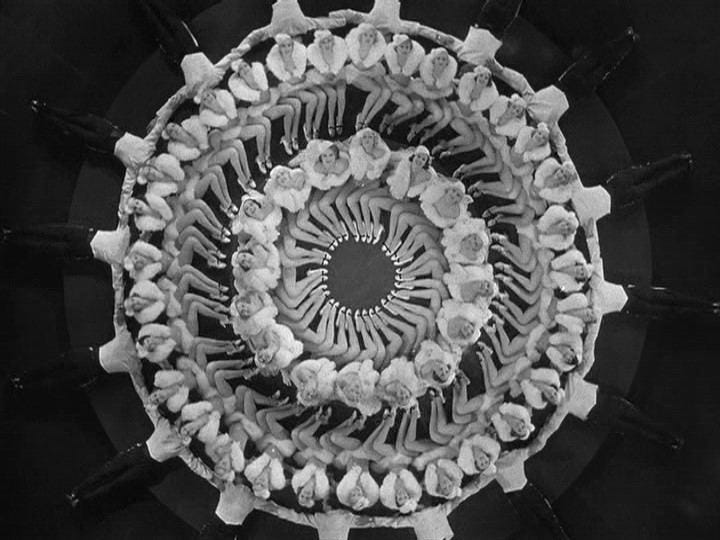
The Busby Berkeley Disc (2006). Grade: B
When we watched Gold Diggers of 1933, the fun wisecracks from Joan Blondell and Aline MacMahon were enough to tolerate the basically non-existent plot, and get us through to the mad, crazeballs, totally psychedelic musical shenanigans of Busby Berkeley. The #1 phrase heard on set must have been “more laudanam for Mr. Berkeley, please!” These dance numbers are BANANAS. (In one case, 1943’s The Gang’s All Here, LITERALLY bananas! There’s a song where everyone wears banana hats!)
But when we watched 42nd Street, the first of these Berkeley extravaganzas, we didn’t have as much fun as watching Gold Diggers — partly, because there’s no Joan Blondell. But also partly because all the musical numbers were at the end, not sprinkled all the way through; so it was a chore wading through 60-odd minutes of “plot” to get to the good stuff.
So when I picked up The Busby Berkeley Collection from the library, I was delighted to find that it has this disc included along with five other films (42nd Street, Gold Diggers of 1933, Footlight Parade, Dames, and Gold Diggers of 1935). This disc has the best musical numbers from those movies… plus a couple of musical numbers that were the highlights of other movies.
Busby Berkeley had no formal dance training; he was assigned to teach soldiers maneuvers and parades during WWI. That’s how he learned choreography. He started directing dance for Broadway shortly after the war, and found his way to Hollywood by 1930.
In 1933, Warner Bros. took a shot at a new kind of musical in 42nd Street — most of the first sound musicals were taken from successful stage shows. 42nd Street would, ostensibly, be about a stage show (it was based on a book by small-time actor Brandon Ropes, and was apparently about the tawdry sex lives and drug habits and such of Broadway actors/dancers).
But the musical numbers for 42nd Street wouldn’t be anything like a stage show. They’d be stuff you could only do on camera. And every bit of them would be lavishly designed and directed by Busby Berkeley.
42nd Street was a smash hit, leading to a duplicate, Gold Diggers of 1933, and a triplicate, Footlight Parade. As Chloe Walker’s entertaining Paste article describes, “each is telling the same story. It’s the Great Depression, and plucky chorus girls are struggling to get by–of course, the only thing to do is put on the best gosh darned show Broadway has ever seen! In the process, plucky tap-dancing ingénue Ruby Keeler will be rocketed to top billing, and fall in love with Dick Powell along the way; Guy Kibbee will be a creepy (but rich and easily manipulable…) old letch; and the director will endure stroke-inducing levels of stress until the show inevitably proves a dazzling success.”
(And at least 42nd Street and Gold Diggers feature the same very standoffish dog, too! I haven’t seen Footlight Parade yet.)
(The above, from Gold Diggers, is from Internet Archive at this link. It has a Pervy Baby. You will hate and totally love the Pervy Baby, played by Billy Barty, who had a LONG career.)
The weird thing about this plot format is, yes we do see rehearsals and such, but the rehearsals are of standard-brand chorus line material. Then, when we see the musical numbers, they are NOTHING LIKE the stuff we saw being rehearsed! (No wonder those directors are having such high levels of stress, they’re not even rehearsing the correct songs!)
Berkeley’s work in these early musicals is simply, hilariously, over-the-top. It’s wasting money on spectacle just for the sheer pleasure of it, like any movie that crashes a real train into a real canyon. Only what’s being crashed here is good taste. These numbers are tacky and glitzy to an extreme, and they’re terrific for it. Yes, you can make the case that they’re objectifying women, and some racial stereotyping occasionally kicks in. But what you’re really seeing is EVERYBODY getting used as a human piece of machinery by Busby Berkeley; he’s as crazy as a Stanley Kubrick. Only he’s a creative, entertaining crazy man.
Berkeley was probably not a happy guy. He was married six times — and engaged two other times! (Good heavens, why? I know some “traditional” gals of the time insisted on marriage before sex, but Berkeley was dating modern urban women in show business.) Berkeley drank heavily, which astounds me — normally, drinking reduces your creative energy, it doesn’t inspire it. (Maybe he was a member of “The Inebriati.”)
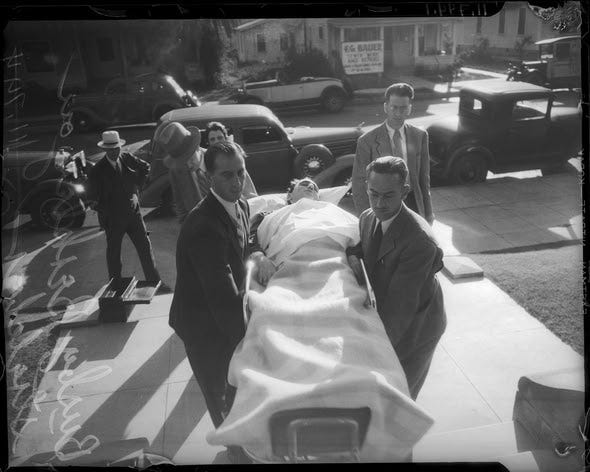
Horribly, he was driving drunk when he got in an accident that killed three people; during his trial for second-degree murder, his lawyers used an old sleazy trick to gain jury sympathy for their client:
Despite his hard living, and despite one attempt on his own life in 1946, Berkeley would live to age 80, although his output was rarer after the suicide attempt led to a prolonged institutionalization. By the 1960s he was directing things like this sad commercial parodying his own work.
When you watch these musical clips back to back to back (The Busby Berkeley Disc runs 163 minutes, although it’s an easy one to stop/restart), some of the flaws of the material show through. Few of the songs are any good (not terrible, just not good — which is really about the norm for most musicals). Most of them are by the team of Harry Warren and Al Dubin, and they were not exactly perfectionists; most of their songs are kinda repetitive.
Powell’s singing voice is by no means bad, yet the style of singing he’s doing here (which was quite popular in the era) involved a ton of warbling, and it starts to grate pretty quickly. (Most of the women do it too, yet not as loudly, so it’s less irritating.) And the dancing, when there is any, is kind of a mixed bag (until James Cagney shows up). Plus Berkeley’s innovation seems to be losing some steam by the end of these things; the later ones aren’t as delightful as the early ones. (They’re still better than 99.999% of music videos ever made.)
As stated, we got this from the library along with The Busby Berkeley Collection; there’s also a Busby Berkeley Collection Vol. 2, which has four later 1930s films plus this same collection disc. Our library also has this disc by itself; yours might, too.
I also wouldn’t dock you any points for seeking out these musical numbers on YouTube, either. Some highlights include “Shuffle Off to Buffalo,” “42nd Street” (here’s the OK start, here’s the better finish), “The Shadow Waltz” (start and finish), Cagney’s dancing in “Shanghai Lil,” “The Girl at the Ironing Board,” the crazy moving columns in “Don’t Say Goodnight,” and some excellent tap dancing in “Lullaby of Broadway” (part 1, part 2, part 3; only part 1 has a creepy floating head). And heck, I’ll do one more (“The Words Are in My Heart,” from Gold Diggers of 1935.)
But you’ll have to get this disc (or Fashions of 1934) to watch the wild as heck “Web of Dreams” sequence which has, I am not kidding you, a bunch of blonde ladies in a Viking boat on an ocean of billowing fabric that’s probably supported by 100 people — or some carefully coordinated blowing fans? In any case, it’s terrific.
Spend a rainy/snowy day sometime watching this disc or those clips. You owe it to yourself as a film fan to be at least somewhat familiar with Busby Berkeley’s great, completely madballs insane work. It’s been a huge influence on choreographers since, and no matter how much CGI modern musicals slap on a musical number, they’ll never top Berkeley’s best. Because they’ll never be as crazy as Busby Berkeley! Few ever have. (OK, maybe Bob Fosse got about halfway there…)