
Weapons
Puzzle-box horror that builds, gets good, then deflates.

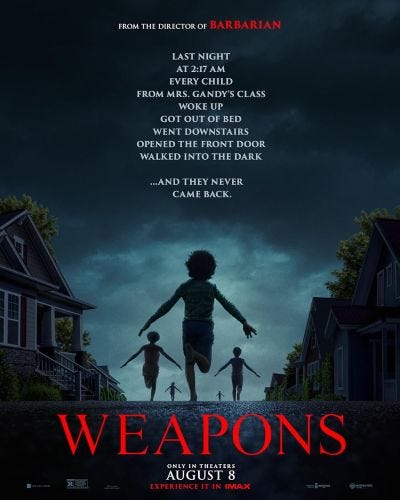
Weapons (2025). Grade: C+
When a modern movie is widely-praised by critics, be afraid. When it’s also a success with audiences, be VERY afraid. Unfortunately, Weapons had both those red flags. BUT… it also has Julia Garner and Josh Brolin, and they’re terrific. So I finally forced myself to sit through the thing.
Surprise! It’s not bad at all, and actually has some good things going for it. It’s not the masterpiece critics think it is, not by a long shot. Yet there’s some innovation, and some sly wit, which most modern movies sorely lack.
The writer-director, Zach Gregger, got his start in comedy, which explains the wit. Most modern horror movies are far too literal-minded; they’re dead set on delivering the gross-out factor, the ghostly children and the jump scares audiences expect. There’s been exceptions, particularly the innovative low-budget Shudder movies, and occasional interesting social-commentary horror, like 2022’s Nanny (about the challenges of being an immigrant working for rich annoying people), or 2021’s The Feast (about what happens when you mess with ancient spirits protecting the land from polluters).
This movie isn’t as unique as some of those others — I mean, it’s hard to top The Feast for uniqueness when that's a horror movie filmed entirely in the traditional Welsh language! This is more of a professionally-made mainstream movie. And it does have the jump scares, gross-out gore, ghostly kids, etc. They come at you, though, in ways you don’t expect. And at times those ways are so unexpected they made me grin.
The plot’s explained in the poster up top. In what looks to be a suburban Northeastern community (actually, it was filmed in suburban Georgia), late one night, children start running from their homes. (None of them wake their parents, which seems dubious, yet audiences can just assume “it’s supernatural, these things happen.”) Then we see the onscreen word “Justine” and the story begins.
Julia Garner plays Justine, who’s dealing with the aftermath of those disappearing children — since all of them are from her third-grade class. There’s another third-grade class at the same school, and none of those kids are missing. Just Garner’s kids — all save one, stone-faced little Cary Christopher. Both Garner and Christopher say they have no idea why the other kids all bolted, or where they went.
Naturally, the parents of the school are VERY suspicious of Garner. At a school meeting for the affected families, one grieving dad, Josh Brolin, gets up and basically accuses Garner of lying. Her principal, Benedict Wong, steps in to defend her.
Shaken, Garner heads for the liquor store, and buys not one but two bottles of vodka, brushing off a panhandler near the entrance. The next day, she runs into her ex, who’s on the police force, and they go out for drinks; they end up in bed together. There’s a series of spooky moments, culminating in a scare that suggests voodoo or witchcraft might be involved; then we cut to black.
Then the name “Archer” appears, and we see roughly the same time period as the “Justine” section — except, this time, it’s shown from Josh Brolin’s perspective. After that, a segment shown from the perspective of the cop who sleeps with Garner; then, the panhandler Garner brushed off outside the liquor store. Then Benedict Wong. You get the idea.
During the “kids leaving” intro and the Garner/Brolin segments, I appreciated what Gregger was doing in terms of directing. The opening song choice is a good one, and the camera movement is very controlled; there’s a nice tracking shot during the school meeting. But I was also getting a little annoyed by the horror cliches; how, every time the camera movement gets very slow and the soundtrack gets very quiet, you’re gonna have a jump scare accompanied by strings. It was like a better-directed version of very familiar material. And the score (those jump scare strings) annoyed me.
About 50 minutes in, though, the music starts getting much better; there’s musical themes for some characters which are really fresh-sounding in a very satisfying way. (The score’s by Gregger and Ryan Holladay/Hays Holladay, and those last two are brothers.) And the jump scares aren’t as predictable — some aren’t even scares so much as they are surprisingly weird. Plus, Amy Madigan shows up.
Madigan has been widely praised for this role, and she’s certainly quite striking; it’s a part she really lobbied for, and you can tell why — it’s a much bigger part than most actors in their 70s generally get. I think the role’s a little underwritten, but Madigan definitely makes a memorable visual impression.
Garner/Brolin are the biggest names here, yet this is really an ensemble movie, and all of the performances are good. (A stroke of luck, that, or smart casting; the actors’ strike of a few years ago meant most of the original cast was contractually obligated to work on other projects instead.) Benedict Wong is always delightful; he’s playing sort of a stick-in-the-mud by-the-rules sort at first, but he really lights up during his own sequence, at both the “befuddled” moments and the straight horror ones. Alden Ehrenreich and Austin Abrams are a little paint-by-numbers as the cop and the (addict) panhandler; both improve when they start investigating the Spooky.1
Julia Garner, whose hair is a national treasure, was in The Assistant back in 2019; oddly, she seemed older in that movie than she does here. Because that character had fierce emotional armor; not letting it crack for one second was her defense against the sh**y way her colleagues superiors treated her. Here, her character is more open and emotionally volatile; it makes her seem more of an inexperienced youngster.
Brolin’s part is really no much more than “be angry/sad,” but I do like the variation on the grieving parent. Usually, when we see a grieving parent, it’s always the mom, who’s then lost all reason to live (as in Gravity). Here, his wife has it together; it’s Brolin who’s falling apart. You need an actor of his caliber to give these scenes some weight, since at the end he’s just a generic horror/action character.
That ending presumably pleased test audiences — I thought it sank what was promising about the movie. Turning witty dread into simple action stuff. I can’t blame Gregger for not finding a satisfying conclusion to this one, since he was clearly trying to work so hard on a skillful buildup, and he mostly achieved it. Still, the end (with characters jumping full-frame through paneled windows over and over) takes most of what felt like complex undertones and makes you think “maybe there was less here than I imagined.” It might be a good one to come back to in a few years, and see if you enjoy the buildup even though the finish disappoints. For some movies, that’s true!
Certainly the inspirations for this don’t point to anything as entertaining as the best parts are, here. Gregger said he was trying to do something like Magnolia and Prisoners. Happily, he didn’t succeed — this movie is actually good. And Gregger cast Amy Madigan because he liked her in Field of Dreams so much! I mean, I agree, she’s a very good actor, but I also agree with Craig Calcaterra about that film.
There’s more inspiring this material than just two other, vastly overpraised filmmakers — Gregger had lost his good friend and comedy colleague, Trevor Moore, to what was probably an alcohol-related accident. And he’d had a father die from alcoholism. So the ideas of loss, and how an unexpected outside force can disrupt lives, are both here. But, in an interview mentioning those inspirations, Gregger also said he wanted the possessed children in the beginning to run like the girl in the famous photo of napalm victims in Vietnam.2
That is — to put it mildly — not a good thing to be inserting into your amusing horror movie. And it makes me question Gregger’s judgement. Not to mention the judgement of gushing critics, like RogerEbert.com’s Brian Tallerico, who thinks the disappearing children here are a metaphor for school shootings (or possibly COVID). Yeah, I suppose those metaphors COULD be here — but there could also be much less than meets the eye.
And I’m not optimistic about what all this critical and commercial success — the movie was a huge hit on a very reasonable budget — will do to Mr. Gregger’s further career. (I’m sure not worried about Julia Garner’s career, though; she’s gonna be great for ages.) It didn’t do any favors to Jordan Peele, whose Get Out was funnier and more socially-relevant than this film is; although Mr. Peele’s problem might just be spreading himself a bit too thin. (His production company bid for the rights to this script, and didn’t get it.)
Still, I’m impressed with Gregger’s talents as a director. At this late date, you’d think there weren’t any original camera angles to use during a car chase scene — Gregger and cinematographer Larkin Seiple find a few. The whole movie, until the end, is elegantly shot in a way beginning filmmakers rarely manage; there’s also skilled cutting done by Gregger and editor Joe Murphy.
And I loved one little detail of that opening “kids running into the night.” How many of the kids, running in the dark, trigger suburban security lights. Suggesting that, after all, our obsession with personal security (like with “smart” doorbells), as opposed to community security (the kind that comes from people supporting each other, not walled up in their castles), is a threat of its own, after all — one scarier than any zombies or voodoo witches out there.
This theme isn’t really developed in the movie, and I wish it had been. Yet it definitely is hinted at, and that’s better than what most modern movies manage to come up with.
It's a a failing when everyone except the main characters is just disposed of… but that's horror movies. What can ya do.
Who is an antiwar activist today, by the way.
I am in 100% agreement on the ending of Weapons. It's a farcical ending in a film where very little up to that point is farcical. I absolutely LOATHE when that happens in a movie (getting the tone wrong at crucial moments). Because of that, I have this at 4/10 stars--or more C- to your B-.
I do love Amy Madigan, though! How can baseball fans like us not after Field of Dreams?! She is great in this creepy role--until that ending, alas.