
The Assistant
Masterfully-directed and acted story about a young woman treated like she's nothing. In the film industry, which specializes in treating people this way.

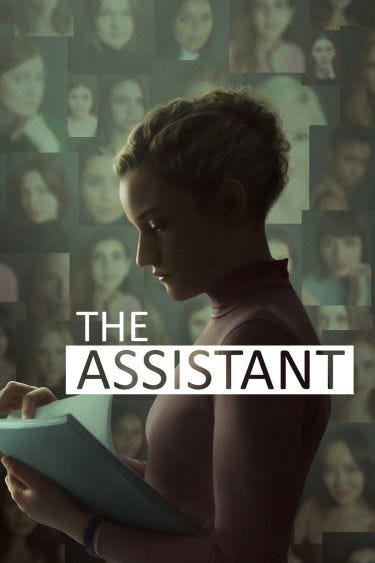
The Assistant (2019). Grade: A-
Sometimes, when people see movies or TV based in a bygone era, they enjoy laughing at how much worse things were, back then. How backwards, some of those social attitudes. How much we’ve changed and improved.
The Assistant is set in the present day. But it would fit as a companion piece to Gosford Park, set in the 1920s. You could watch both and think, um, in some ways, in some places, things haven’t improved much at all.
The reason this movie reminds me of that one isn’t that they’re about the same thing, or stylistically similar. But that Julia Garner’s office assistant is treated a lot like the servants in Gosford Park, and expected to follow the same (somewhat unwritten) rules. Make everything as easy as possible for your bosses, leave no whim left unsatisfied, and stay in the background as much as possible. Let your presence go unnoticed.
In a way, her situation might be worse than the one those servants had! They were paid semi-OK salaries, film industry assistants aren’t. Writer/director Kitty Green told critic Alissa Wilkinson “the wages in Hollywood are so low that you can only work there if you have another source of income, where you come from a rich family.” And at least some of the other 1920s servants would help out the newest one. Not here. The idea, Green said, was that “there’s nothing more lonely than being around people and still feeling alone. In a way, it’s actually worse than being by yourself.”
Garner’s first-in, last-out. It’s her job to come in, turn on the lights and the computers, get the break room stocked, and clean up the studio boss’s private office — there’s a custodial service for the bathrooms and such.1 But the private office is the one with the comfy couch — the one where Garner might find an earring on the floor. So she’s expected to have discretion.
As the other employees trickle in, though, Garner becomes more invisible. To most of them, at least. For her to address anyone higher-up by name with a smile and say “hi!” would be total impertinence, she’d be fired on the spot. For the others to acknowledge her presence would be seen as weird — why are you chatting with the help? It’d be like talking to the janitor.
Part of this is the supreme arrogance of the film industry. The people on top really think they’re superior geniuses. After all, the companies make money, don’t they? Before COVID, at any rate, a company like this one (which isn’t based specifically on Harvey Weinstein’s, but is a similar size/mentality) could regularly expect to stumble its way into a hit, every now and then, and if they stopped getting lucky they could at least get bought — their old catalog would be worth something to some streamer or studio.
One of Garner’s duties is printing out/handing out script revisions to all of the top executives, and it really shows why the majority of movies are crap, now. (It’s also very wasteful; Mrs. twinsbrewer wondered “how many trees had to die for all that paper?”)
If you’re running, say, an investment firm or some such, it makes sense for a team of top people who understand investments to weigh in on major decisions. But a film production company is theoretically in the business of producing something creative! Why do so many non-creative people think their input is worth a hoot? In 2016, Brian De Palma described how infuriating the constant interference of all these non-entities had become.
A good film producer might, theoretically, exist; someone who genuinely enjoys movies, and hopefully knows a little literature too. Who isn’t creative themselves, but recognizes quality when they see it, and can help artists organize their ideas into something workable. Like a good editor in publishing does — they don’t write the books, they help the authors. (And in the case of movies, they could help writers/directors avoid expensive mistakes in judgment, extra spectacle the films don’t need.)
Unfortunately such people in the film industry are rare, exceedingly rarer with each passing year. And so movies are stitched together by artists trying to maintain an original inspiration and enthusiasm through the lengthy, soul-eating process of having arrogant clods like these ones suggest “changes.”2
A good writer CAN benefit from creative suggestions! Kitty Greene did. But it was her friends and other filmmakers she respected who provided those suggestions. Originally, her drafts had all of the rotten executives be male; others told her, “listen, women are guilty of this kind of behavior as well.”
Yet there is a rancid kind of Little D**k energy at play in the company, here. The other assistants (both guys) in Garner’s small office are the few employees who do acknowledge her existence, but it’ll be by throwing a piece of crumpled-up paper at her. (They never use her name.) Or condescendingly looking over her shoulder and giving advice on self-debasement when she’s writing an apology to the tyrant boss. Or making Garner deal with the boss’s furious wife on the phone.
Ah, yes, the phone. I should note: the A- grade up top here is ONLY if you watch this on a screen attached to a proper sound system, played at the proper volume. It doesn’t have to be the kind of thing they demonstrated at Best Buy back in the day — a Dolby 5-channel system with subwoofers and such. (That’s the kind of system you watch Terminator 2 on, not a movie like this.) But it should be at least two real speakers, elevated off the floor (even on top of some old books will do).3 Because otherwise you’ll miss the incredible sound design, and it plays a REAL role in the tension here.
Originally, Green wasn’t going to have the voices on the other end of the phone be audible; it was only going to be the reactions on Garner’s face. But when Green saw how amazing Garner’s reactions were, she decided to add the faint sounds of the conversations, so that you knew what Green was reacting to. Brilliant directing! Responding to what your actors bring to the movie, and adjusting your technique to fit!
And it’s not just the phone calls that enhance the film, it’s the sound atmosphere overall. (The entire sound department deserves praise; here’s the IMDb credits list.) The slow hum of office equipment that, along with Michael Latham’s excellent, clinical cinematography, creates the sensation of Garner being in a machine. One which sucks all the life and hope right out of you. Unless you aspire to be one of the cool “top guys” bragging about who they met at Cannes.
You can watch this on your TV’s crappy sound system and it’s still an excellent film; the acting and directing are that good. You’ll get the gist of the phone calls. But it’s the sound that elevates this from “very very good” to absolutely brilliant and chilling.
All the other actors in small parts are terrific, but it’s mostly Garner’s movie, she’s in virtually every shot. And it’s practically a non-speaking role. She is stunning. It’s all there in her expressions, in her posture, the way she positions herself around others in a small space, trying not to stick out. Or how she wraps herself in a scarf like it’s armor for a tense interaction.
That interaction’s with the company’s HR manager, played by Matthew Macfayden, one of the best things on HBO’s too-shallow Succession.4 I don’t give a fart about awards, but if I did, this is the kind of performance that should have gotten a “supporting” award. It’s maybe a five minute scene. Green said she tried to write the scene as if he feels he’s doing her a favor. You can see that in Macfayden’s performance. And you can see in Garner’s exactly what this favor really amounts to.
This was praised as a “Me Too” movie, and in a way, it is — it’s about men who think their professional position entitles them to sex. (One of Garner’s jobs is keeping the boss’s med fridge stocked with a syringe you can inject into your weiner for a raging boner — doesn’t Hollywood use cocaine for that anymore?)
But in a way, saying it’s a “Me Too” movie diminishes what Green and Garner have accomplished, here. Like Women Talking, this was considered to be part of a Important Social Statement Trend. Both are great films because they’re great films, with terrific acting and skilled, thoughtful direction. They’d have been great in 2000 and will still be great in 2040, in countries that still allow quality films to be seen.
And it’s quite the achievement which manages both to show something that’s rotten in modern society — the way women, and powerless people, and especially powerless women are ground down by vicious structures — while also showing what’s rotten, specifically, in the movie industry. Companies like this one exist in all kinds of fields, but the movie industry has always been one of the nastiest, and there’s no reason to think it’ll get better anytime soon.5 Kitty Green said she had a helluva time getting this made, that people who admired the script were still awfully wary of the subject.
Yeah! I’ll bet they were!
Incidentally, in looking at their Wiki pages, I see that Julia Garner and Matthew Macfayden have now done Marvel movies. Boy doesn’t that just f***in’ say it all.
I actually knew a couple who made a nice living doing this — they’d come in and clean up the bathrooms of various office buildings, vacuum the floors, empty office trash cans, etc. Do it for enough companies and you could get pretty comfortable, financially.
And then there was the ex-Hell’s Angel guy I worked for in Portland who did this, and hired me, and just yelled at me all the time, so that wasn’t so fun.
There ARE certain Big Name directors whose movies get made with a limited amount of studio interference. They are the established critical darlings, most of whom are idiots, but their movies can count on universal critical praise and hence prestige for the film company.
If you have a giant TV, the sound on it might be alright. Generally, though, the sound on smaller TVs is through garbage speakers in the back of the TV. The reason for having external speakers off the floor is the floor absorbs sound. You'll be shocked at how much better the sound is if you get them off the floor.
The whole cast of that was good, but its depiction of a rich family was puerile. And the show started repeating itself pretty quickly. I’m glad I heard that Brian Cox’s character died early in the final season, since it saved me from being tempted to slog through the thing. He was great. He’s always great.
Apparently a male moviemaker friend of Green’s took several weeks to respond after she sent him a copy, finally writing: “I’m sorry, I felt really guilty, because I have all these assistants who I ask to do too much for me, so I’m still processing my role in this.” Green told Wilkinson, “That’s incredible, the idea that someone will treat someone differently after seeing the movie.” Such a hopeful lady. If they’re 30, maybe. But a jerk at 40 will always be one.