
The Navigator
Hinjinks on the high seas from Buster Keaton and Kathryn McGuire.

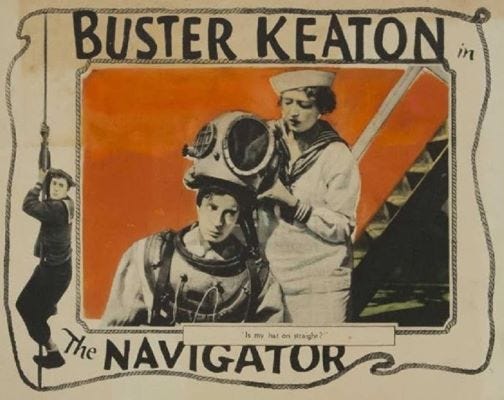
The Navigator (1924). Grade: B
It’s helpful — at least to me — to think of silent film comedy as like a sketch show. No, I don’t mean crap like SNL. I mean the good sketch shows — Monty Python, Carol Burnett, Mitchell & Webb, Key & Peele.
The best sketch shows have moments of brilliance to them. And they inevitably have stuff that falls flat. Sometimes it’s because a joke is dated (there are popular music refences in The Navigator which almost nobody will get now). Often it’s just because different people have different senses of humor. I thought the running post-apocalypse gag in one recent Kids in the Hall reunion episode was absolutely brain-breakingly funny; I can see how some people took it as too bleak.
The Navigator is essentially a 60-minute sketch comedy featuring the different trials/tribulations of Buster Keaton and Kathryn McGuire. Keaton is, as a title card puts it, “Heir to the Treadway fortune — a living proof that every family tree must have its sap.” He’s besotted with McGuire, plans to propose, and has booked a honeymoon cruise for two. He heads for her place (with a joke Steve Martin borrowed in L.A. Story), is rejected, and decides to go by himself.
Naturally, a series of fortunate events results in the two of them stuck on the same ship together, with nobody else aboard. And neither of them knows anything about how to do anything on a ship.
Some of these sketches are inspired, some others might enjoy more or less than me. The pacing stays sharp all the way through, though, so if one bit isn’t working for you, there’s bound to be a new one pretty soon. I liked a bit where the two of them are chasing each other without knowing it; where they haplessly try to make their own breakfasts; where Keaton is trying to shuffle a deck of cards so wet they’re limp cardboard.
There’s a very fun diving sequence, which was actually shot underwater — always tricky, and more so in 1924 than today. Per film historian Yair Solan, this was filmed in Lake Tahoe! “The water was sufficiently clear but extremely frigid … Keaton and his cameramen had to be constantly brought to the surface and revived with copious helpings of whiskey.” It’s mostly wonderful for how silly it is. Some really, super fake-looking swordfish are involved, and they’re great because nobody cared about making them look real. The joke’s the thing.
Solan’s also good on McGuire, who shows herself to be just as skilled a physical comic as Keaton in this one:
“This puts the lie to the claim by some critics that the comedian invariably approached his leading lady as just another prop. A former dancer and Mack Sennett Bathing Beauty, Kathryn McGuire is the only actress who twice played opposite Keaton in his ‘20s features, appearing in the earlier Sherlock Jr. (1924). McGuire has more to do here, playing off Keaton’s bumbling exploits and contributing comedy of her own, whether by socking him squarely in the head with a life preserver or scrambling across the deck on an eerie night aboard the cavernous liner. One gag went awry during filming – when setting a diver’s helmet on Keaton while he smokes a cigarette, McGuire accidentally locked it, nearly suffocating him. Although reshot, we can still see his genuine look of distress in the film.”
The climax involves an island full of dusky-hued “cannibals,” and some might find that annoying, but it’s no more serious than Gilligan’s Island. And the “cannibals,” after originally being easily scared off, get to show off some neat ingenuity in trying to get to Keaton/McGuire on the boat — who then show their own ingenuity right back. Which was of course the ingenuity of Keaton and all the writers.
On set, you had a pretty funny artistic kerfluffle between Keaton and actor/filmmaker Donald Crisp; Crisp had been hired to do the straight scenes while Keaton worked out the comedy gags (many of which involve very elaborate props). Crisp was adding his own comedy ideas to the straight scenes, and Keaton didn’t care for it. So Keaton fired him — although he did give Crisp equal billing as director, which is decent.
There’s a joke involving a creepy picture of a crusty ol’ sea captain that freaks out Keaton and McGuire both. It’s Crisp’s face in the picture. (Actually a perfectly normal-looking guy, he had a long and very financially lucrative movie career.)
In the ending, aboard a submarine, someone pushes the wrong controls and the submarine starts tumbling around and around. So, the set tumbles around and around! Not the camera, the set! And the actors and props! Head over heels, over and over!
The “kinda sorta” film buffs among you will know that a rotating set was used to simulate life aboard a space station in 2001. The big nerds among you will know that Fred Astaire used a rotating set for a dance sequence in Royal Wedding.
But even the Astaire one wasn’t the first time. The first appears to be a 1919 Douglas Fairbanks movie, When the Clouds Roll By. So Fairbanks walks on the walls, ceiling, etc. Here that is:
Feel free to stop it after that shot’s over. Unless you want to watch the whole thing! (I haven’t seen it yet.)
Actually, The Navigator wasn’t the first time Keaton had used a rotating set, himself! He used one in The Boat, a 1921 “two-reeler.” (Those were short films, about 20 minutes or so, that would only fill two projection reels; most adventure “serials” were two-reelers.) Both The Boat and another short, The Love Nest, are included on the 2001 Kino Video our library had. And I liked ‘em!
The Boat has married Keaton, his wife and two kids,1 having misadventures with a homemade boat. There’s a lot of technically very challenging stuff, here — a house falls down, the boat sinks several times, finally that rotating set. And a naughy 1921 joke: the boat’s called the “Damfino.” As in, “damn if I know.” It’s also the name of the International Buster Keaton Society! They have annual conventions in Muskegon, MI. Sounds fun.
The Love Nest (1923) has another spurned suitor on a boat to ease his heartbreak. Naturally, everything goes awry. It’s got big, burly Joe Roberts as a mean ship’s captain — if anyone makes a mistake, he tosses them overboard (and adds a wreath). Roberts was in 16 of Keaton’s short films, and knew the family from their Muskegon days, when they ran a vaudeville theater there.
Roberts/Keaton are good together, but my favorite joke came at the beginning:
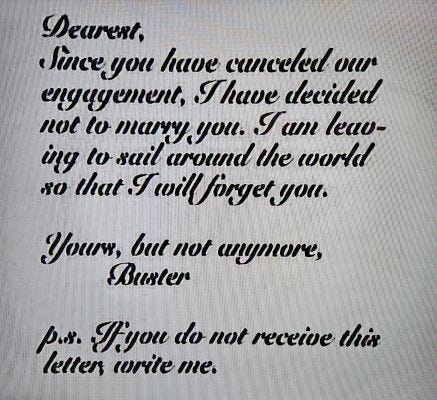
Now, most title cards in these films are on the screen for a long time (so that even audiences who struggled with reading English could read them). Not this one! You have to pause the DVD to see it.
Is it film’s first throwaway joke? Eh, probably not. But, until somebody proves me wrong, I’ll say it is. And so I’m a Film Historian now! Hey, nobody said historians are always right.
Not REALLY his wife/kids, of course… actors. The “wife,” Sybil Seely, had actually just married screenwriter Jules Furthman. He later co-wrote The Big Sleep.