
The Circle
A strong Jafar Panahi movie about layers/circles of repression.

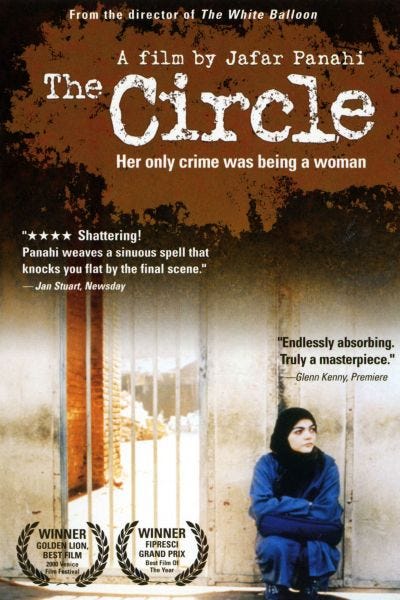
The Circle (2000). Grade: B-
Five women, roughly ages 17-46 or so. First, we see A & B. A leaves, and we follow B’s story for a while. B narrowly misses meeting C, and we follow C for a while. Then C briefly meets D, and we follow D; D sees E across the street, and we follow E. Then E ends up in the same spot as A & B. It’s a circle.
There are also circles within circles; like the spheres in a Venn diagram, they sometimes interact, sometimes not. The circle that encloses all these characters is the repression of women in modern Iran. Within that circle, some have more relative freedom than others…
This was the third feature by Jafar Panahi, after 1995’s The White Balloon and 1997’s The Mirror; both of those are about girls. These characters are all women, but some are older and a little world-wiser than others. For example, we see young Nargess Mamizadeh showing her older friend a painting of her home village, which was a “paradise.” The friend’s a little dubious that paintings depict reality. And perhaps is too kind to say that it’s not Mamizadeh’s home village, it’s a Van Gogh.
(Specifically, “A Wheatfield With Cypresses,” something I either know because I am Twinsbrewer The Great Art Expert or because Wiki says so on its The Circle page.)
Panahi’s filmmaking methods do not lay out for you exactly what’s going on at all times; you have to puzzle it out for yourself.1 That was never a problem for me with Offside, Taxi, This is Not a Film, or No Bears, all of which were made later on. It did cause a major problem here, and it threw me out of the movie. Not enough that I didn’t still appreciate and enjoy it, but I did find it frustrating.
So I’m going to describe EXACTLY the moment that frustrated me (and Mrs. twinsbrewer, too).2 It’s not a spoiler, or if it is, it’s a teeny tiny one. It happens fairly early on.
Mamizadeh has gotten her bus ticket to her home village (and it took quite some doing). She’s about to board the bus, and asks the driver how long until departure? Ten minutes, he says. Don’t be late, I won’t wait for you.
So Mamizadeh goes back upstairs into the bus terminal. And she sees a shirt she likes in a shop window. She wants to buy it for a boyfriend/fiancee waiting back home. The shopkeeper is helpful.
All of this is Panahi at his finest. Even without the subtitles, we’d know what is going on at the shop. It’s also agonizingly tense. You want to scream “just get back on the bus already! Don’t miss your bus!” When the shopkeeper asks “do you want this gift-wrapped?” and Mamizadeh says “sure,” it’s adding to how nervous we are. It’s a masterful scene, completely absorbing you, and there’s no spooky music or anything. It’s all about the pacing.
Then Mamizadeh takes her nice gift-wrapped present back to the bus and… leaves? She doesn’t get on the bus?
We were UTTERLY confused what was going on. Maybe Mamizadeh got lost in the terminal, and went down the wrong departure stairwell to the wrong bus? But if then, why does she keep wandering sort of aimlessly? Did she get cold feet about traveling alone at the last second?
After such an incredibly skilled buildup of tension, to have it just… deflate into confusion was a MAJOR letdown.
Thanks to the special features on the Winstar/Fox Lorber DVD, now I know what happened.
Mamizadeh wasn’t lost, she got back to her bus. It’s still there, she’s not late.
It’s just that she sees cops searching the bus. And she’s knows if she gets on, they’ll nab her. She’s not supposed to be traveling alone without student I.D., and she’s got no student I.D. So, she can’t get on the bus; she goes looking for her friend instead. That’s what’s happening.
Now, I’m not going to blame the confusion on Panahi; sometimes, these things can be subtitle fails. Still, I haven’t been confused (or, if I was, it wasn’t for long) at his later movies. So, he might have gotten better at making his movies subtitle-fail-proof. This movie might have also been primarily aimed at Iranian audiences, who would have known exactly what was going on; later Panahi films would make things clearer to outsiders like my slow-on-the-uptake self.
And now, if you watch this movie, you won’t be confused as to what’s going on. And you should watch this movie! I’d say Offside is probably the best entryway into Panahi’s films, but this one would work, too.
If you do watch it, you won’t be hurt by watching the same special feature that explained this plot point for me, called “The Women of the Circle.” I’d wait until after seeing the movie, since there are some mild spoilers like the one I just mentioned, and I didn’t find the plot confusing in any other instance. But DO look at it after seeing the movie; it’ll give you extra details about the characters you may have missed (I missed a few). And a fun extra thing; how either the names of the actors of the names of their characters often have a meaning that’s relevant to this story, such as “hope” or “angel.”
(The name “Solmaz Gholami” is called out at both the beginning and ending of the movie, which means that the first room we saw, and the last room we see, are both part of the same larger facility. And “Solmaz” means “eternal” — hence, the circle coming back to itself.)
In another special feature, a short and watchable interview with Panahi, he mentions that only two of the women had any acting experience. Fatemeh Naghavi plays a middle-aged woman so desperate that she’s actively trying to abandon her kid, hoping it will end up in a better home. Who knows why? Is she mentally unwell? (Life as a woman in Iran would mess up anybody.) Is her family just terribly poor? Panahi’s filmmaking style won’t tell us (this script was co-written with Kambuzia Partovi), but it’s not important for us to know. Naghavi’s anguished face tells us everything we need to know.
Maybe she’s just had one two many kids already. Along those lines, the other actor with prior experience is Fereshteh Sadr Orafai, who (among other troubles) is an unmarried woman trying to get an abortion. She’s tried telling the authorities her husband just died and she can’t afford the baby; they say, fine, then… just get signed permission from your father and your husband’s father. Obviously, that’s impossible. (But it still means it’s easier for a woman to get an abortion in Iran than in Texas.)
The hospital-worker friend Orafi appeals to is Elham Sabotakin, and she’s very solid, as are fellow non-professional actors Maryam Parvin Almani (the one who doubts a Van Gogh is “paradise”) and Mojgan Faramarzi, who’s suspected of prostitution. (Just getting into a car driven by a man who’s not a husband/relative is grounds for suspicion.) I don’t think Faramarzi even has any lines, just a wary, resigned expression. This is the world she lives in and she’s used to it.
Best of all is Mamizadeh’s hopeful “two tickets to paradise” character. Panahi said that character was the hardest to cast, and he was really getting frustrated over it until he saw Mamizadeh at random. He had her come in for some screen tests, and that was it. Mamizadeh’s fantastic, I’m surprised that she doesn’t seem to have done anything since. Maybe she didn’t have any interest in acting as a career; or maybe she got scared off by the heat that came down on Panahi.
Because his first two films had passed the censors; this one, for obvious reasons, did not. I haven’t seen those first two yet, although I will. Apparently, one’s about a girl trying to get her mom to buy a goldfish, and the other about a girl who’s lost in Tehran and trying to find her way home. Those two plots don’t sound like they’re showing any kind of structural hardships in society at large, just characters overcoming obstacles.
But once you go full “it sucks to be a woman in Iran because of all the restrictive rules,” then, yep, they’re-a-gonna ban ya. And just about all Panahi’s films have been banned since (although people still see them on bootleg copies, of course… video piracy existed long before the internet did, my friends.)
Yes, this is a movie about living in a repressive authoritarian theocracy, which sounds bleak, and it ain’t a laff riot. But it’s not a grim-fest either, it’s not meant to grind you down emotionally. These women are going to keep on surviving, it’s just a chore for them to do so. And as far as authoritarian theocracy goes, Americans can consider it their training manual for the future!
Some more things Panahi mentions on the interview. One, that they shot the movie in 53 days, but they missed about 16 days because the weather wouldn’t cooperate. Still, getting all the footage to match the correct time of day as an impressive achievement (the movie takes place over the course of one afternoon becoming night). Two, that the opening continuous shot required almost a week to so, because it got messed up over and over and required retake after retake. So then, don’t make it a continuous shot! It’s not important that it be continuous. What’s important is that the first and last images we see in the movie are similar.
Finally, in the interview, Panahi is asked if he’s ever seen Max Ophuls’s La Ronde (French for “a circle”), another movie where A meets B meets C and so on, until G meets A again. (It’s also close to my favorite movie.) Panahi quickly says no, he hasn’t. Says he doesn’t watch foreign films.
Hmm. By the time of 2015’s Taxi, he definitely says he likes watching foreign films. It may be that in 2000, he just fibbed a bit and said he didn’t, in order to convince the censors that he wasn’t Corrupted By Decadent Western Culture, or anything like that.
Still, even if neither Panahi or writer Kambuzia Partovi had seen La Ronde, they’d probably heard about it. There seems to be a connection of sorts between Iranian and French culture; I don’t know what that is, I am ignorant of everything when it comes to other lands and peoples… but I do hear the occasional French word in these films. And La Ronde is pretty well known to cinema history buffs, even if they haven’t seen it, the same way Nosferatu is. So I’m guessing they’d at least heard about the structure idea. No harm in borrowing it for your own purposes! (Somebody somewhere invented the first “flashback” scene in drama or literature and the world’s been borrowing that ever since.)
This is a darn good movie — and once you understand why Mamizadeh doesn’t get on the bus in that one scene, it’s even better. The high quality and the watchability of Panahi’s movies comes from his basically humane outlook. Here, and in Offside and No Bears, when we see authorities being sticklers for rules, we also see their vulnerabilities, the way that they’re not always trying to be a-holes, sometimes just trying to stay out of trouble themselves. Panahi said in this 2000 interview that we all live in circles restricting our thoughts and movements and awareness of what’s outside. “I hope that if this film has any kind of effect on anyone, it would be to make them try to expand the size of the radius.” Spoken like an artist… and a MATH NERD.
Something this blogger feels as well, and their post on this film also has some videos about the movie/about Iran in general that you might find helpful.
In case anyone ever wonders; I use “Mrs. twinsbrewer” because I don’t like the possessive “my wife.” I could just type “Morticia,” but then I’d have to keep explaining who “Morticia” is, which would be annoying for all 12 regular readers. So this way is bestest.