
No Bears
Jafar Panahi's movie about how it takes a village to spy on you.

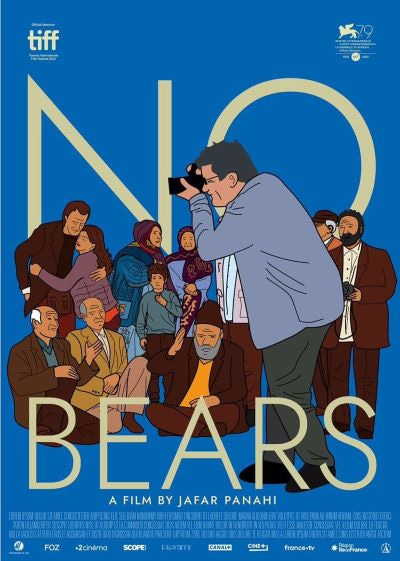
No Bears (2022). Grade: B+
Jafar Panahi’s wonderful Offside was a fiction film, using non-professional actors, about girls trying to sneak into a soccer match in Iran; his This is Not a Film was a documentary about being under house arrest (for, among other acts of rebellion, making Offside).
No Bears is another fiction film, but one with a real subject to it. Panahi was no longer under house arrest, but he was barred from leaving Iran, and had a hard time getting permits to film in Iran. So this is a story where Panahi plays a fictionalized version of himself.
He’s making a movie filmed across the border in Turkey. He’s doing it via remote videoscreen. And in order to be somewhat close to the shooting, he’s rented a room in a little village not far from the border.
The movie he’s directing is about two urban lovers trying to escape Iran by getting fake passports. There’s technical problems with the videoscreen connection; phone service in the village is spotty. So, one day after finishing work on the movie project, Panahi goes out to take pictures of village life.
These pictures, eventually, cause a problem. Somebody’s been spreading word that one of the pictures depicts something that could cause an uproar in the very insular village community. Panahi denies photographing any such thing.
First, the requests to give up that picture are guardedly polite. Then, little by little, the pressure mounts. We meet some village elders. We meet the village “sheriff” (that’s how it’s spelled in the subtitles; it might mean a more unofficial form of village authority, the guy isn’t a cop). We meet people who have differing reasons for Panahi to give them the picture, or to keep it hidden. All the while, Panahi keeps insisting he never took the photo.
And he distrusts that the photo is all anyone’s after. He’s not rude, and he’s not paranoid (no more than is perfectly resonable!). But he’s pretty sure there are bigger reasons for people to want him out of the village. (So, in its way, the plot vaguely resembles that of John Sturges’ 1955 Bad Day at Black Rock, although, in that one, the thugs pushing Spencer Tracy out of town are doing so to cover up a murder; here, they’re not thugs, they’re just scared villagers afraid of attracting trouble.)
One of Panahi’s great gifts on display in Offside was his sensitivity to the guards who were keeping those girls from getting into the soccer game. They’re just average guys. They don’t make the dumb law, but it’s their job to enforce it, and they’ll get in trouble if they don’t.
It’s a similar situation here. Even as Panahi becomes more and more frustrated with the insular villagers, he doesn’t show them in a cruel light. The “sheriff” is trying to maintain the respect he gets from local bigwigs. The guy who rented the room out to Panahi — and who obviously has been gossiping about him — badly needs the rent money, and doesn’t want any bother from Iranian authorities. What if Panahi fled across the border? Who would be blamed if a famous dissident got away?
Even the one young man who seems unpleasantly angry eventually gets his say. In a scene near the end, he tells the village leaders what that picture means to him; how it’s his last chance at getting a life he’s been promised, and how the leaders betrayed their promises to him several times before. You won’t agree with what he wants it for, but you can’t blame him, not at all, for being upset.
Are there flaws, here? Yes. The movie-within-a-movie that Panahi’s filming via videoscreen looks, frankly, pretty boring! It’s not as compelling a story as the village one. That could be a subtle way of telling us that directing via remote videoscreen is an unacceptable substitute for being on set yourself. But it’s still not the interesting part of THIS film.
And when the movie-within-a-movie breaks down, and tragedy ensues, it feels melodramatic. It feels conventional in a way the village story doesn’t… and, it’s got the only two actors with previous professional experience in the whole film.
What’s the title mean, here? It’s explained late. It’s a threat that isn’t real, except it is… in a different way than you were told.
There’s a key spooky night sequence (nothing awful happens, it just feels like it will) which explains, perhaps, what Panahi’s career is about, at this point. He IS famous in the art-film world. He could very likely get out of Iran, and make films about Iran in Turkey (or another similar-looking country). It’s not like Iranians are allowed to watch his films, anyways (although some do, on pirated versions).
But I think Panahi feels an obligation not to leave, not yet. After all, he has a special place of privilege few others do. Few others even have the option of fleeing — what country would take them? Panahi’d be welcomed somewhere else; they wouldn't. After No Bears came out, Panahi was arrested again for protesting against other filmmakers being jailed; he was released after a hunger strike. (He was born in 1960, so a hunger strike put him at considerable risk.)
Honestly? If it were me, I would have gotten the heck out. But I respect why he doesn’t.
Incidentally, one fun DVD plus… you will not remember Panahi taking the picture he’s said to have taken. After watching the movie, go back to the scene in question, and rewatch it — it only takes a few seconds. You’ll see what’s very subtly done here! That’s the kind of thing I’d still be wondering about after I left the movie theater.
I definitely don't have that kind of bravery. I have in the past; but it was 100% ignorance. I do fear the guy might not understand just how much harm he puts himself in. But bless him!
Looking at Trump/Musk in America today, I have a bit more respect for the Iranian regime. They at least base their oppression on something real. Here it's like watching vicious toddlers just breaking things for its own sake.