
Roxanne
Steve Martin's Cyrano, less maudlin and more light-hearted than most.

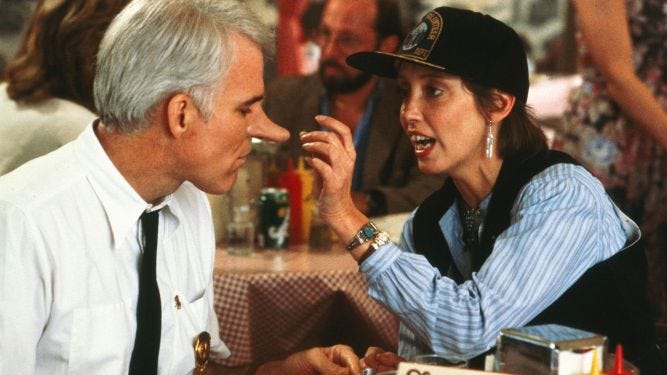
Roxanne (1987). Grade: B-
Boy, was I one hell of a gawky, geeky-looking kid with glasses.
I dunno why. I don’t look bad with them now; I am in my 50s, so I’m not exactly attractive, but it’s not a bad look. Kind of the “old amusing cynic.” From about 25-45 it was “that guy who will become an old amusing cynic,” and that wasn’t bad either. But, as a kid and a teenager, the glasses looked terrible on me. I dunno why. Maybe I wasn’t cynical enough. Who knows?
I see pictures of myself from that age, and it’s Cringe City. Without glasses, I looked alright! And I did get contacts for awhile, although I hated them. They’re annoying to put on, and after a few hours, they started to get foggy. Everything started looking like I was in that smoke-filled Russian sub from Hunt For Red October; every light source had haze around it.
Plus, I hated the fact that I had to wear contacts to stop looking gawky and terrible. Glasses were a big blessing, and I loved putting them on. I didn’t have them until I was six or seven or so. My mom was tired of my dad yelling “stop squinting!” So she took me to an optometrist, and I sat in the “which is better? One, or two?” chair, and after the exam, the optometrist gave me a sample pair of glasses to wear. The real ones would be finished in a few weeks, but I could try the sample pair, see what I thought.
I put on the sample pair, and looked out the window.
Whaaaat? Trees in the distance are supposed to look like that? CLOUDS LOOK LIKE THAT?
So, I loved my glasses. I hated the way they made me look, but I loved the way they made me see. I was much less goofy and awkward-looking with contacts, but they felt phony; they weren’t who I was.
And thus, naturally, I was a sucker for Cyrano.
If you’re not familiar with Cyrano de Bergerac, it’s an 1897 play by Edmond Rostand, loosely inspired by a real guy, Savinien de Cyrano de Bergerac. An author of plays, novels and stories (most now lost, some destroyed by his enemies),1 he is considered one of the forebears of modern science fiction; he wrote about characters riding on fireworks to the Moon, among other impossibilities. He had a notorious chip on his shoulder, and fought many duels (which, really, is a dumbass thing to do). He died at 36, in what might have been the result of an accident, or might have been the result of an assassination attempt. Monsieur de Bergerac ticked off quite a few people; he wasn’t a fan of living under a theocratic dictatorship, and neither am I, although I think we’re stuck with one until long after I die. (Probably not from an assassination attempt; people can’t be THAT mad I didn’t like The Fall Guy, can they?)
Cyrano also had a rather large-ish nose, and never married or had kids. In Edmond Rostand’s imagining, it’s because Cyrano’s nose made him too “ugly” for the elegant woman he admired. In truth, it’s probably because the real Cyrano was gayer than Rock Hudson.
In Rostand’s play, Cyrano falls for the lovely, sophisticated Roxane, as she’s falling for Cyrano’s fellow soldier, Christian de Neuvillette. Christian is a brave and good-hearted fellow, but he’s rather inexpressive; think of him like a nice, handsome sports star. A decent chap with some talents, but words aren’t his strong suit.
So, eventually, Cyrano and Christian work out a method of Wooing; Christian says the words that Cyrano feeds him. Which, OOK! But it’s not Cyrano trying to help his bro buddy put another notch on his bedpost; Cyrano really loves Roxane, and likes Christian. Plus, there’s an evil duke or count or whatever who wants Roxane, too, and that guy’s a slime. So, by helping Christian, Cyrano is expressing his own love; and he’s helping Roxane get a much better husband than the slimy dude.
Cyrano FEELS more deeply than other men. Yet he must sit by, and at best help his buddy win the dream girl. He will always be an afterthought; the girl won’t realize it was his beautiful words, his beautiful soul, all along. Not until he’s giving his dying soliloquy, waving his sword at the world, as Roxane weeps, realizing her real, TRUE love was right there, all along! Under her very nose! She never knew!
Obviously, this material is frickin’ GOLD for a gawky, awkward kid/teen with glasses (and one who has much better-looking friends). It was for me. My mom knew how painful it was for me to be a gawky, awkward kid, and introduced me at 13 or so to the 1950 José Ferrer version (it’s really slovenly-directed by some hack named Michael Gordon, but Ferrer is terrific in it). I fell in love with the character.
Now, unfortunately, the material/the character can appeal to some other people besides lonely/awkward youngsters…
It can appeal to actors, too. And that’s… well, that can be a problem.
Because, generally, the actors doing Cyrano are successful, and well-liked, and (one would presume) quite attractive to a large number of people. So, in doing Cyrano, an actor can be channeling their inner, insecure self, the one who’s always back at their first tryout for their first insignificant role, having the casting director go “thank you. Next!”
In short, it can be a vehicle for an actor feeling sorry for themselves. Or a writer! I kinda am here, which is bullcrap, I haven’t had it too bad! There were some hard years in the love department, but some terrific ones, too! More of those! Stop whining, twinsbrewer!
See, that’s this material. It invites self-pity.
Ferrer — a friggin’ handsome as hell dude — dances on the edge of it, but doesn’t completely fall into the trap. Neither does Peter Dinklage, who is short, but he’s not hurting in the great face department; he’s even more blessed on that front than Ferrer is. (The only problem with his version is it’s a musical, and the music is bland; but that’s not Dinklage’s fault, he didn’t write the songs.)
Does Steve Martin fall into the trap? Umm… he gets close. But I think he avoids it. Mostly.
Martin here is a fire chief in a mountain town that’s kind of a second-class Aspen; Fred Willard, the mayor, hopes that someday it’ll BE the next Aspen. Never mind that places like Aspen are full of a**holes and greedheads and only humongous jerks want to vacation there; in this imagining, the second-class Aspen is like the town in Northern Exposure. It’s off the beaten path, but it’s not a backwater; it’s full of kooky intellectuals like Shelley Duvall. (It’s about the most “normal” character Duvall ever played, and she’s an absolute joy; the movie’d be nothing without her.)
It’s also a town that draws a astronomy grad student, Daryl Hannah; she’s the Roxanne of the title. And the dueling, witty, big-nosed dreamer who falls for her is Steve Martin, here playing a guy named C.D. Bales (the C.D. being a reference to Cyrano de).
I fell hard for this movie as a teenager, and as a result, fell hard for Steve Martin. Now, I have a little more mixed emotions about the guy’s act. Martin has his comedy schtick, which for me is a little hard to take; fortunately, in most moments here, director Fred Schepisi (Six Degrees of Separation, The Russia House), films Martin’s schticky-moments at a distance. He’s seen in long-shots, doing his schtick to amuse himself; we’re not asked to love it as much as he does. He’s another oddball in a town full of oddballs; and when this town has Duvall and Fred Willard and wonderfully-goofy Michael J. Pollard in it, we can forgive Steve Martin being a little self-amusing in long shots. (Pollard is a amateur fireman and boxer who reads Jean-Paul Sartre, and this seems just right.)
This isn’t the Schepisi of The Chant of Jimmie Blacksmith; there’s nothing serious going on here. But it’s got that movie’s excellent cinematographer, Ian Baker; all Schepisi’s movies do. And it might be the smartest move Schepisi ever made as a director, latching on to a guy as talented as Baker. Other Schepisi/Baker movies take place in exotic settings like Texas or Japan and you can mistake the great visuals for just keeping the great scenery in focus, as if anyone could do it. Hardly. Here, some of the best-photographed visuals are Martin simply staring through a bunch of tree leaves; my favorite is him leading a fire truck, at twilight, on foot, the truck with its flashers flashing right behind at a snail’s pace. (Good thing those flashers are on, so snails have time to get out of the way!)
The script’s by Martin, and it’s got its great sides and its weaknesses. The great side is how he adapts the Cyrano character to the modern age; he’s not a soldier for a big empire’s various stupid wars, he’s a fire chief. (Trying to train a hapless group of volunteers, and all the stuff about the Keystone Cops fire department is pretty funny.)
Instead of dueling with swords, we’ve got ski poles and tennis racquets. (Martin’s on his way to return a racquet he borrowed from Duvall when he meets/beats some clods, and when he gives the racquet to Duvall, she says, “what’s that on the cover? Is that Vitalis?” “It’s blood.”) Instead of Roxane only finding Cyrano’s true love when he’s giving his last, dying speech, it’s Roxanne/Hannah finding it out with Duvall’s help; and then smacking Martin right in the face, yelling “you sonuvab***h!” And quite rightly, too!
The weaknesses? Well, I didn’t need C.D. to be able to beat up any bully he faces. It’d have been funnier, in a way, if he didn’t beat them up, he just caused them to fall or hurt themselves in other, stupid clod ways, yet everybody THOUGHT that C.D. beat them up. But I can’t think of a clever way to do that, so I can’t blame Martin for not doing it, either.
It’s a little disappointing that his witticisms aren’t, very, witty. But are they in the original Rostand? That’s debatable. They sound witty to me, but my French is for s**t. And they seem witty when Ferrer or Dinklage are doing them with clipped-English panache, yet it’s their delivery that’s sharp, it’s not necessarily the lines themselves. In a key scene, Martin challenges himself to outdo a bully/clod’s “big nose!” insult by coming up with 20 better “big nose” insults himself, in front of a crowded bar; the only one that’s actually really good is “keep that guy away from my cocaine!” The others kinda smell like that psuedo-intellectual side which Martin unfortunately feels a need to indulge. (He’s not JUST a comedian, you see, he can star in Waiting for Godot.)
What’s way more winning here than Martin playing a “walking encyclopedia” (who doesn’t seem all THAT informed) or a great verbal wit (his throwaway lines are better than his jokes) is Martin just playing a normal guy. It’s what was best in All of Me, too, although there he got to do less of it. Here, when he’s just talking to Duvall, being normal, you like him a lot. Or when Roxanne throws him out of the house, and he’s having a hissy fit on the porch; she’s right for being furious with him, and he’s understandably upset that she’s furious.
At its best, this isn’t a movie about a genius tortured romantic soul who suffers for unrequited love; it’s about crossed signals. It’s a romantic comedy, like The Shop Around the Corner; you know the two are gonna end up together, you just don’t know how. Steve Martin the moony, deep-souled dreamer may not be a romantic figure for the ages; but Steve Martin, the guy who’s gonna win the gal, he just doesn’t know it yet, is very fun.
Rick Rossovich is the good-looking dope Martin helps woo Hannah; you don’t quite buy any of it. Much better is when Rossovich and good-time bartender Shandra Beri hit it off — they actually seem like the real young people you generally will meet working in resort towns. (Good-natured, but not anybody you’d ask for Life Advice.) John Kapelos does his “smarmy” act he always did; he’s skilled enough at it that you assume he’s probably an actual nice guy in real life.
The music’s by frequent Schepisi collaborator Bruce Smeaton; actually, the best music in the film is just selections from classical tracks. Smeaton’s main theme is a kind of peak-80s Kenny G-style sax number that will either make you smile with nostalgia or wince remembering the era; it’s also acceptable to do both.
This is, basically, a nice little movie for grownups the way Moonstruck is, and just as (non)believable; you don’t want something like this to try too hard to be real, you want Nick Cage yelling “I lost my HAND!” or Steve Martin leading a fire truck on foot. You want the dream gal to be Daryl Hannah, bright and beautiful without being unattainable; Cher would have been good, too. (But not Judy Davis or Judy Dench!)
The source material maybe isn’t as good as Martin thinks it is; if I caught myself wallowing in it, he should have, too. Yet the setting of the Northern Exposure-style dream town and the happy ending make it work. I will suggest that letter-writing as the way to a beloved’s heart is not, necessarily, a very good idea at all! It was probably not a great idea in 1987, and, today, it’d probably come across as a setup for a identity-theft scam! And you shouldn’t climb houses the way Martin’s stunt double does in this movie! But, if you have the chance to be friends with somebody as cool as Shelley Duvall — 100%, go for it.
Here is an interesting piece on Cyrano posted by a modern translator, Don Webb. Well worth a read.
Your first couple paragraphs here remind me of the phrase: "If you ever start feeling sorry for yourself--just remember that you don't look like you once did in 6th grade" (hahaha). So very true!
I've never seen this one. My favorite Steve Martin flick is Father of the Bride.