
Moonstruck
Too-much-a, but still likable, Cher/Cage Italian-American romantic comedy.

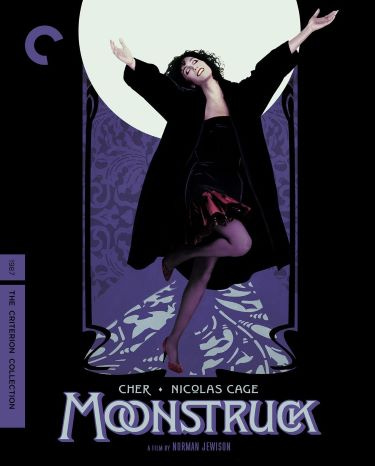
Moonstruck (1987). Grade: B-
When the moon hits your eye like a big pizza pie, oh-dear-Lord-we’ve-got-Dean-Martin alert! And the very next year would see Married to the Mob, which opens with Rosemary Clooney belting “Mambo Italiano.” I guess it was just kinda going around. (And I kinda like that movie, too.)
Putting a big cornball Dean Martin song over the opening credits could almost kill off your movie immediately, threatening the audience with some overly ethnic hijinx; The Beverly Hillbillies but with a spaghetti-throwing food fight. Yet there’s something else going on, too — we’re watching people setting up signs and bringing in props for a Metropolitan Opera production of La bohème.1 The meaning’s clear; we’re going to get a celebration of over-the-top-ness. Like in the Martin song, like in opera. (When one character’s feeling grumpy, he keeps playing Vikki Carr’s ridiculously too-much “It Must Be Him” over and over.)
Cher plays a 37-year-old accountant/bookkeeper in Brooklyn, doing taxes and making bank deposits for various family-owned businesses in the neighborhood. She’s just accepted a proposal from a longtime suitor, played by Danny Aiello. She’s not “in love” with him, but likes him alright, and wants to be married, to somebody. Her first marriage didn’t last long; her husband was hit by a bus. (Which isn’t exactly treated as a big tragedy here.)
Aiello’s flying to Sicily to visit his dying mother, and he wants Cher to get in touch with his estranged brother (Nicolas Cage) while he’s away. To invite him to the wedding. When Cage refuses to talk on the phone, she goes to the bakery where he works, and Cage explains why he and Aiello fell out; Aiello distracted him while he was operating the bread slicer and “I LOST MY HAND!” (Which isn’t exactly treated as a big tragedy here.)
Cage and Cher leave the bread ovens (which look like railroad fireboxes)2 and head upstairs to his apartment; they basically fall into each others’ arms and end up sleeping together. He’s passionately in love with her, and she’s pretty gaga for him too, but she’s gonna try and forget the whole thing. After one more date, at Cage’s begging request; a night at the opera.
To prepare for the date, Cher has a makeover. The Criterion essay by Emily VanDerWerff (who wrote the wonderful A.V. Club Slings & Arrows episode reviews) calls the scene a “transformation”: “It is less about who she could be and more about the person she has always known herself to be, if she would just admit it to herself.”
And I agree with half of this; I liked the quiet scene of Cher, at home, by herself, putting on a wonderful dress, taking care to look nice for a nice evening out. It’s sweet, and you get the sense she doesn’t get to do this often enough. But I dislike the hairdo! Before, Cher had little fringes of silver around her face, and they looked almost twinkly. They match the actor’s sparkling intelligence. Once she gets the hairdo, it’s too dyed, and it matches what everybody else was wearing in 1987 (including the metal bands). I missed it the way it was before!
The opera really drives the plot, though. Cher bumps into someone who doesn’t want to see her there and REALLY doesn’t want Cher to see them there. Danny Aiello returns unexpectedly from Italy and wonders, why isn’t Cher at home? This is what’s pushing everything forward to a big, theatrical-style conclusion at the end. A very satisfying conclusion, too.
John Patrick Shanley was usually a playwright; this was his second movie script to be filmed. He is a wildly varied fellow, for sure. He wrote/directed the odd, depressing-but-endearing Joe Versus the Volcano with Meg Ryan and Tom Hanks; he also wrote the play Doubt, and directed a very fine film version in 2008. (It’s the one with Philip Seymour Hoffman as a priest and Meryl Streep as a nun who hates him, with great supporting performances by Viola Davis and Amy Adams; it’s an excellent film.)
This was the 18th film by director Norman Jewison, who wasn’t a stylish director, but was a smart, sensitive one who could do good things with good material. He directed a great television special with Harry Belafonte and Odetta; he did In the Heat of the Night and Fiddler on the Roof and A Soldier’s Story; he’d later do The Hurricane.
When he made Moonstruck, Jewison was 60, was respected as a great actors’ director, and wasn’t in demand from a studio system that wanted dumb blockbusters. That’s from this outstanding “behind the scenes” article by Ira Wells; it’s a must-read for fans of this movie. Wells describes how the shoot was actually a little bit contentious, with both Cage and Cher questioning the other’s acting ability. The end scene got so heated, everybody was fighting. Aiello grabbed his nuts and told Cage “you gotta give it to me from here!” Cage threw a chair. Finally, Feodor Chaliapin (who plays the wizened grandpa) had to calm everyone down. Wells writes:
“‘Calma, calma, calma,” he implored. He explained that they were working in the tradition of Feydeau farce, “and in a Feydeau farce, we pull everything together in the last scene.” Chaliapin’s castmates may have been baffled by his reference to nineteenth-century French playwright Georges Feydeau, but the elderly actor’s intervention somehow deescalated the situation.’”
Oh, and when Jewison considered casting Chaliapin originally, he called Sean Connery, a friend of Jewsion’s who’d worked with Chaliapin before. Connery said “he canna see, he canna hear, and he’ll steal every bloody scene in the film.” (He was right; and so do Chaliapin's funny dogs.)
I remember seeing this when it first came out; I was 15, and starting to go to “grownup” movies. I told some friends “this is the funniest movie in years” and one friend said, “how do you know? You haven’t seen that many movies.” I was so ashamed! It was a line I repeated because I saw Gene Siskel saying it on TV.
Actually, my reaction to it at 15 wasn’t far different from my reaction to it today; I enjoyed it and loved the ending, but didn’t get the romantic stuff as much. Then, it was because I didn’t understand romance at all. Now, I just look at Cage & Cher and think “he’s way too young for her.” (He was 23, she was 41.) It’s not creepy or anything, you merely wonder how she could have anything to talk to this very young man about. He’s quite sweet when he expresses his love for the opera, though. (Unfortunately, when he asks her to go with him, Shanley gives her the worst line in the movie; “where’s the Met?” She’s a smart woman, she would know how to look up the address in a phone book.)
I also don’t understand why Olympia Dukakis (as Cher’s mom) is so devoted to Vincent Gardenia (as her dad). He’s really slimy, and not only because he’s having an affair with a younger woman; he’s a plumber who sells people expensive upgrades they don’t need. Then, brags about it to his mistress. Even if he was bragging about it to his friends, that’d still be slimy.
Dukakis has a great scene with John Mahoney, a college professor who keeps dating/getting dumped by his students. After Dukakis, at a restaurant, witnesses one of these breakups, she asks Mahoney to finish his dinner with her instead. They have a nice chat, and he walks her home, but she won’t let him in; “I’m too old for you,” she says. Well, she was 56, he 46 — that’s less of a divide than Cher and Cage! (And Vincent Gardenia was 67.) But, she believes that marriage vows are marriage vows, and I can respect that. I’d just respect it more if Gardenia was less slimy. (He was too slimy in Little Shop of Horrors, too, but the plant eats him, which fits.) And least she gets to tell him off a little at the end, and he does, grumpily, take it.
And quite a few people like the Cage/Cher relationship in this movie — here’s one current blogger who does, in a nice review. Again, I didn’t mind the relationship, I simply don’t see a great future for it. But whadda I know.
I basically enjoy hanging around with this cast (even Julie Bovasso and Louis Guss as the aunt/uncle out-ethnicing everyone, which is saying something; Bovasso trained the rest of the cast in their Brooklyn accents, per Pauline Kael). This isn’t a realistic Italian-American family like in The Feast of the Seven Fishes, yet they’re not meant to be. Opera and cheesy pop songs aren’t realistic, either, and they have their enjoyable moments. I just wish they’d let Cher keep the glints of silver in her hair.
Per IMDb, the first version of the movie had music from La bohème played during the opening credits; test audiences “shifted uncomfortably on their seats, thinking that they had been lured into an art film.” So maybe Jewison picked “That’s Amore” because it was the cheesiest song he could think of, and he was subtly taking a dig at idiot studio execs who care what random strangers pulled off the street to watch a movie think.
The movie made the very real Brooklyn bakery into a tourist attraction for a while!