
Old Joy
Kelly Reichardt's expressive, emotional film about male friendship.

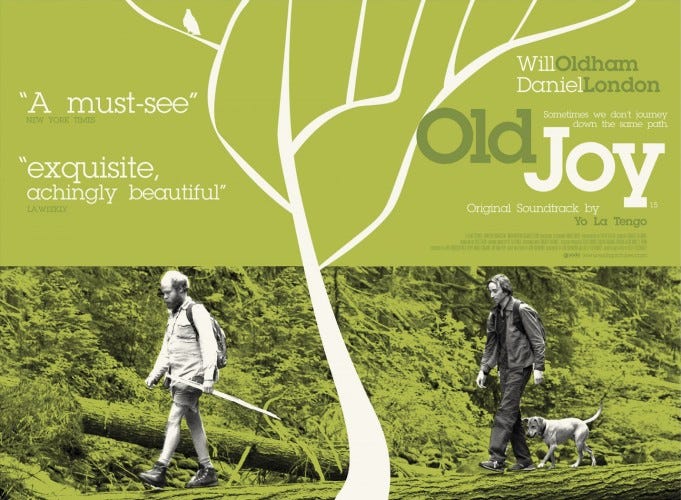
Old Joy (2006). Grade: B
I’d probably do better if I liked people more. Don’t get me wrong, I like you; you’re a reader of taste and discernment, of course, which you’ve proven by clicking on this site. But most people eventually annoy me. Especially pretentious creative people.
When Kelly Reichardt made her first, interesting-but-flawed feature, River of Grass, she acknowledged (in the DVD commentary) that she wasn’t, at that time, a good enough writer. She knew the kinds of characters and the kind of mood and setting she wanted, she just didn’t know how to shape a story around these things.
In the subsequent 12 years, Reichardt worked on short films and taught college courses,1 and met many people. One was fellow indie filmmaker Todd Haynes. Haynes introduced Reichardt to short story/novel writer Jonathan Raymond. And Raymond provided the story for Old Joy.
Now, if I had met Todd Haynes, I wouldn’t have listened to anything he had to say. I would have been like, “your movies suck!” I mean, that would be in my head. Out loud I would just say I hadn’t seen them. In my head, though, I’d think “this guy’s movies suck” and that would be the end of it.
And that’s why Kelly Reichardt is a MUCH better filmmaker than I would be.
I’ve worked on indie films, one with a budget that wasn’t much less than what Reichardt had for Old Joy. But the script was too thin. There were some decent-enough ideas, but they weren’t shaped anywhere NEAR thoughtfully enough. And that’s on me. I would have done better if I knew somebody who could write!
There’s not a complicated plot here, or complicated characters. Just two basically decent guys and a cool dog. But the feelings seem real; they seem like things people I know have gone through. That’s the kind of framing a writer can help with.
Musician Will Oldham plays an aging stoner/drifter character (he lives out of a van, and he’s in his mid-30s). Oldham has called up an old friend of his, Daniel London, offering to “hang out” for a weekend. Go camping, visit some natural hot springs. Just chill; I miss chilling with you.
London says, sure, I’d like that.
And then the onslaught of horror begins…
No, actually, I’m f***ing with ya. No onslaught of horror happens. The old friends hang out, they chill, they remember why they like each other. Then they go their separate ways, and probably won’t be able to hang out much again in the future. If at all. They might not be able to be friends anymore.
That’s it; that’s the plot. Is it enough of a plot?
I think it is. I think it’s a remarkable movie. But it’s not for everyone. It’s for people who are interested in the dynamics of real male friendships.
In Hollywood movies, male friends are always Guys who do Guy Things. It’s either rural/conservative-coded Guy Things (hunting, fishing), or it’s urban-coded Guy Things (shooting pool, going to sporting events together), etc.
Well, when I’ve had male friends, we generally haven’t done any of those things. Not that I have anything against them, some are things I enjoy. But I’d enjoy them by myself. With friends, I would rather just hang out and chat.
You can’t have that in a Hollywood movie because it breaks movie rules about how feelings are for women (usually bonding over white wine) and men are afraid to share theirs. That might be true in Hollywood, where everybody’s competing with everybody else for a limited number of jobs. But it’s not true in my life, and I suspect in the lives of most people.
There’s a little competitiveness going on in Old Joy. Yet it’s not the stupid type that movies generally show us (where guys are competing over who’s best at grilling, for instance). It’s more that you’ve got two people whose lives are drifting apart.
London’s married; he lives in a house in Portland, and his wife is pregnant with their first child. He talks about things like how much he enjoys volunteering with local kids, and it’s not a brag per se; it’s something he wants to talk about because he thinks it’s cool. No sooner does he do so than he realizes it could sound like a brag to Oldham, so he adds, you could do something like that too, if you wanted to. (And then probably realizes that line didn’t help things!)
While Oldham never out-and-out tells London he’s a sellout, but it is implied at times. Oldham’s been to the coolest hippie happenings up and down the Northwest. He’s the one who’s been to the hot springs before, because he Knows More about all the cool nature stuff than most people. He’s the kind of guy who probably went to Burning Man in the early 90s and stopped when it became “too commercial.”
It’s not specifically mentioned what these guys’s former friendship was, but the way they reminisce about a favorite music store (now closed), they were either college roomies or maybe members of the same social scene; that kind of 1990s, alternative-rock, vaguely rebellious scene (which was less overtly political and more just rejecting a lot of consumer/corporate culture). Clearly, they used to smoke a LOT of pot together. And clearly, London doesn’t anymore, and Oldham still does (he tokes up at basically every opportunity during their drive).
What’s sweet here is how London doesn’t reject Oldham because he’s poor, or because his new friends are cooler, or anything like that. It’s just that their goals and perspectives are so vastly different now. London tries listening to Oldham’s odd stoned ramblings, and he simply can’t make any sense out of them. He realizes his friend, who he still likes, is trying to reach out, and he doesn’t want to reject that outright or cause him any pain. He simply can’t understand what the guy’s talking about half the time. And he doesn’t WANT to bang as many hippy chicks as possible anymore. (From the way London’s wife icily disapproves of the reunion, you get the sense she assumes that part of him still does, that the weekend trip will be a hippie bachelor party. Which it ain’t.)
A big help is an absolutely lovely score by Yo La Tengo,2 which is used mostly during the driving scenes. (The drive's to a hot springs about two hours southeast of Portland, although my eyes think they spot some sights you’d see driving north along US-30.) The very fine cinematography’s by Peter Sillen; if you get your face really really close to the TV, you can tell at times that this is blown up from 16mm. But most of the time you won’t notice. It captures the lushness of the forest well. (No wonder the dog seems happy; this forest would be Scent Heaven for a pooch.)
It’s a blast listening to the various interviews included on the Criterion disc, especially the one with Reichardt and another with London/Oldham. Oldham had appeared in small roles a a few movies, London was more of a professional character actor. At first, their parts were switched, since Reichardt was hesitant to cast Oldham as the aging stoner since it was “too on the nose.” At first, there was no thought to making this a feature to be shown in theaters! It was just going to be a little art project done by friends. When it was shown at Sundance, it was buried “in an experimental sidebar alongside nonfiction works by visual artists,” Criterion’s Ed Halter tells us. Critics picked up on it enough for the film to get a small national release, although critics quickly moved on to the latest massively-publicized dreck, as is their wont.
More fun from the interviews? Reichardt said that her dog, Lucy (who was in Wendy and Lucy, too)3 could be a destructive fiend at times; you needed to give Lucy something to do or she’d amuse herself by chewing something to bits. Yup, I’ve known doggos like that! One of the final scenes of the movie takes place at a real hot springs, which I took one look at onscreen and thought “oh, man, bacteria city!” Oldham met a park ranger who told him this was totally true. (And Oldham made sure he didn’t have any skin nicks before getting in that water.)
Oldham adds that “one could look back at this movie, and feel like it represents something peaceful or something innocent in comparison to what feels to be an unbearable insanity that we’re living through right now.” Yes.4
I’ve never lost friends in quite the way the movie shows these two drifting apart. But I appreciate how the movie takes me back to an Oregon of a specific time, anyways. You don’t have to have lived there to appreciate it. Just know that those places existed. There were spots in the woods filled with old trashy furniture where people would go to shoot beer cans and such. Just like you can get into a movie where icehouse fishing is one of the settings even if you live in warm places where that never happens. The vivid sense of a different place is still interesting in itself.
Again, this isn’t for everybody. Not much HAPPENS. But it’s a movie with a definite feel and mood, which, although it’s a sad one, at least isn’t aggressive. It’s not a movie intending to make you feel lousy. You’ll just feel bad for how lonely Oldham is. Although at least he has the capacity for friendship. Not everybody does. (I’m not the greatest at it.)
This website has an e-book about Rechardt’s films… well, I don’t pay $30 for e-books, so that’s a no-no. It’s got a decent overview of her career, though. And, oddly, merch. A T-shirt for First Cow and a mug that might go well with this movie:

Yeah. That feels about right.
At least in 2023, she was still teaching, and using a neat method. Most film schools choose a few precious students to write and direct student films, while others work as crewmembers. In Reichardt’s classes, every student got to direct 10 minutes of a remake of a 1970 movie.
It's an expensive college, which is sad. That’s not Reichardt’s fault. It's because we don't fund public education enough. She couldn't teach seminars at a community college AND scrounge funding to make indie movies AND make a decent living.
That's a shame. I've met some really great teachers at community college, and Reichardt would be wonderful teaching at one. Maybe someday we'll fund them properly? I can dream.
The band was formed in Hoboken in 1984. The name comes from a thing that happened with the New York Mets. Wiki has it here:
‘“The name came from a baseball anecdote from the 1962 season, when New York Mets center fielder Richie Ashburn and shortstop Elio Chacón collided in the outfield. When Ashburn went for a catch, he would yell, "I got it! I got it!" only to run into Chacón, a Venezuelan who spoke only Spanish. Ashburn learned to yell, "Yo la tengo! Yo la tengo!" instead. In a later game, Ashburn happily saw Chacón backing off. He relaxed, positioned himself to catch the ball, and was run over by left fielder Frank Thomas, who understood no Spanish and had missed a team meeting that proposed using the words "Yo la tengo!" as a way to avoid outfield collisions. After getting up, Thomas asked Ashburn, “‘What the hell is a yellow tango?’”
Reichardt said that Lucy is not playing the SAME dog in Wendy and Lucy. She wasn’t part of a Kelly Reichardt Expanded Universe. That’s from this very fun 2005 interview, where Reichardt does get a little cranky with the interviewer. If the guy was super-young, that probably wasn’t called for; but if he was over 30 or so, he WAS being a slight yutz.
He also said that re-watching it, he thought the political radio clips were hear were just an aural assault, that it was useless grumbling. Reichardt herself said the movie was partly a “metaphor for the self-satisfied ineffectualness of the left.” I share those feelings about my fellow lefties as well, but I don’t think the radio clips add much to the movie. I agree with Oldham on this one. I should try out some of his music!