
Libeled Lady / The Big Heat
Two middling genre pictures; one's a more entertaining genre.

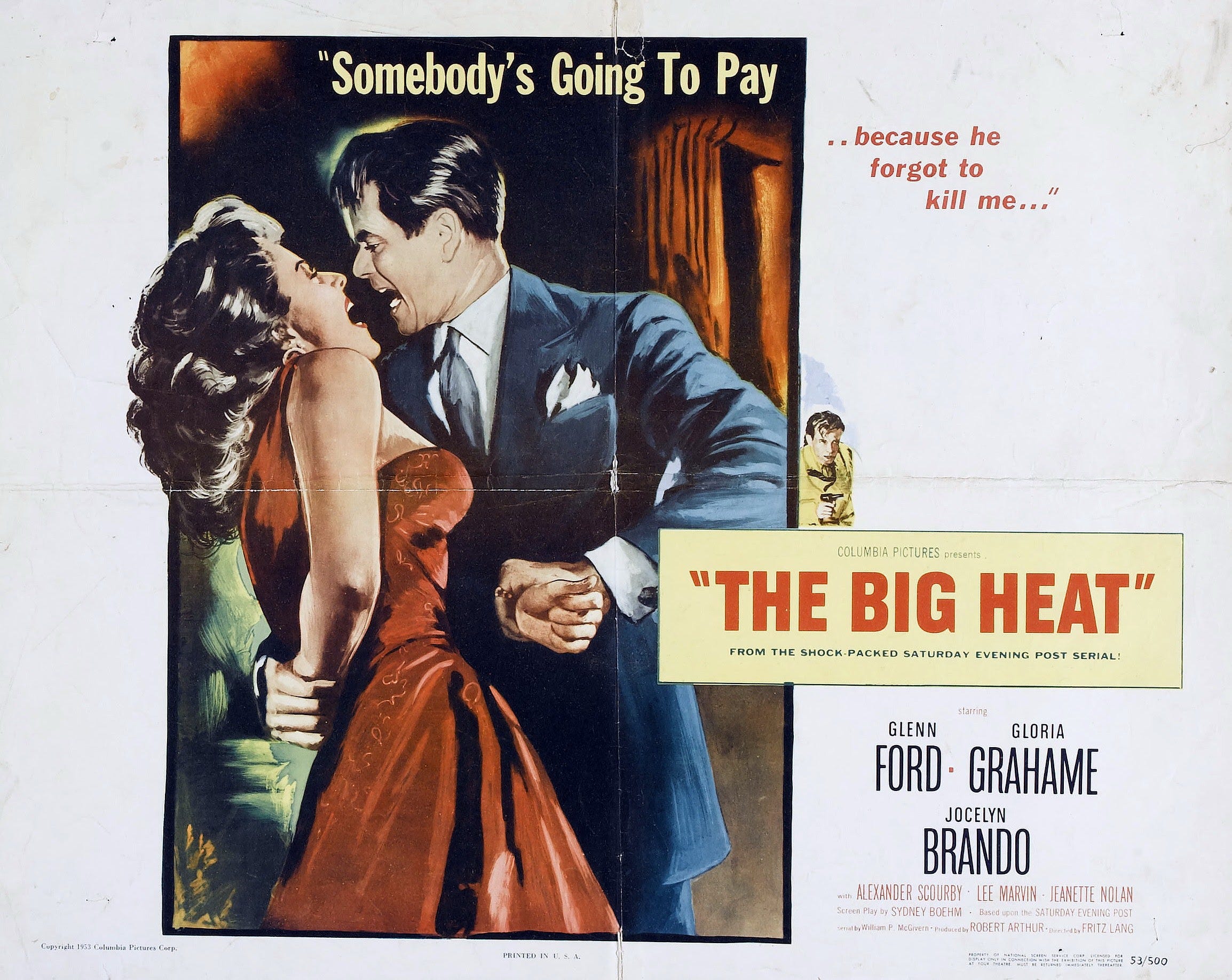
Libeled Lady (1936). Grade: C+. The Big Heat (1953). Grade: C
Here’s a thing I found recently; an old essay by film critic Paul Schrader. Schrader would later be known as the writer of movies like Taxi Driver and director of movies like Patty Hearst, but he started his film career as a critic. In New York, he met critic Pauline Kael and passed out drunk at her place, arguing movies; she encouraged him to become a critic. (And she thought the script for Taxi Driver was too scary, but she loved the movie.)
The essay’s called “Notes on Film Noir,” and it came out in early 1972 (when Schrader was 25 and I was a fetus). Superfans of the genre should give it a read; it lists some movies they might be interested in. I found a couple of statements interesting. “Film noir is both one of Hollywood’s best periods and least known.” Maybe that was the case in 1972, but there’s been a TON of writing about the genre since.
“Picked at random, a film noir is likely to be a better made film than a randomly-selected silent comedy, musical, western and so on.” I suppose that’s pretty fair when it comes to musicals (I love ‘em but most are bad), and definitely fair when it comes to Westerns. A fair number of Western fans didn’t especially care what the movie was about so long as it had the hats/horses/guns, etc. So a lotta Westerns were just churned out by rote, and these were pretty terrible.
But is a random film noir better than a random comedy? I mean, if you prefer the genre, I guess so. But the thing is, I could probably name 50 great comedies off the top of my head, and the number of good film noir movies is far fewer. There’s The Big Sleep, The Maltese Falcon, Double Indemnity, The Killers, The Killing, Laura, Notorious, Sunset Boulevard, and Touch of Evil. Then you start really having to stretch your definition of “good.” Edmond O’Brien is great in D.O.A. but the plot stinks. (The Hitch-Hiker is much better, but generally isn’t considered “film noir” despite having a darker, scarier plot than most such movies; it doesn’t count because it’s mostly filmed in the daytime and the director was a woman.)
I’m sure I’m missing a few, but the point stands. A lot of the vaunted “film noir” classics just have ridiculous, unbelievable plots and characters. So do a lot of the best comedies, but you don’t have to believe in a comedy to enjoy it. When a movie’s supposed to be an unsentimental, hard-hitting look at the dark sides of society and human nature, and all you have is idiots reacting to improbable things, it makes your movie a lot less watchable.
Glenn Ford in The Big Heat is not an idiot; his character figures out who’s lying and telling the truth. Another thing Glenn Ford is not in The Big Heat is an actor. He’s all Brylcreem, scowling, and punching people. He’s a bore.
That might be in Fritz Lang’s direction — he frequently used actors as if they were props. But he got good performances from Spencer Tracy in Fury and Henry Fonda in You Only Live Once; I think it’s more here because Ford seems uninterested in acting. He’s being a Star. Well, goody for him. (Ford liked to tape all the conversations he had with famous people over the years, to remind himself that he was a Star. He installed the secret taping system to record the conversations of his wife, to find out if she knew about his serial cheating. She divorced him on grounds of mental cruelty in 1959.)
Your (bad) plot here is from a serial published in The Saturday Evening Post by crime writer William P. McGivern; the script adaptation’s by Sydney Boehm, who wrote the delightfully silly When Worlds Collide. It you remember that one, you’ll remember that having too many believable human characters was not one of its problems.
Ford plays a cop in Generic City who’s investigating the suicide of a fellow policeman. It turns out, eventually, that the policeman was on the payroll of a local crime lord, Alexander Scourby (a less intimidating and less interesting crime lord is hard to imagine). Corruption reigns everywhere in the police department, and following a major tragic event, Ford has “nothing to lose” and a vendetta to root out all evil.
The tragic event was predicted exactly by Mrs. twinsbrewer before it happened, and none of the evil corruption is remotely compelling. This is Fritz Lang going through the motions of creating a cookie-cutter film noir and not giving a dang about the plot. Do you like shots of light entering the room through blinds? You got it. Sigh. (At least in Double Indemnity, the movie which might have invented that cliche, the scenes have light appropriate for the time of day.)
About the only interest to be found here comes from how consistently nasty everybody is to everybody; this is described as “the most ferocious rage in the noir canon” by enjoyable film writer monstergirl. It’s epitomized by Lee Marvin, here in one of his first big roles. Marvin (good as usual) is a sadist who enjoys tormenting both men and women, and the most rewarding moment in the movie comes at the end, when one of them gets her own back.
Actually, that end scene is pretty well done overall; for once, what’s going on is compelling, and Lang can stage it excitingly, something he was good at doing. Spoilers in the clip, but it is the only good scene. Skip it if you want to watch the rest of the movie first. (Stop this at about 3:40; I left more on by mistake and I'm too tired to fix it. The beginning's at exactly the right spot, though; it’s a great shot.)
(Cinematography by the very veteran Charles Lang; harmless score by Henry Vars.)
Gloria Grahame was a very lovely and fairly talented actor who had an obsession with her appearance; not unusual in a business that values women based on how they look. Grahame thought her upper lip was too thin (it’s not), and she would frequently pad it before turning to multiple rounds of botched plastic surgery. Her niece1 said “she carved herself up, trying to make herself into an image of beauty she felt should exist but didn't. Others saw her as a beautiful person, but she never did, and crazy things spread from that.”
In any case, she’s good as the kept-then-discarded girlfriend, and it’s fun seeing her revenge. Apparently she and Lang did NOT get along; he threatened to shoot her only from the back and “get a parrot to say your dialogue!” When this became a hit, the studio wanted Lang, Grahame, and Ford together on another movie, Human Desire (and this got Peter Lorre canned from what became the Ford role); Lang was such a jerk to Grahame, co-star Broderick Crawford grabbed the director by his lapels and lifted him off the ground to cool his jets. Way to go Broderick!
In any case, if you picked a film noir at random, this is likely what you’d get; a rather boring movie with a really boring main actor and a good scene of violence or two. You can definitely sit through it, but it’s not exactly my idea of fun. Incidentally the Jocelyn Brando in the header artwork is the Method actor’s sister. She’s fine in this. Hopefully she was less of a mean wierdo than her brother.
Not any deeper, but certainly more entertaining, is Libeled Lady, so-named because famous heiress Myrna Loy has been described as a “homewrecker” in the New York Evening Star. She’s suing the paper for a gazillion million dollars.
This would bankrupt the paper, and the paper is managing editor Spencer Tracy’s life. But he’s got a Cunning Plan to prevent that from happening.
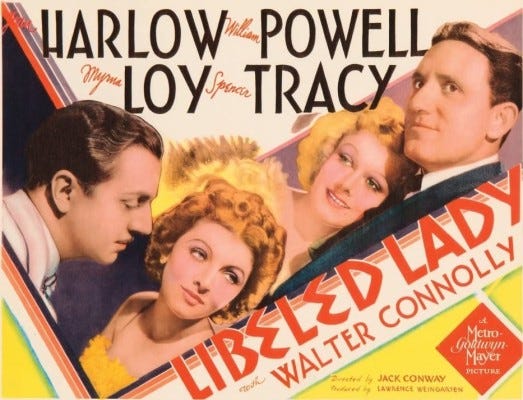
Tracy’s gonna recruit dashing former reporter William Powell to save the day. Powell is irresistible to the ladies, you see, so he’s gonna seduce Myrna Loy. AFTER having a wedding-in-name-only to Tracy’s long-suffering fiance, Jean Harlow. So, when Powell seduces Loy, Tracy can catch them red-handed and prove that Loy is, indeed, the homewrecker his paper libeled her as. Harlow hates the idea but grudgingly agrees, since Tracy promises to finally marry her after the whole matter’s over (and after she/Powell get a quick divorce.)
Follow all that?
Movies with wacky, complicated plots like this involving oddball heiresses and mixed-love-signals were often referred to as “screwball comedies.” This isn’t one of the greats, like Bringing Up Baby, but it has its charms.
Tracy’s one of them; only 36 here, he didn’t have the grumpy presence he would have in the weaker Tracy/Hepburn films. He’s good blustering fun. So’s Harlow, who’s a nice match for him (and for Powell, too). Powell’s just repeating his funny/suave bit from My Man Godfrey and The Thin Man, and it works just fine. (He also shows some real trouperism in a river scene that requires him to faceplant multiple times.)
There’s less fun with Myrna Loy; something about the Hays code neutered her. She was a blast with Powell in the first Thin Man, yet the sequels had diminishing returns (and by the time they added a baby and called each other “Mother/Father,” the fun was all gone). Loy was cast in more goody-two-shoes roles pretty much ever since, and she was most fun when she was being naughty.
Not that she was ever bad, but she is the fourth wheel here, and it’s not a blast. In fact the whole movie, after a sharply-paced start, begins to lose steam after that river sequence, and doesn’t pick it back up until the end, where there’s a fun exchange involving marriage validity.
It was the fifth of fourteen films where Loy and Powell were paired together, and while it’s certainly better than the later Thin Man sequels, it is put together almost by rote. The director’s Jack Conway, who keeps the actors in focus and that’s about it. The writers are nothing special, although one of them, Maurine Dallas Watkins, wrote the 1926 play Chicago, which later would be adapted as the Bob Fosse musical. The bland cinematography’s by Norbet Brodine and the bland score’s by one Dr. William Axt. (An actual Doctor of Musical Arts from the University of Chicago; I thought they only turned out bad economists)!
Still, this is harmless and fitfully amusing, especially at the beginning. It’s one of those movies where the MGM stars all walk arm-in-arm during the opening credits, and in this case they actually do seem able to stand each other. Although Jean Harlow had wanted to be the character who ended up with Powell (who she was dating), but the studio insisted it be another Powell/Loy matchup. Well, that was the studio’s fault, not Loy’s, so Harlow held no grudge. (Loy wrote in 1987 that this was one of the more fun movies she’d ever done, and the cast did like each other, plus the amusing Walter Connolly, who plays Loy’s dad.)
Poor Harlow would be dead within a year after this was released, at age 26. It was a terrible, misdiagnosed case of the flu, which led to kidney failure. What a horribly unlucky fate for anybody, much less such a bright, likable personality. Get your shots if you can, no matter what Secretary Brainworm tells you.
So there you have it. A fairly random comedy, and a random film noir. Mixed here together because a 25-year-old’s essay claimed that a random pick from the one genre would be better than the other. Well, I suppose I showed Paul Schrader! Although he did write/direct several good films.
Vicky Mitchum, who married Robert Mitchum’s brother.