
Double Indemnity
Formula, but awfully satisfying formula at that.

Double Indemnity (1944). Grade: B
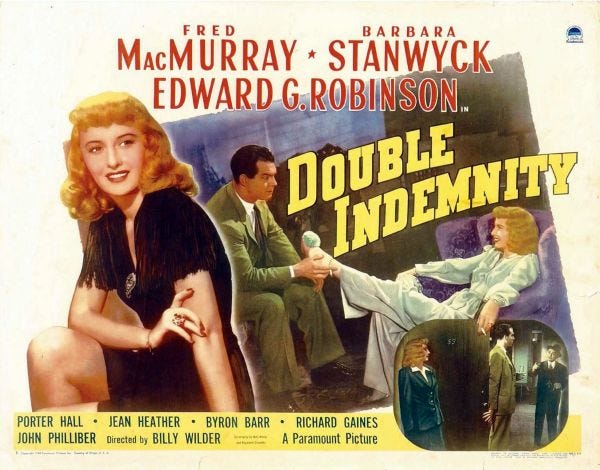
I’ve mentioned before that “film noir” generally means “tired formula.” (And that one should beware of using terms invented by French critics.) All the elements which make up “film noir” — the heavy use of shadows in lighting, the cynicism, the alluring/dangerous “femme fatale” (French again) — can end up being boxes critics check off to determine if a movie’s fit for inclusion in a sainted category, and hence a masterpiece, even if the movie is dreck.
That’s not to say that one shouldn’t be a fan of any kind of genre (French word!), be it cozy mysteries, police procedurals, romance novels, horror, anime, jukebox musicals, you name it. If you really like books/movies/whatever in a particular genre, good for you. But one should be aware that not everybody’s as much of a fan of these things. And when film critics bend over backwards to venerate “film noir,” what they’re really worshiping are a set of cliches (French word!) derived from popular novels of a particular era. Novels which probably weren’t very darn good to begin with.
That said, while Double Indemnity is pretty by-the-numbers formula stuff, it’s very good and very fun at what it sets out to do. And a slickly entertaining shallow classic is a special kind of movie in its own right. It’s one you can enjoy without thinking about it and still not feel dumbed down by the experience.
The story here’s from a novel by popular/pulpy novelist James M. Cain (I haven’t read his work, but unless the prose is simply the greatest in the English language, those plots sure are pretty pulpy). In the movie’s plot, an irresistible sex goddess convinces a lover to murder her husband for money. It seems like they’ve gotten away with it, but a savvy investigator pulls at one loose thread and the scheme unravels… especially as the man & woman begin to turn on each other.
If that sounds familiar to you, it’s exactly the plot of Cain’s The Postman Always Rings Twice (and that’s the review I linked to, above). That book came out in 1934, sold very well and Cain deliberately copied the formula for this 1936 story in the hopes it would sell very well (presto, it worked). The story was published with two others in the book Three of a Kind; both the other stories were made into movies before this one. The Hays censorship office objected to the material here, since it was supposedly a perfect instruction manual for how to get away with murder.
(It is not. Try copying this murder scheme and you will fail. It’s very dopey. In fact, the real-life couple who pulled off just such a murder in 1927 were caught very quickly; their case was one of Cain’s inspirations for the story. The other was a newspaper printer who’d snuck the word “f**k” into a printed ad, and claimed that working in printing compelled him to try and see what he could get away with. Cain imagined an insurance agent wanting to commit insurance fraud for the same reason. Because, sure, everybody in a highly-regulated field just waits for the chance to cheat at it. Maybe in Cain’s mind!)
Paramount’s brainstormers eventually changed enough stuff for the Hays office to relent, and they assigned writer/director Billy Wilder to the project. Wilder’d written multiple hits during the 1930s and directed two films of his own in the 1940s; both came in under budget and made money.
When Wilder’s regular writing partner Charles Brackett balked at the material, Wilder first approached Cain; he was working with another studio on another project. So he turned instead to crime/mystery writer Raymond Chandler, whose book The Big Sleep had been a big success despite Chandler not exactly being sure who had murdered whom in the thing. The writing process was contentious, with Chandler being annoyed by the much-younger Wilder and Wilder being annoyed by the much drunker1 Chandler, but they muddled through.
Superfans of the movie should check out this thorough CinephiliaBeyond page about the movie, which has quotes from Wilder interviews about the writing, filming, and casting. Almost nobody wanted to play the wicked Fred MacMurray character (including MacMurray); James Cagney, Frederick March, Spencer Tracy and George Raft all turned the part down. Dick Powell, however, begged for the part. Wilder: “‘He knew that was the way out of those silly things — you know where he was singing smack into Ruby Keeler’s face and he had to get out of that, so he was dying to play [the MacMurray role]. That was before Murder, My Sweet. He came to my office to sell me: “For Christ’s sake, let me play it.” “Well look, I can take a comedian, and make it. But I don’t want to take a singer.” And he was damned good, you know, in Murder, My Sweet.’”
Barbara Stanwyck was hesitant, too, under Wilder challenged her by asking “are you a mouse or an actress?” While Edward G. Robinson was hesitant for a different reason (after all, he plays the good guy); he wasn’t sure he wanted to take third billing. Whose name was listed on top of whose was a bid deal in those days; then as now, dumb audiences and dumb critics liked to follow what’s popular and who’s up/who’s down in the entertainment industry. Finally Robinson agreed, since he was being paid the same as the other stars for half the amount of shooting time.
I’ve given the barebones plot outline above, but for more detail, here it is. MacMurray’s an insurance agent who considers himself mighty clever; he hasn’t been wanting to commit insurance fraud himself, he simply thinks he’d be bright enough to pull it off if he tried. After all, he’s good pals with Robinson, the company’s chief fraud investigator; from Robinson, MacMurray’s learned all the ways that fraudsters slip up.
One day, he heads over to the house of a wealthy client whose lucrative policies are nearing their renewal date, and instead of the client, he runs into the client’s wife, Stanwyck. MacMurray’s immediately stricken by Stanwyck’s ankle and falls madly in lust. (What is it with male moviemakers and their obsession with feet? Well, for all I know, it’s in the book, too.) Some “crackling 1940s dialogue” follows (transcribed here by film historian Tim Dirks):
Neff: I wish you'd tell me what's engraved on that anklet.
Phyllis: Just my name.
Neff: As for instance?
Phyllis: Phyllis.
Neff: Phyllis, huh. I think I like that.
Phyllis: But you're not sure.
Neff: I'd have to drive it around the block a couple of times.
Phyllis: (Standing up.) Mr. Neff, why don't you drop by tomorrow evening around 8:30? He'll be in then.
Neff: Who?
Phyllis: My husband. You were anxious to talk to him, weren't you?
Neff: Yeah, I was. But I'm sort of getting over the idea, if you know what I mean.
Phyllis: There's a speed limit in this state, Mr. Neff, 45 miles an hour.
Neff: How fast was I going, Officer?
Phyllis: I'd say around 90.
Neff: Suppose you get down off your motorcycle and give me a ticket.
Phyllis: Suppose I let you off with a warning this time.
Neff: Suppose it doesn't take.
Phyllis: Suppose I have to whack you over the knuckles.
Neff: Suppose I bust out crying and put my head on your shoulder.
Phyllis: Suppose you try putting it on my husband's shoulder.
Neff: That tears it... (He takes his hat and briefcase after his advances are coldly rebuffed.) 8:30 tomorrow evening, then.
Phyllis: That's what I suggested.
Neff: You'll be here too?
Phyllis: I guess so. I usually am.
Neff: Same chair, same perfume, same anklet?
Phyllis: I wonder if I know what you mean.
Neff: (Opening the entrance door.) I wonder if you wonder.
Now, some people love this stuff… me, I guess I can take it or leave it. Both MacMurray and Stanwyck are fine in these roles, but they’re not exactly burning up the screen with barely-restrained passion. The dialogue in that scene sounds like it’s written for two people who can barely resist ripping each others’ clothes off, and they both seem eminently resistible to me. Stanwyck’s wig doesn’t help. Wilder intended it to show that the character was “phony” all the way through, but realized halfway through the shoot that it was really too much. While MacMurray, perfectly likable as say, the inventor of Flubber in a Disney movie, is not exactly Dr. Smouldering Charm.
In fact, the relationship between MacMurray and Robinson gives off more of a jangle than the one between MacMurray and Stanwyck. He keeps lighting matches for Robinson with one hand by flicking his thumb, and, at the end, Robinson duplicates the gesture; that’s true romance, tight there! And Wilder even said “it’s the love story of the picture.”
That last scene where Robinson lights the match for MacMurray came off so well, in fact, that Wilder cut the last scene of the movie. Even after it’d been shot, and Wilder considered it some of his best work. Here’s a still from the cut (and now lost) scene, again from CinephilaBeyond:
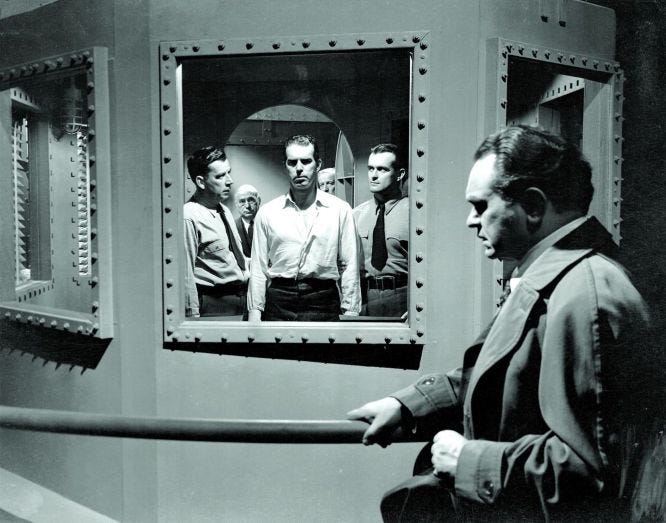
That is terrifically well-staged, but Wilder’s right; the movie doesn’t need the “death chamber” scene. It would have put too hard a stamp on the real betrayal in the movie; not Stanwyck and MacMurray turning on each other, but MacMurray counting on the genuine affection Robinson has for his colleague/protege. And Robinson already has the movie’s best line when MacMurray turns down the offer to be his partner/assistant in solving fraud: “I picked you for the job, not because I think you're so darned smart but because I thought you were a shade less dumb than the rest of the outfit. I guess I was wrong. You're not smarter, Walter, you're just a little taller.”
There’s a truth to that relationship, and a sense of hurt, that’s better than the cynicism of the lovers’ plot, and the kind of cynicism Wilder would display in later movies like Ace in the Hole and The Apartment. (Where MacMurray was even slimier than he is here; so much so that after the movie came out, one visitor to Disneyland started whomping on fellow visitor MacMurray with her purse.)
The cynicism in the later Wilder movies can be fun, to be sure, yet there’s something sour to it. It hadn’t soured all the way yet in 1944. Maybe the postwar experience of being one of the few filmmakers to oppose McCarthyite “loyalty oaths” in the movie industry was one of the things that soured Wilder on American life. (Robinson was staunchly against McCarthyism, too.) Wilder’s mother, grandmother, and stepfather were all killed during the Holocaust. He couldn’t have liked that the America which fought fascism had its own far-right undercurrents.
Speaking of the political right, Stanwyck was pretty conservative, as were many talented performers of the day; largely, they were bothered by New Deal-era taxes on high earners such as themselves. (With some fair, if self-centered, reasoning! A movie star or writer/director who makes a lot of money is only going to be making it for a short time, in many cases, and those high taxes on one year’s income don’t account for what are certainly the lean years to follow.) In fact, Stanwyck was so right-wing, she was an Ayn Rand superfan. Blech. She thought that since she came from poverty and got rich, anybody should be able to do it. Double blech! But she was generally well-liked on film sets for the way she treated the less-famous actors and the crew as human beings, so good for her.
(Incidentally, during her “up from poverty” years, Stanwyck worked as a chorus girl and sometime dance instructor in several NYC speakeasies owned by one Mary Louise Cecilia “Texas” Guinan; some of the speakeasies catered to gay customers. If the name Guinan as a bar-runner who accepts all sorts into her bar strikes certain TNG fans as a strange coincidence, it might not be a coincidence at all; the Whoopi Goldberg character might have been named after Texas Guinan. Media historian Carol Stabile has further details.)
One of the things which made Stanwyck appealing is how, when you look at her face, it’s not quite conventionally pretty the way that the identical starlets of the 1930s were. It’s still drop-dead-gorgeous by normal human standards, but by Hollywood standards, it’s almost a little plain. Which made her seem more human, less like a beauty bot. Her best role was probably as the con artist who goes after Henry Fonda’s nerdy Science Guy in The Lady Eve; she got to bring her warmth and humor and her sexiness to that one; you don’t blame Fonda at all for being a little overwhelmed.
The cinematography here’s by John F. Seitz, and one could probably point to it as the source of all the film noir cliches about sunlight entering smoke-filled rooms through the shutters. (Which Seitz and Wilder wanted to make the characters look like they were trapping themselves behind prison bars with their dastardly schemes.) Unlike many of the imitations that followed, here the angle of the light coming through the window at least makes SOME sense in most of the scenes; they’re often taking place early in the morning or late in the afternoon.2 (Seitz was considered a visual pioneer who helped invent/refine matte photography, among other things.) The musical score’s by Miklós Rózsa, and not as terrible as most of his were; Paramount music director Louis Lipstone thought it was better suited to something like The Battle of Russia.
This is about as good as “film noir” gets, and it’s not quite the genre it’s cracked up to be; I’ve met a great many pretty ladies in my life, and never one so irresistible I’d flat out kill somebody for them. Incidentally, the amount they’re murdering for would come to about $2.25 million in today’s money. That’s not a lot! Fred MacMurray looks around 35 here, he’s gonna live another 40 years or so, that’s less than $30,000 a year per murderer. A decent living but not exactly worth offing some hapless drab over. Now, if the husband was a real abusive monster, and we’re talking $22.5 million, well, that’s different! Of course, you’d want a pre-nup when you married the widow that neither party could ever spill the murder beans on the other. Which you could probably, actually, get, although I suppose the legal fees on that contract would cost a bit of major cash in itself.
Plus the Hays code itself makes these movies just that bit more ridiculous. A sight of ankle and a chaste kiss and you’re sensually enraptured? (Again, at age 35, which is a bit old for Penis First thinking…) I realize savvy audiences would have assumed the characters were boinking behind the scenes, yet still, MacMurray seems mighty hooked, mighty fast. And what’s with the cliche how every femme fatale has to be a backstabbing bimbo, too? Is that just the way writers like Cain and Chandler and Dashiel Hammett saw all women, as two-timing honey traps? Sometimes, in these movies, it sure feels that way.
Still, the stuff here with Robinson solving the case and MacMurray trying to stay one step ahead of him is fun. (And added by Wilder/Chandler to the story; it’s not a major subplot in the book, as I understand.) In a story like this one, you know the baddies are gonna get caught, you just want it to play out in a clever, entertaining way, and this does. More power to it! This is better than The Postman Always Rings Twice because in that one, you had two performers who were only semi-interesting to watch (and a lawyer, Hume Cronyn, who’s very fun to watch); here, all three leads are enjoyable. You may not buy the romance but you buy the sly skill of the acting. These three are having fun here; so’s Wilder, and so are you. Just don’t copy this as a murder plot in real life! Think up a better one.
It’s said that Wilder’s experience with Chandler is one of the reasons he became interested in filming The Lost Weekend, about a struggling alcoholic.
Some of the cityscape night scenes were actually filmed in Arizona, to comply with wartime Los Angeles blackout restrictions and such.