
The Sugarland Express
Spielberg's first feature does some things well; the story ain't one of 'em.

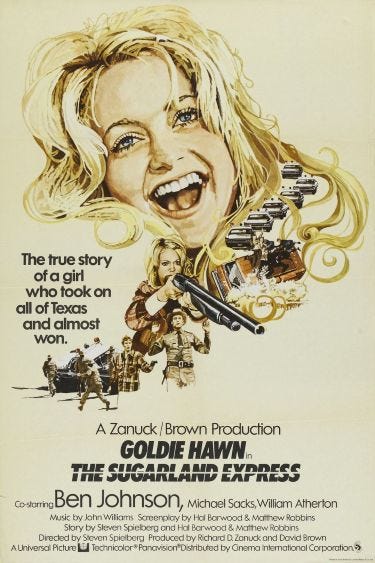
The Sugarland Express (1974). Grade: C+
Goldie Hawn’s been declared an “unfit mother” and lost custody of her kid; the kid’s been placed in a foster home. So, naturally, what’s the best way to get the kid back? Find a pro bono lawyer who can help with the case? That’s by no means easy, but it might be worth a shot.
Or, maybe, break your husband out of jail and set off to kidnap the toddler — in a stolen police car. While you’re holding the officer hostage. That’s by no means easy, but it might be worth making a movie about. Mayyyybe.
This was the first feature directed by the 26-year-old Steven Spielberg; he’d been working in television since 1969, having basically talked his way into getting Universal to give him a shot. He’d done episodes of Night Gallery and Columbo, and three made-for-TV movies; one, Duel, about a guy in a car getting chased by a crazed semi-truck driver for no reason, was well-received and got a theatrical release overseas.
So it was likely the success of car-chase-themed Duel which gave Universal the idea that Spielberg could make a bummer story featuring tons of cars into an entertaining movie. And the stuff with the cars IS entertaining, innovative work; nobody had shot patterns of vehicles this way before. Others have since, so it might not seem as impressive today. Including Spielberg himself; Close Encounters cribs a lot of shots from this movie. But that’s alright; there’s nothing wrong with plagiarizing yourself, especially if very few people saw the first time you did it.
Universal had planned originally to release this in a few cities at first, hoping for good reviews and word-of-mouth to build enthusiasm for a wider release. But they lost their nerve after a terrible preview showing, and so it was dumped into wide release without much fanfare and to little moviegoer interest. The reviews WERE mostly good, though. From the Amblin’ website (Spielberg’s own movie production company):
“‘The Sugarland Express certainly caught American film critics’ eyes, with Pauline Kael of The New Yorker declaring the film to be “...one of the most phenomenal debut films in the history of movies.” “Spielberg uses his gift in a very free-and-easy, American way—for humor, and for a physical response to action,” wrote Kael. “He could be that rarity among directors—a born entertainer—perhaps a new generation’s Howard Hawks.”’
Sure — but that’s omitting the following from Kael’s review: “I can’t tell if he [Spielberg] has any mind, or even a strong personality, but then a lot of good filmmakers have got by without being profound. He isn’t saying anything special in The Sugarland Express, but he has a knack for bringing out young actors, and a sense of composition and movement that almost any director might envy.”
I’d say that’s proven to be a pretty fair summation of what’s been good and bad in Spielberg’s career. Composition and movement were really his greatest gifts; being a Deep Thinker, not so much. His best dramatic movie, Schindler’s List, had at its soul solid material from the brilliant historical writer Thomas Keneally; the very-good Lincoln and Munich came from the work of skilled playwright Tony Kushner. Meanwhile, Spielberg just doesn’t seem to know when the material he’s working with is trash, like War of the Worlds or War Horse or the tepid script for The Post or sadistic one for Saving Private Ryan. But then a lot of good filmmakers have gotten by without knowing a good script from a lousy one (Howard Hawks certainly did his share of duds).
Also, I’ll add something that Kael didn’t pick up on, but seeing it now makes it obvious; it’s clear from Sugarland Express that Spielberg is incapable of showing any kind of romantic scenes whatsoever. I don’t mean sex scenes (as bad as the ones here and in Munich are); sex scenes are REALLY hard to pull off, and most of the time are a bad idea. But Spielberg can’t get into romance at all, period; the closest might be the two survivors paddling back to shore together at the end of Jaws.
That doesn’t hurt this story much, though. William Atherton is basically just following his wiener; Goldie Hawn straight-up tells him if he doesn’t go along with her harebrained plan, she’s never gonna jump his bones ever again. And Atherton, for whatever reason, says alright, sure, you fugged talked me into it.
This is loosely based on a real story that happened in Texas, in May of 1969, per TCM’s Frank Miller. An ex-con and his wife were pulled over for not dimming their high-beams as they drove past a cop; the couple fled into the woods, then robbed a nearby farmhouse. When a cop came to answer the farmhouse call, they kidnapped him in his own cop car. This began a sometimes high-speed chase that went for over 200 miles, lasted six hours, drew as many as 90 cop cars and media trucks into the mix, and did not end well for the couple.
Spielberg’s script was reworked by Hal Barwood and Matthew Robbins, and it varies a little from the real story in some small unimportant ways, then some much bigger and annoying ones. So, instead of it being an ex-con driving at night who makes a series of increasingly poor decisions, it’s Atherton in a pre-release minimum-security facility with four months left to go on his sentence. Then Hawn shags him into escaping and hitching a ride in the world’s crappiest car. When a cop pulls over the car for being a road safety hazard, they kidnap the cop. That’s not exactly the real story but it establishes that these people are not-so-bright, which seems close enough to the truth.
But then it throws in some real head-scratchers. The AFI Catalog site tells us that “the night spent in a motor home on a used car lot, the attack by vigilantes, and the couple’s purpose of regaining their child from a foster home were all fictional.”1 Well, anybody watching the movie had figured that out already. (The AFI site also has a big spoiler about the ending, which differs a little from the real-life ending; only click on it if you know the movie and are curious for more details.) The motor-home scene and the vigilante attacks make NO sense whatsoever. And how the heck does Goldie Hawn know the address of the foster home where her kid’s been placed? Even in Texas, they’re not gonna just give that information out. (The real life couple on the run were headed for the ex-con guy’s father-in-law’s house, because the father-in-law had the kid.)
There’s three (well, three and a half) major roles here, two are pretty darn good, and one will surprise you. I’m a “gimme the bad news first” sort of fellow, so we’ll start with that. Ben Johnson is the older, grizzled sheriff who becomes the main negotiator over the police radio; a veteran Western actor, Johnson is a bit wooden. Goldie Hawn got a lot of praise for this, since she’d only played dumb blonde parts before; I would rather see those. I don’t mind Hawn’s comic acting. But here, her character’s tiresome, and while Hawn commits to the part well enough (taking much less than her usual salary to do so, she was a popular actor), I don’t think there’s much anybody could have done with it. Maybe a young Diane Keaton, or Glenda Jackson doing an American accent? In any case, the character’s a vain, foolish idiot, and while Hawn doesn’t embarrass herself by trying to play this part as “lovably kooky,” she can’t make the woman any less irritating.
There’s a much more winning role for Michael Sacks as the kidnapped cop. It’s not the way any cop would actually behave, but Sacks makes the fellow likably laid-back and compassionate; he’s the main one you’re rooting to come out of this unscathed.2 The real surprise is William Atherton as Hawn’s husband; because movie fans from the 80s will remember Atherton as “this man has no d**k” from Ghostbusters and the horrible TV reporter from Die Hard. He’s got one of the toughest jobs any actor can ever have, and that’s to play a pretty dense fellow sympathetically, without trying to show the audience that you’re “acting” dumb, you aren’t really dumb. Atherton guts it out. He makes you feel bad for the guy; even if he really is doing a dumb thing, he’s doing it for understandable reasons. He loves Hawn and doesn’t want to lose her.
The cinematography’s by the talented Vilmos Zsigmond, and makes fine use of existing light; the end shots are a bit cliched, but damn if they’re not pretty and they really do work. The score’s by John Williams (of course!), and while his use of harmonica might make you want to slap the guy, the quiet moments are fine. (And don’t slap John Williams! He’s 94!)
In a pretty funny “behind-the scenes” story, Frank Miller tells us that “producer Richard D. Zanuck instructed the production manager to start the film with relatively simple shots. He also decided to get to the location late that morning so that Spielberg could establish control of the set. When he arrived, however, he discovered the director had set up one of the film's most complicated shots, which he pulled off just fine.” Well, the kid did have a knack for moviemaking. And no doubt that’s why Zanuck went right ahead and assigned Spielberg to Jaws despite the relative financial failure of this one, and while that shoot had its share of troubles, the movie did pretty well, I hear.
This is a fine directing debut and a watchable movie, if the added-on plot implausibilities might completely throw you out of the story (they sort of did for me); the energy of the whole project still keeps your attention. The main reason for seeing this is to take a look at what young Spielberg was already capable of doing (in both the good sense and the disappointing one). And to see William Atherton as a sympathetic character; he was pretty good at it. It’s too bad he was eventually typecast as a sniveling baddie; I think he’d have been a fine character actor.
Incidentally, under the “Personal life” section of Atherton’s Wiki page, it says: “Atherton has been married to writer Bobbi Goldin since December 8, 1980. On The Phil Donahue Show in 1981, Atherton claimed that he was once homosexual but changed due to the Aesthetic Realism of Eli Siegel.”
Well, that’s certainly his business, and you always wanna congratulate a long marriage, and people can date and love different kinds of other people, all things are possible with humans. Although the next part of the Wiki page says: “‘Atherton has sung in various productions in later years. In 2011, he performed “I Remember It Well,” a popular song from Gigi with his former Reprise Theater co-star, Millicent Martin, at a sold-out performance in Palm Springs for Michael Childers's One Night Only, benefiting the Jewish Family Service of the Desert. He returned in 2013 to the same sold-out event to sing the classic, “Isn't It Romantic?’”
So what, he loves belting the showtunes. That doesn’t make ya gay. Although, man… Gigi? That’s… um, that’s a bad musical. But “Isn’t it Romantic” is a good tune. So it all evens out.
There’s a ending “what happened a year later” scrawl which seems really improbable; it DID actually happen.
Sacks retired from acting in 1984 and became an expert in using computers to make high-speed international stock/bond trades. So he shoulda stuck with acting! But it’s no fun, I’m sure, if Hollywood won’t give you any fun roles.