
Die Hard
Best of the 80s action-ers, with all the good/bad that implies.

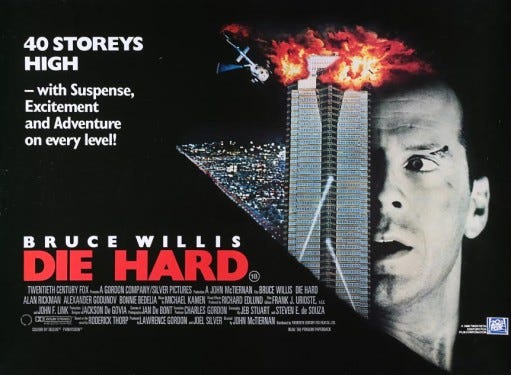
Die Hard (1988). Grade: B-
So, did you join in the internet debates about whether or not Die Hard qualifies as a Christmas movie? Did you have strong opinions, one way or the other?
Thanks for ruining the world. I’m not entirely joking.
It’s stupid, pointless, idiotic internet “debates” like this one which got us where we are today. To a large degree, it really is. And of course the Die Hard Christmas question wasn’t the first one, or the biggest one, or the most annoying one (my candidate for most annoying was that bit of nonsense about whether a dress was blue or gold, or whatever the color options were).
What all these debates had in common was in showing, and solidifying, the power of “social media” to dominate so much of the internet and of our lives. Friends would absolutely insist that you had opinions on these matters and demand that you share them and that these opinions said something about who you were. Not, you know, your opinion on universal Medicare For All, or any other kind of concrete proposal by an ever-more-ineffectual American left wing, any ideas which could halt the rise of authoritarianism.
It was the internet as a means of permanent distraction and pointless division, and it’s ruined America for the rest of my lifetime, and plenty of other places, too.
Here’s a typical article (from 2017) on the stupid Christmas debate (where Bruce Willis is quoted as saying he doesn’t think it’s a Christmas movie, it’s a “Bruce Willis movie”). In 2017! Was there NOTHING ELSE worth being concerned over in 2017?
Frankly, I don’t give five sh**s if you think of Die Hard as a Christmas movie or not. It doesn’t fu**ing matter. For years, there was some cable channel that ran the two Godfather films at Christmas, and I think it’s a great time to watch them. They both have winter scenes, and Christmas presents, and families with bottled-up dysfunctional resentments that explode in searing arguments, so they’re perfect!
If there’s any reason Die Hard wouldn’t be thought of as a Christmas movie, it’s just because it takes place in Los Angeles, and to me, a Christmas movie should have winter scenes in it. L.A. doesn’t really have winter, not in terms of bare tree branches and snow.
But then again, if you’re from L.A., or Florida, or most of Mexico or Australia or anyplace else warm, your Christmas memories might not be tied to snow or bare branches at all. So I guess Die Hard being in a warm-weather spot still works!
I’m not gonna run down the plot, since I assume you all know it; it’s, basically, every other James Bond movie (escaping from the evil bad guy’s fortress) combined with The Towering Inferno. In the case of Inferno, that’s the literal truth. Book author Roderick Thorpe fell asleep after watching Towering Inferno on TV; he had a dream about a man being chased by armed baddies in a skyscraper. So Thorpe wrote Nothing Lasts Forever, a sequel to his 1966 book The Detective, which had been made into a 1968 movie starring Frank Sinatra as a police detective. In the book, he’s a private detective, so Thorpe changed the character to a retired cop; he was hoping Sinatra would be in the sequel.
The movie The Detective had been a big success, with a script by Abbie Mann (who usually worked with Stanley Kramer on “social issues” movies like Inherit the Wind). Sample plot point, from Wiki: “New York City police detective Joe Leland is called to the home of a murder victim who has been beaten to death, head crushed, and has had his penis removed.” Perfect for Ol’ Blue Eyes!
From the Wiki page on Nothing Lasts Forever, it’s surprising just how much of the movie Die Hard came directly from the book. The hero taking off his shoes to relax after a plane flight, then being forced to walk on broken glass. The hero crawling through air ducts. Dropping a C4 bomb down an elevator shaft. Jumping off a roof holding a fire hose, and shooting the window to get in. Taping a gun to his back to hide it. Even the scene where a sleazy exec tells the bad guys he knows the hero, and can get him to surrender, then getting shot.
Except in the book, the hero is visiting his daughter, not his wife, and the exec IS dating her, and the daughter dies at the end. But it does all happen during Christmas season. The movie version kept the Christmas setting for plot reasons — it’s a good excuse for why there isn’t anybody else in the building.
If you’d like to know more about the similarities to the book, this Variety article has you covered. It’s basically a lesson about how to turn a trash novel into a movie, and features an inspiring story where writer Jeb Stuart, having nearly missed a freeway collision after having a fight with his wife, decided the movie’s character should be a younger guy trying to save his marriage, rather than a retired guy visiting his daughter. OK. Brilliant. I would think you’d want a younger guy, anyways… if you’re going to keep the jumps-off-roof-with-fire-hose-shoots-window-to-get-back-in scene. Should ideally be somebody under 60.
While Fox owned the book rights, Sinatra still had a piece of it via contract rules, so they had to offer him the role first (in 1987!). He declined. So did James Caan, Clint Eastwood, Harrison Ford, Richard Gere, Mel Gibson, Don Johnson, Paul Newman, Al Pacino, Arnold Schwartzenegger, and Richard Dean Anderson (TV’s MacGyver). That’s one of those things where people like to say “oh, they were so stupid,” but think of what action movies were really popular at the time? Chuck Norris and Schwartzenegger movies, which were exceedingly violent and usually exceedingly dumb, and that’s the kind of thing which can typecast an actor for life. And you can say, “well, they should have seen that the script was great,” but it WASN’T great. It’s barely serviceable. The best role was for a foreign actor, anyways. (Alan Rickman got it after someone saw him in a stage production of Les Liasons Dangereuses.)
Bruce Willis had a hit show on TV with Moonlighting, and the “witty repartee banter” which made the show popular (between Willis and co-star Cyril Shepard) was… not to everyone’s tastes. Certainly not mine. I remember complaining about Willis on Moonlighting to my theater professor at school (one of the real heroes, a great and kindly teacher), and he told me he didn’t like the show either… but when he lived in New York, he’d seen Willis in an amateur theater production, and Willis was amazing. So, maybe the guy had some real acting chops, underneath the smirk and the snark?
It’s something director John McTiernan (fresh off Predator) noted when he was hired for the movie. He recalled later, “On a little screen with low resolution, Bruce’s smart-aleck stuff was funny. But, when you could really see him on a big screen with high resolution, you could see his eyes. You could really see his face. It was offensive. He was doing his stock TV character. That had failed essentially because he came across unlikable, a pain in the ass.” And Willis DOES tone it down in the move (although he’d tone it right back up in stuff like Hudson Hawk and The Last Boy Scout; then back down again in 12 Monkeys and The Sixth Sense. I like the toned-down version much more).
McTiernan also changed the bad guys from terrorists with a political agenda (which they are in the book) to robbers, and made the Willis character more of a working-class guy. In the script, he rode in a fancy limo because he was a fancy dude; in the movie, he’s never ridden in a limo before.
There’s a million more production details over at Wiki — for Pete’s sakes, you’d think this movie was the friggin’ invention of cinema for how much has been written about it. I waded through most of the source articles for you, and didn’t find much I thought was interesting. But if you really NEED to know that there’s different opinions on whose idea it was to cast Reginald VelJohnson as the friendly cop instead of Robert Duvall or Lawrence Fishburne, you can read that, or how some people say Bruce Willis cast Bonnie Bedalia and he says he didn’t, you can read that.
I will link to an article by Empire’s James Dyer that’s a whole scene-by-scene viewing guide, and it’s very well done, superfans of the film should check it out. The details I found interesting (because I’m a geek) are the musical ones. The scene where VelJohnson saves the day doesn’t use the Michael Kamen score; it recycles some of James Horner’s score from Aliens. I knew I heard Horner in there! And in Aliens Horner was recycling his own bit from Star Trek III where the Enterprise breaks out of spacedock. Also on the music; it was McTiernan’s idea to use the “Ode To Joy” theme from Beethoven’s 9th; Kamen hated the notion. Well, it’s the best music in the movie! Kamen was a terrible friggin’ composer who redid the same hacky action crap he did in the Lethal Weapon movies.
Another thing that’s borrowed from those movies… or, really, just from 1980s action movies in general. The incredibly annoying bad guys. Not Rickman; he’s evil, but he’s a delight. I mean like William Atherton as the world’s sleaziest reporter not named Geraldo (screenwriter Jeb Stuart’s idea, since he hated journalism students in college) or Hart Bochner as a pervy coke freak (somewhat in the book, but producer Joel Silver’s idea to ramp up the unlikability). And then the LAPD deputy chief (Paul Gleason of The Breakfast Club) and the FBI (Robert Davi and Grand L. Bush, both of whom would be in License to Kill) are utter incompetent nitwits. The movie isn’t making fun of how their macho egotism ruins everything (that would be funny); it’s simply taking a Reagan-era position that government, and the press, and the rules, are all idiotic things getting in the way of the good guy with the gun who’s gonna solve everything.1
Guess who wrote “‘Our “elites” are like the feckless drug-addled businessmen at Nakatomi Plaza, looking down on Bruce Willis’ John McClane in Die Hard. But there will come a day when they realize they need John McClane — that in fact their ability to live in peace and prosperity has always depended on guys like him being honorable, powerful, and deadly.’” Give ya a hint! That writer's now the Secretary of Defense, and used to throw axes (badly) on Fox News!
(Oh, and on the Reagan-era comparison? Guess who got a new office into the Fox building in Century City (where much of this movie was shot) right after filming completed? Well, the 40th President himself! Yep, as soon as shooting on the movie finished, Reagan’s staff started preparing the office Ronnie would use after leaving D.C. in January.)
Most of the stuff with the dumb, unlikable baddies and Willis out-hero-ing them all is really kind of a drag (Roger Ebert thought so in 1988, Richard Brody of The New Yorker thought so in 2017, Mrs. twinsbrewer thought so in 2025). This kind of thing in a movie (and it was really common in the era, and still gets used today) is there for one reason; it’s to get the audience feeling sadistic. It’s to get you cheering for baddies to get what’s coming to them. If you can poke a sharp stick through your frontal lobe and enjoy the crafty action parts, it’s enjoyable. But you are definitely being manipulated to want the annoying folks to get it, and to forgive anything that good guy lone wolf Willis is willing to do.
Here’s a counterpoint. My mom worked at 9-1-1 for almost 20 years, and she said she HATED the influence of the movie Die Hard upon cops. How after watching this movie, way too many cops saw themselves as freewheeling Bruce Willis, saving the day, when all they were doing was putting themselves and their colleagues and the public in extra danger.
Actually, my mom could never make it all the way through Die Hard for another reason; people interrupting each other on the walkie-talkies. If you’re using short-wave radio, and for 9-1-1 she did, when you’re talking, you can’t hear anything. When you press that talk button, the speaker turns off. Most people have never used short-wave radio, so it’s not a big script problem; it’s just that, once you look for the interrupting, you will see it happen in this movie, over and over and over and over…
What makes the film entertaining, despite the strikes against it, are Rickman’s performance and the crack action direction by McTiernan. (Of course cinematographer Jan de Bont deserves credit for the camerawork as well, yet when de Bont directed his Twister the action scenes were terrible, so I think we can give more credit to McTiernan here.) McTiernan’s gift, in this and in The Hunt For Red October, is to give you a good sense of exactly what’s happening in any action scene, where the threat(s) are coming from, the obstacles our protagonists have to escaping/defeating those threats. You’ve got a spatial awareness of where everything is. It makes the scenes 100 times more dynamic and exciting than simply using shaky cameras and fast cutting to jazz up the tension level.
McTiernan’s skills are needed here, because, with a few exceptions, most of the action scenes are stupid. Like Willis falling down a shaft and magically grabbing a ledge to stop his fall. Like most of the punch-out scenes. And most of the gunfire scenes, as well (often the baddies, shown to be hyper-competent in all aspects of the robbery, are shooting basically in each others’ direction.) But McTiernan keeps them humming along anyways. And with the big setpiece at the end (the roof scene), he’s really terrific, even if the stuff with the helicopter and the roof exploding are all way too much; the way it’s all shot and edited is dazzling. (Credit to Frank J. Urioste and John F. Link for the editing.)
While Rickman in this is just… he’s just… well, you know how great he is. I don’t believe that a super-robber from Germany would simply happen to be a really good actor at playing a scared American when he had to, do you? But it’s an inspired little bit of cowering. Almost everything he does here is inspired (as it was in Galaxy Quest), from the bizarre Eurotrash accent to the way he can go from soft-voice to snarling, and of course the way he mutters “ho… ho… ho.”
And while his character’s a psychopath, he’s not completely classless! When Bonnie Bedalia (badly underused here) negotiates with Rickman to treat the hostages a little more fairly, he’s actually listening to her. And then the way Rickman gets to be triumphant when his robbery plan works out (very implausibly) and the Beethoven strains come on is actually quite fun.
The movie’s had a big influence on several directors since, some decent (Darren Aronofsky, Dan Trachtenberg), most lousy. And none seems to have learned the best lesson one could learn from this movie, which is a stylistic lesson about the way you should shoot action sequences. By making the action perfectly clear to the audience. It seems to be a lost art, these days (and it’s one few directors ever managed in the first place).
When you read an interview with McTiernan, he sounds like a thoughtful, considerate fellow, so it’s a puzzler to me why he did so many terrible movies after Red October, and was involved with so many terrible-sounding other projects that fortunately fell through. Although, when you look at the list of movies which fell through, there were some more intriguing ideas at the beginning; the later ones got worse and worse. Maybe after having good ideas shot down, his standards went down as well. Who knows.
In any case, this is the one 1980s action movie that isn’t entirely an insult to the intelligence of the audience (well, this and RoboCop, but that’s different, that one’s satire). The robbers’ “plan” is implausible as hell, but it’s fun to see it play out. The action scenes are dumb as hell, but they’re smashingly filmed. And the movie introduced Alan Rickman to American audiences, and for that, I will always be grateful.
But I’m still gonna blame you “Christmas movie” internet debaters for ruining the world. You really shouldn’t have done that.
William Atherton also played a Mean Gummint Official stopping the Good Guys with Zappy Guns in Ghostbusters.
One of my all-time favorites!
I agree that the "is it a Christmas movie?" angle is WAY overplayed! For me, it just so happens to be such a good movie and tangentially set around the holiday that each December provides a great opportunity to watch it again!
I really like Willis' performance. He perfectly embodies the smirky, cock-sure New York detective/cop. I love the scene at the very beginning where he gets off the plane and sees the blonde woman in the skin-tight pants jump into the arms of her boyfriend/husband/whatever. He mutters "California" in a derogatory yet somehow also comical tone under his breath. That instantly makes him a relatable character to many audiences.
Of the Planet Hollywood gang--Bruce, Sly, & Arnie--I think Willis is the best pure actor for roles like this and The Sixth Sense.