
The Manchurian Candidate
Extremely fun conspiracy political thriller, lots of surprises.

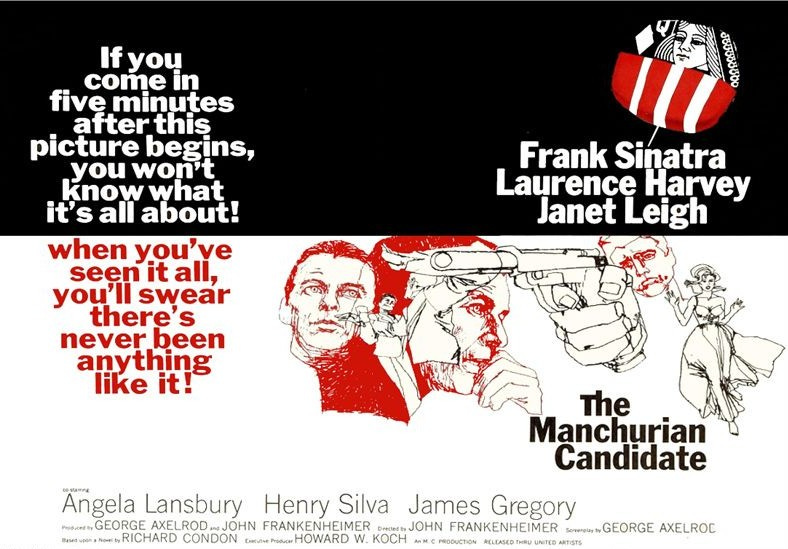
The Manchurian Candidate (1962). Grade: B
Alright, since the story is about secret conspiracy plots, is there a hidden EXTRA secret conspiracy plot in the movie? One which sits right under our noses, and casual viewers might miss?
Roger Ebert thought there might be. In an interview included on the Criterion disc, the brilliant filmmaker Errol Morris says he wonders if there might be.
What conspiracy is this? Lemme explain.
Frank Sinatra plays a Korean War vet who keeps having horrible nightmares about an experience in Korea. Not one he can remember when awake; he can only access this memory in his nightmares. When awake, when conscious, he remembers that his commander, Laurence Harvey, was the bravest, kindest, warmest, most wonderful human being he’s ever known in his life. One who single-handedly saved almost his whole unit, minus two soldiers killed by a stray enemy mortal shell. You can’t save everyone.
But we in the audience know this is fake; we know Sinatra’s nightmares are showing what REALLY happened. Because another veteran, James Edwards, has been having a version of the same nightmare.
In the nightmare — in what really happened — Laurence Harvey didn’t save anyone. The whole unit was captured by the enemy, taken deep into China, and hypnotized/brainwashed. (This isn’t a spoiler, it’s shown in the movie’s first 15 minutes.) Then the soldiers had a fake memory of Harvey’s heroism planted in their heads; then they were returned to the place they were captured. The (fake) story of Harvey’s heroism, repeated by the whole unit (since they’ve all been brainwashed), wins Harvey the Medal of Honor.
Except now, Harvey’s got a brainwashing trigger mechanism stuck in his head. If anybody says to him, “why don’t you pass the time by playing a little solitaire?”, he becomes zombified. At which point you can give him any order, and he’ll follow it calmly and blindly.
The evil Commies have the perfect assassin on their hands. One who can never trip himself up by making a sloppy attempt to cover his tracks; since he won’t remember committing the assassination at all. As his evil Commie handler puts it, “relieved of those uniquely American symptoms, guilt and fear, he cannot possibly give himself away.”
(Uniquely American? This evil Commie hasn’t read Crime and Punishment.)
Now, neither Sinatra nor any of the other veterans having these nightmares know that Harvey’s been programmed with trigger words to make him a zombie assassin. We in the audience have seen that part in real time, not in a nightmare dream sequence.
So, have any of the other soldiers from the unit been programmed with zombifying trigger words?
Ebert and Morris thought that maybe Sinatra’d been programmed. And that maybe Janet Leigh activated the trigger words. BECAUSE…
At one point, Sinatra’s on a train to NYC. He’s gonna look up Harvey and tell him about the nightmares. But he’s really upset on the train, he’s shaking, the nightmares have gotten to him that much. He can’t even hold a match steady enough to light his cigarette.
Janet Leigh, a fellow passenger who doesn’t know Sinatra, notices how shaky he is. So she lights a cigarette for him. Then begins a really, really strange passage of dialogue.
LEIGH: Maryland's a beautiful state.
SINATRA: This is Delaware.
LEIGH: I know. I was one of the original Chinese workmen who laid the track on this stretch.
[China! Is this a hint about who she’s working for???]
LEIGH: But, um, nonetheless, Maryland is a beautiful state. So is Ohio, for that matter.
[Why the conversational jump to Ohio?]
SINATRA: I guess so. Columbus is a tremendous football town. You in the railroad business?
[Wait, why would he mention railroads?]
LEIGH: Not anymore. However, if you will permit me to point out, when you ask that question, you really should say, “Are you in the railroad line?” Where's your home?
SINATRA: I'm in the Army. I’m a major. I’ve been in the Army most of my life. We move a good deal. I was born in New Hampshire.
LEIGH: I went to a girls’ camp once on Lake Francis.
SINATRA: That’s pretty far north.
LEIGH: Yeah.
SINATRA: What's your name?
LEIGH: Eugenie.
SINATRA: Pardon?
LEIGH: No kidding. I really mean it. Crazy French pronunciation and all.
SINATRA: It’s pretty.
LEIGH: Well, thank you.
SINATRA: I guess your friends call you Jennie?
LEIGH: Not yet, they haven’t, for which I am deeply grateful. But you may call me Jennie.
SINATRA: What do your friends call you?
LEIGH: Rosie.
SINATRA: Why?
LEIGH: My full name is Eugenie Rose. Of the two names, I’ve always favored Rosie because it smells of brown soap and beer. Eugenie is somehow more fragile.
SINATRA: Still, when I asked you what your name was, you said it was Eugenie.
LEIGH: It’s quite possible I was feeling more or less fragile at that instant.
SINATRA: I could never figure out what that phrase meant, “more or less.” Are you Arabic?
[Where’d “are you Arabic” come from? Musing over “more or less,” since Arabs invented algebra?]
LEIGH: No.
SINATRA: My name is Ben. It’s really Bennett. I was named after Arnold Bennett.
LEIGH: The writer?
SINATRA: No. A lieutenant colonel. He was my father’s commanding officer at the time.
LEIGH: What’s your last name?
SINATRA: Marco. Major Marco.
LEIGH: Are you Arabic?
SINATRA: No.
[Arabic again!]
So, what Ebert and Morris guess is that this dialogue is so bizarre and non-sequitur because it shows Leigh using Sinatra’s trigger words, and him responding as programmed. Since, immediately after meeting him, she helps bail him outta jail after he’s arrested for assault, and dumps her fiancee to be with Sinatra forever (or until he dumps her for a younger model, something the real-life Sinatra tended to do).
The problem with this theory is that nothing Sinatra does over the rest of the movie would indicate he’s under Commie control. In fact, he’s key to defusing the Commies’ fiendish plot. (Spoiler alert this time: the evil Commies do not win and take over America.)
Now I just assumed that the scene was some tacky “love story” thrown onto the plot, and that screenwriter George Axelrod (who adapted the 1959 Richard Condon novel) was just fugging terrible at romantic banter. Axelrod wrote The Seven Year Itch and How to Murder Your Wife, both movies which assume how any male who’s been monogamous for a few years is bored and henpecked and never gets any, so we’ll just say Axelrod’s idea of romantic dialogue isn’t mine.
Then, poking around online, I found this comment by JMCJ on a message board from 2000:
(And, side note: Remember when the internet was message boards and blog comments? Not algorithm-driven lies shoved in the faces of gullible idiots all the time? That was less bad than now. Anyways, the comment…)
If I was informed correctly, Leigh’s role was added in at the very last minute. After a first screening of the movie, the studio executives insisted that it just wouldn’t be a success (read: make a lot of money) unless there was a love interest for Frank Sinatra.
The writer, horrified at the idea of having to dilute his masterpiece in order to accommodate the greed of the execs, wrote the worst possible love scenes he could. All of the conversation between Sinatra and Leigh was non-sensical and non-sequitorish (“Are you Arabic?” being one of my favorites). The writer’s hope was that the love scenes would be so bad that the execs would insist they be cut, but because the filming had run over-long (given the new scenes and old scenes to be re-filmed), the execs would just release it without the romance plot.
The execs did hate the romance plot, but decided even a stupid, non-sensical romance was better than none at all, and there wasn’t enough time left to write a better one, so the movie was released with all of the idiotic scenes intact.
That’s what I remember hearing; of course, that could just be urban legend and misinformation.
Now, one hears stories like this all the time if one’s ever lived in Los Angeles and known movie geeks there. Or if you’ve known people adjacent to such people. Hollywood Rumors circulate; some of them are actually, certifiably, things which happened. Others are things which sound very plausible, and so it’s quite possible they happened; this story falls into that category, and I’d be inclined to maybe buy it… if I didn’t also already think that George Axelrod wrote bad romantic dialogue.
Well, neither my theory or JMCJ’s are correct. Axelrod didn’t write this, not badly on purpose or badly because he’s bad at romance. The original book author, Richard Condon, wrote it. You can read it right here from Internet Archive. All Axelrod did was shorten the passage a little. The rest, non-sequiturs and all, is straight from the novel. (I did not read the rest of the novel. The parts I saw looking for this scene did not made me thirsty to read more.)
In fact, it seems like the whole “are you Arabic” thing is just that the Sinatra character (in the book) is somebody with a really wide range of interests, one of those being Arabic history and culture. (In the movie this is shown as his reading a lot of different stuff because he’s half-loony.)
So, I think the passage from the original book shoots down Ebert’s/Morris’s theories about Leigh using trigger words to hypnotize Sinatra. It just seems that way, a little, in the movie (and Mrs. twinsbrewer thought that scene was mighty odd, too). I don’t think it’s an intentional extra meaning, at all. (If anything, it’s a scene where Leigh, a good actor, is trying her best to cover up for the fact that she has zero chemistry with Sinatra; these two just don’t click romantically, although they’re supposed to, so Leigh’s doing her damndest to force it.)
So hey, we’re only 1600 words into what’s supposed to be a movie criticism site (or whatever this fugging blog is) and I’ve gone off on a theory about the movie which isn’t correct! Anything about the movie itself to add?
Sure. And if you wanna read straight movie sites, there’s always the “reviews” tab on Rotten Tomatoes.
Historian Susan Carruthers provides some interesting historical background in a feature on the Criterion disc. During the Korean War, a large number of American POWs cooperated quite freely with their captors, giving them some information that might have assisted the enemy side militarily, or participating in radio broadcasts condemning U.S. military behavior.
Some of this happened in every war, of course, but the numbers of soldiers willing to cooperate freaked out the U.S. military. What had caused it? (There were several causes, such as psychological and physical abuse.) Furthermore, after the war ended, several captured U.S. soldiers chose to stay in North Korea. (Most were from deeply impoverished backgrounds, and most did return to the U.S. within a decade.)
So the idea of “brainwashing” started floating around — the notion that cooperating POWs, or the ones who chose to try out life in North Korea, had been mind-zapped by their captors. (And that the Commies in China had, essentially, brainwashed the entire population, which is why the country went Communist.) Mainstream psychologists repeatedly pointed out that you couldn’t actually, permanently alter anyone’s thinking against their will… but the idea became widespread among the American public. Brainwashing was real, and the Commies could do it to anyone they got their hands on. The victims wouldn’t even know they’d been brainwashed.1
(America had its own secret military program, MKUltra, which attempted to use drugs and psychological manipulation to “control minds.” It ran from 1953 to 1973, when it was discontinued for lack of results. Some of the people subjected to this treatment were volunteers. Some, tragically, weren’t. Errol Morris has looked a LOT into this.)
Meanwhile, an oafish fool of a Senator from Wisconsin, Joseph McCarthy, had gained massive national attention by claiming there were hordes of secret Communist agents in government, in the military, in Hollywood, etc.2 This idiocy was widely-believed by many, since America has always had its fair share of morons. But, eventually, even some of the morons started to see what a lying, incoherent fraud McCarthy was; “McCarthyism” was largely discredited, except for some kooks in the John Birch Society and fringe elements like that. (It would return with a vengeance later.)
The disgrace of McCarthy worried some more serious American right-wingers. They felt that McCarthy’s boorish idiocy was distracting people from the REAL spies in our midst. (Which, sure, the Soviets had some spies here, like we had some there, but there was no way Soviet spies could overthrow the U.S. government or anything serious like that.) The worried right-wingers thought that, if McCarthy had been a Communist agent himself (he wasn't), he couldn’t have done any better at making vigilant anti-Commies like themselves look like idiots.
So in that atmosphere, the Richard Condon book, The Manchurian Candidate, appears in 1959. (It’s about brainwashing, and has an oafish McCarthy-type character.) Screenwriter George Axelrod and director John Frankenheimer liked the book and wanted to film it; Frank Sinatra liked their script and agreed to be the star, which was enough to get United Artists to fund the thing.
The movie’s first half is mostly about Sinatra’s attempts to find out the source of his brainwashing nightmares. We in the audience know the truth, that those nightmares are real, suppressed memories; Sinatra gradually puts the pieces all together. The second half of the movie is largely a series of twist plot developments. We start to learn more about the secret Communist plot (we knew they had a plot, but we didn’t know what it was, exactly), who’s involved, and the lengths they’ll go to in order to pull everything off.
I wrote about Les Diaboliques that it was a movie you can still enjoy, even once you know what the secret surprise ending is gonna be; it’s directed and acted so superbly, you can appreciate the craftwork of the setup. That’s not quite the case with Manchurian Candidate; it’s still good on repeat viewing, yet it lacks the excitement of all those surprises.
The most impressive sequences are in the first half, and come from Frankenheimer’s experience in live dramatic TV (usually hour-long broadcasts; Rod Serling wrote a lot TV). In live TV, you might switch from one set to another, and then have studio hands quickly rearrange the first set to look like a different location; then you’d switch back to the first set, and studio hands would rearrange the second one, etc.
The best sequences play like this. In one shot, we’re shown Sinatra/Harvey’s unit listening to a boring prissy lady give a lecture on birdwatching to a rapt audience of other boring prissy ladies; as the camera pans around, we eventually see the audience change from a room of boring prissy ladies to a group of Communist military observers, and the lecturer change into a bald Chinese man with a evil villain mustache. (The prissy ladies are what the soldiers are brainwashed into thinking is reality; the evil Commies are the actual reality.) It’s a live-TV type of trick, and it’s a joy to watch. (It’s also funny at times; a neat joke is, depending on who’s having the memory, the appearance of the prissy ladies changes.)
There’s another where Sinatra is a press assistant to a high-ranking Army official. As the official’s giving the press conference, our McCarthy-ish character stands up and accuses the official of covering up all the Commie spies in the Army. We’re not just seeing the two yell back and forth; we’re also watching the event as shown on the monitors of the live TV cameras covering the chaos. Again, this is staged terrifically well; you’ll enjoy watching it even if you’ve seen the movie several times. And the very climax, at a televised live event, has some neat little touches added to heighten the tension. (We’re cued to await a certain passage in a prepared speech, and the movie adds things like having the character start coughing right before he gets to the key words.) The scene where Sinatra’s looking at different photographs to try and identify the baddies is nicely-done.
The straightforward expositionary stuff isn’t handled with the same flair, and doesn’t have the same interest. (The way Sinatra accidentally finds out about Harvey’s brainwashing defies all probability logic.) The love stories are pretty drecky. Harvey’s mooning over pretty Leslie Parrish feels like it’s right out of a dopey MGM musical (without any cool musical numbers). Janet Leigh seems way too mature and intelligent to fall for the “broken guy only I can fix him” plot device. (Jamie Lee Curtis is Leigh's and Tony Curtis’s daughter; you can see that Curtis’s intelligence comes from her mom’s side. Incidentally, Curtis served Leigh with divorce papers during this shoot, and she still managed to keep her cool.) Some of Axelrod’s dialogue is really clunky as hell, although that may come from the book, given how directly the train scene does.
Sinatra is, I guess, earnest; you kinda wish it had been Edward O’Brien instead, but what can you do. (O’Brien at least probably wouldn’t have tried to do a “karate fight” the dopey way that Sinatra does here.) Harvey is simply out of his range in the lovey-dovey sequences, or when he’s drunkenly moping; he’s much better when he’s being a pompous prig, and his calm hypnotized voice is a neat one. Khigh Dhiegh is a good deal of fun as the bald Commie baddie, and so is the uncredited Joe Adams as a sharp Army psychiatrist. (For a movie where a lot of the bad guys are Asian, it's a wise touch to also show smart good guys of color.) James Gregory is convincingly dippy as the McCarthy-type Senator.
The real star of the show is Angela Lansbury as Harvey’s domineering mother (only three years older than him, she’s go good at being a Mean Mom that you don’t question the age gap, and her Far Side-type hairdo helps as well). This character’s motivated by the seething rage she has over playing a posh political wife; but it’s not feminist rage, she’s no Betty Freidan! She’s fine with her role for the idiot public; but political movers and shakers better know she means business. In her finest (and funniest) moment, she vows revenge on those who “so contemptuously underestimated me.” Lansbury never got the film roles she deserved when she was younger (perhaps because she always looked so much younger than her age), but she was highly-regarded for her stage performances. And people sure noticed her in this movie.
There’s some mystery over why the film essentially disappeared between its release in 1962 and re-release in 1988. On a Criterion interview, Lansbury says it’s because Sinatra took it out of circulation. The movie does involve political assassination, and Sinatra was a huge Kennedy supporter; supposedly, after the killing of Kennedy, the thought of this movie pained him. But Michael Schlesinger, who was in charge of the 1988 re-release, said it was simply because the deal for the original royalty rights ticked Sinatra off; by 1988, he’d stopped being pissed about it. It certainly caused a sensation among cinema buffs in 1988; coming right as the Reagan administration was lying its butts off over the Iran-Contra scandal.
If you’ve never seen this, you absolutely should do so; you’ll have a fantastic time. Despite the corny love plots, which don’t take up TOO much time, the various surprises will really delight you. And despite all the heavy political background going on at the time, what happens in this movie is too preposterous to be taken seriously; it’s not a heavy political drama like The Best Man. There’s some very clever visual jokes, and the depth of Lansbury’s nastiness is terrific fun.
If you have seen it, you’d likely still enjoy it… just not quite as much as the first time. And hey, you can always test out that “train scene sleeper agent” theory and see if it works for you. I mean, it’s pretty certainly not the case, but if something makes a movie more fun to watch, then roll with it.
The term “brainwashing” was coined by one Edward Hunter, a journalist for the Miami News, who later published a book, Brain-Washing in Red China: The Calculated Destruction of Men's Minds. Neither Hunter’s Miami News articles on the subject nor his book mentioned that Hunter was a C.I.A. agent.
Incidentally, guess who considered running for the Senate from Wisconsin in 1946, the year McCarthy was first elected? Kenosha’s own Orson Welles. He was convinced not to run because he was divorced, and an actor. By 1964 Ronald Reagan was already becoming a force in American politics, with his fearmongering that Medicare would lead to a Communist takeover. Reagan was divorced, and an actor.
Somewhat oddly, I've never seen this one but HAVE seen the 2004 remake. Great cast in that one: Denzel Washington, Liev Schrieber, Jeffrey Wright, & Meryl Streep. But I remember thinking it was "just okay" and that seemed to be the general critical consensus as well. Not as good as this Sinatra/Lansbury/Leigh original.