
The Dead Zone
Cronenberg and Walken's solid take on Stephen King's novel.

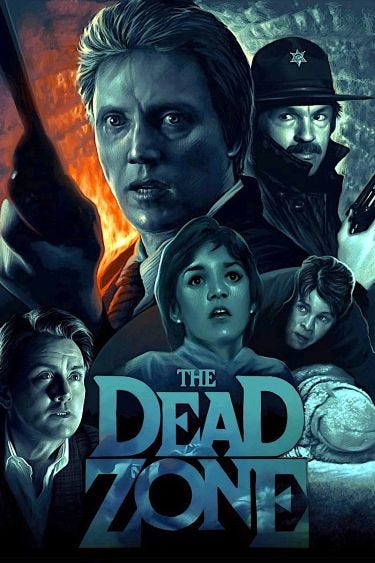
The Dead Zone (1983). Grade: B-
It is a dark and stormy night. Mild-mannered schoolteacher Christopher Walken is driving home alone after hanging out (chastely) with his pretty fiancee, Brooke Adams. But there’s been an accident on the road ahead! A tanker truck has overturned! Walken, alas, crashes into the tanker. And it seriously messes up his life.
In a sly little bit of morbid humor, what’s the tanker truck carrying? Well, you might say that the early message is, don’t cry over spilt milk.
The movie is based on a 1979 Stephen King novel; I haven’t read his earlier books yet, only the 21st-century ones (which I like a great deal). This 2012 review by James Smythe of The Guardian says the book “feels like King pushing himself, challenging himself to write something outside his usual patch, even as it appears to be entirely resting there. As with many of his best, it’s not a horror, even: over its many sections it's a slow-burn psychological thriller; a crime novel; even (whisper it) a more literary novel about rehabilitation and loss.”
Sounds like what I enjoy in the more recent King books! So maybe I’ll get around to this novel, one of these days.
If the book was a departure for King, it also was for Canadian horror director David Cronenberg, then known for what’s called “body horror”; movies featuring gruesome images of mutated and mutilated flesh like Scanners and Videodrome. There’s virtually none of this in The Dead Zone, merely one spooky killer who’s dispatched in a grody way, and the shot doesn’t last very long. The movie’s more about what suddenly possessing psychic powers does to its hero, Christopher Walken.
Because, after the crash and a five-year coma, Walken awoke with an unusual ability; when he touches people, he can get glimpses into traumatic events from their lives, sometimes in the past, sometimes the future. Right away, his power helps save a life; it rescues a child from an imminent house fire. Hearing about this, local sheriff Tom Skerritt wants Walken to use his visions to help catch a serial killer on the loose. He tells Walken, God blessed him with this gift for a reason.
Walken responds, “‘Bless me?” Do you know what God did for me? He threw an 18-wheeled truck at me and bounced me into nowhere for five years! When I woke up, my girl was gone, my job was gone, my legs are just about useless... Blessed me? God’s been a real sport to me!’”
Which, I’ll admit, is always my response when someone says that people should just “get over” some awful hardship and see it as a “gift.” Sure, it’s great and inspiring that Jim Abbott learned to pitch with only one hand. And stories like his should make you extra grateful for what gifts/luck/blessings you’ve had in your life. But if a drunk driver smashed your car and it lost you a hand, I sure wouldn’t tell you to look at the bright side.
Walken got the performing bug early, and began as a dance student before moving on to theatrical roles. (You can see his excellent dance moves in this Pennies From Heaven clip and this video directed by the great Spike Jonze.) He’s been cast as a lot of weirdos over the years, sometimes very amusing ones; he said in 2012 that he thought it was a sort of typecasting. “With movies, they’re so expensive to make that if you do something that works, especially early on, it can stick.”
Here, Walken gets one of his rare “normal guy” roles, and it’s nice to see him in it. What’s most vivid about the character is the way that the visions shake him up so profoundly. In most of the visions, he’s not just watching those awful past/future events; he’s part of them, but powerless to alter anything he sees. In one, he sees a woman being murdered, and after the vision keeps mumbling, stunned, “I didn’t do anything. I didn’t do anything.” If you were force to witness horrible events and had no power to change them, how would you feel? Not just on video — that’s bad enough — but happening right in front of you?
I’d guess that part of this concept, how having such “powers” would be incredibly emotionally draining, comes from the King book. That’s King’s specialty; he fuses his fervent imagination with empathy. But it’s also in Walken’s performance.1
The way that Walken’s powers leave him feeling so overwhelmed makes what’s a slight bummer of an ending tolerable; sure, it’s a disappointment for him, but it’s also a relief. And so does the way Cronenberg directs the scene, and the whole film. Remember that truck of spilt milk? Cronenberg isn’t asking us to take any kind of emotional gut-punches, merely to sit back and enjoy a pretty good story, well-told.
The rest of the cast fits in with the general vibe; nobody’s acting like they’re in a Eugene O’Neill play. The point is to hit a few notes which show us what your character’s basically about, and let the plot do its work. Skerritt as the kindly rural sheriff, Brooke Adams as the warm-hearted girlfriend-turned-friendly-ex, Herbert Lom as a thoughtful doctor, Jackie Burroughs and Sean Sullivan as Walken’s nice-yet-rather loopily fundamentalist parents. Maybe the most fun are the various baddies; Martin Sheen’s pretty good as a lying politico, Anthony Zerbe’s better as a stubborn rich a-hole, and Colleen Dewhurst has the best little role in the movie as a pistol-packin’ mama; she’s only got a minute or so of screen time, and it’s a real hoot all the way through.
It’s odd, to me, that for a writer as prolific as Stephen King, and for how many movies/TV programs which have been made from his stories/novels, there aren’t, really, any which get close to the emotional pull of King’s books. Even in the flawed novels, you generally find yourself strongly drawn to the main character, and you feel for them as they go through their lives and loves and fears. Some of the adaptations get the fear, alright; Mike Flanagan’s do. Yet the adaptations never get close to the heart of the writing. (Cronenberg in this one barely even tries, which is wise; emotional yearning is not Cronenberg’s strong suit, gruesome brain-twisters like Dead Ringers and eXistenZ are.)
The screenplay’s by one Jeffrey Boam, a fellow with a lot of ego to spare; in interviews, he seems to think that everything he ever wrote was genius, and if the movie wasn’t received as such, it’s the director’s fault. Looking at Boam’s filmography (he sadly died at only 53), I’m less impressed than he was with the output. (Lethal Weapon 3? The Lost Boys?) But it’s my understanding that this novel is a very complex one with a ton of characters, and Boam did a good job of condensing it here. The plot’s very easy to follow without feeling simplistic. (Most of Boam’s original scripts are very simplistic; they feel written for teenagers.)
There’s a late development which confused me; I’d be curious to know if it’s also in the book. Walken’s ex, Brooke Adams, has taken up door-to-door campaigning for Sheen’s evil politician. He’s running as an independent, saying both parties are corrupt and that people receiving public assistance are lazy losers. Why is nice Brooke Adams supporting this evil fraudster? If it was in the book, I’d guess that King was making a point about how people we love can become hardcore right-wingers over time; it’s sad, but it happens. If it’s not in the book, I’d guess Boam just stuck it in there as a fun coincidence and didn’t think for a second about the politics of the story. (Although Cronenberg would have; I’m guessing he simply thought, as a Canadian, that Americans were pretty easy for conman politicians to fool.)
The very decent cinematography’s by Mark Irwin, another Canadian; the movie takes place in King’s usual Maine setting, but it looks like Canada, and Irwin knows how to shoot Canada, how to give you that feel of long winters. (It looks so like Canada and some of the actors in smaller parts have such Canadian faces that it threw me for a second when Sheen worked a rich political donor for money; I had to remind myself, “oh, that’s right, we’re in America where that’s legal.”) The music’s by Michael Kamen, and while Cronenberg’s usual collaborator Howard Shore is surely missed, Kamen doesn’t embarrass himself the way he usually does.
This is certainly one of the more intelligent King adaptations out there. It might not get to the emotional pull of King’s writing, yet movies generally don’t, unless they’re awfully manipulative about it, and emotional manipulation doesn’t work well on me. Who would be a good filmmaker to adapt King? Maybe somebody who’s known for their ability to make movies about real people with real feelings. Kelly Fremon Craig’s Are You There God? It’s Me, Margaret was genuinely touching; both about the awkward girl going through puberty and her empathetic mom who saw her daughter struggling (and probably remembered the struggles she had at that age). And Craig wrote the script herself! She’s no slouch at book adaptation.
But, generally, studios aren’t interested in King’s books because they care about the emotions of the stories; they like the famous name. So they prefer horror directors, and not thoughtful ones like Cronenberg. That’s why there’s so many bad King adaptations out there, folks. It’s not because the original material’s bad. OK, maybe Maximum Overdrive shouldn’t have happened, but everybody makes mistakes.
Not me; I’m not only perfect, I’m psychic! I typed this one in a library, and looked up a few seconds ago, and what books did I immediately see? Ones with the name Stephen King on the sides. That’s the computer I picked without even knowing this library very well, it was the one right by the Stephen King books! Proof of my paranormal abilities! Or, maybe, proof that there’s generally a large Stephen King collection in every library fiction section, because, you know, the guy’s written a ton of books.
Or… it was King’s spirit solemnly intoning, “ifff you're going to write a review of a movie made from my book… reeeeead the book first, you lazy puuuttttzzz…”
Alright, alright! Next on my list.2 Geez, those spirit voices! So pushy!
Which is mostly due to Walken’s skill as an actor, except for one thing; the jolts that Walken does when a vision comes over him. That wasn’t acting. Walken asked Cronenberg to fire a .45 without telling him, so he’d react with a jolt. So on certain days, Cronenberg would be directing with an actual gun in his hand. It had blanks inside, but still, that’s a strange way to direct a movie. Unless you’re John Milius.
Update: now I have read it. Pretty good! The movie's fairly close to it. One Cronenberg change: in the book, the psychic saves some graduating students from dying in a fire. In the movie, it's falling through ice while playing pond hockey. I'm sure they play pond hockey in Maine, but it’s SO a Canadian thing.
One thing King nails is how the evil politician campaigns on both rabble-rousing AND ludicrous, impossible proposals, and morons think “gosh, he doesn't talk like other politicians, I like him.”
I imagine that, like the protagonist in this story, King feels pretty lousy about his awful prediction coming true.
I'm swapped with you on this one--read the book but not seen this movie.
Stephen King is my all-time favorite author. I've read all of his stuff once--and most twice! He's at his peak when writing about writers or academics--character types he can personally identify with. In The Dead Zone novel, John Smith is basically a King archetype--a guy who just wants to be a teacher but has this great power thrust upon him. Hmm...King after the success of Carrie?! The outlandish politician is very Trump-ish, though King treats him (understandably) as sort of "something that could never really happen in the real world". Oops.
I watched Batman Returns so many times as a kid that Christopher Walken will never not be Max Schreck to me (hahaha).
I agree that most King book-to-movie adaptations are poor. The best one might be The Green Mile. That one really captures the essence of the book. I also really enjoyed Gerald's Game (Netflix) & Doctor Sleep. I'm a bit outlier on Kubrick's The Shining, however, in that it is just too darn weird for me. Nicholson: stupendous. But everything else? I side with King.
I think what makes King so hard to port to the big screen is that his prowess is all about getting into the heads of characters (much internal dialogue). Good luck portraying that in a visual medium. I remember that for the 11/22/63 miniseries they had to invent characters just so the main character wasn't talking to himself every episode!