
eXistenZ
Gross, surreal sci-fi spooker that frustrates and somehow works.

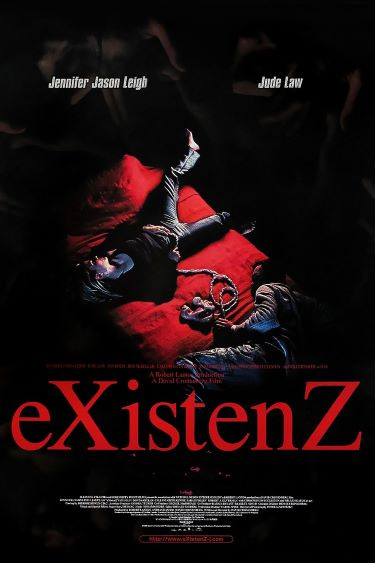
eXistenZ (1999). Grade: B
The title’s goofy spelling is because it’s the name of a futuristic video game; goofy spellings/use of capitalization were common in the computer industry when this came out. (And haven’t gone away.) eXistenZ is a next-level virtual-reality sort of game, one that is downloaded straight into your brain. When you’re in it, it feels exactly like the real world. (And yes, this was released the same year as The Matrix, so several people were wondering where computing technology might go.)
Jennifer Jason Leigh is the world’s biggest hotshot game designer; she’s having the first focus-group testing of the game when the movie begins. Jude Law is the software company’s PR guy. Soon enough, they are on the run together. A group of anti-technology extremists have put a price on her head. They call themselves the “Realists,” and want to destroy the entire virtual-reality game industry.
For those unfamiliar with writer/director David Cronenberg’s films, they generally contained what’s called “body horror.” Which isn’t just limbs getting chopped off or anything like that, it’s imagery that’s intended to disgust you. That involves body parts being mutated, dissected, infected, and such — like what happens to Jeff Goldblum in 1986’s The Fly. (Although Cronenberg would do more conventional dramas after this film.)
Most of the body horror here has to do with the “pods” that are used to control the game. They’re like Xbox controllers, but larger and fleshy. When players are using them, the controllers undulate and wiggle around, with lumps rising underneath their “skin.” You hold the “pod” in your lap — winkwinknudgenudge — and it plugs into a game port installed in the back of your spine through an umbilical cord. The port in your spine looks to be half-belly button, half-anus.
It was pretty easy to find a lot of good writing about this movie on the internet; it’s that theme of “what is reality” which fascinates a lot of sci-fi fans. Anders Bergstrom at 3 Brothers Film cleverly caught that there’s a fast-food bag we see labeled “Perky Pat,” and how this is a reference to Philip K. Dick’s The Three Stigmata of Palmer Eldritch; Dick, of course, wrote the short stories which Blade Runner and Total Recall were based on. Both stories that ask if our memories are real, or were they implanted in us without our knowing? (Bergstrom also points out something I didn’t know — how Dick became very mentally troubled later in his life, and believed himself to have had demonic revelations.)
Some writers complained that the “game” presented here is too unrealistic, and too boring, and that old people seem excited to play it (oh, no!). I don’t see why older people playing it is preposterous at all. Older people may not want to play Fortnite (or whatever the most popular thing is now), but they’re perfectly fine with games that simulate golf, or even operating a farm tractor. (And one writer said the focus-testing in eXistenZ was very like workshops he’d attended.)
Besides, I don’t think Cronenberg is interested in video games in-and-of themselves, anyways. I think he’s interested in how media of any kind can shape our perceptions. At one point, Leigh’s facing down a would-be killer who wants to collect the reward put out for her death; she asks him, does he really think the people offering that money are gonna actually pay up? “Haven’t you seen any movies?”
It’s not explained why the Realists want to destroy all virtual-reality games. Is it because they think that living in virtual reality reduces part of our humanity? Or that they think the software companies are too powerful? Or are they just anti-technology kooks? Could be any or all of the above.
Personally, rewatching this, I think of GamerGate (the harassment campaign targeting female gameplayers/designers/journalists). And how the Pentagon put actual recruiting tools into war-themed video games. How does spending a lot of time in the game world affect one’s views about the real world? Can it distort people’s understanding of what the real world is like? Affect what they want reality to be like?
I’ve never been big into gaming. I’m not against it, I enjoy computer games a lot. But I know, from experience, that it’s easy for me to get hooked by the things. I had to cold turkey myself off a computer version of Risk one time in college… and off Sim City another time at another college. So when I do play games, I play sports games — and force myself to turn the machine off after one game is over.
I did once try a shoot-’em-up game; it was a free download. Within one minute I’d been killed — by the other online players. Whenever I started a new game, the same thing would happen; the messages on my screen would read “noooob alert” or something like that, and I’d get killed. So, not even worth the time it took to download, really. But it made me wonder about the people so bored and purposeless that they sit around waiting to kill “noobs” on a video game. (Probably, quite a few are teenagers; I’d have found that pretty funny at 13 or so.)
I don’t mean to say that people who play violent video games are nasty people. No more than people who like violent movies. But the addictive nature of computer screens has really had a major downside for us all — not just GamerGate, but the algorithm-delivered “information” that’s constantly delivering lies and conspiracy theories and scams. It may have been the force which destroyed democracy for good.
It’s strange — but maybe was inevitable — that the addictive side of computer interaction has led to almost entirely terrible outcomes; it was hoped to be something else, originally. Look at The Matrix, and its idea of computer hackers as rebels united together against an unjust system. But now the term “red pill” means entering into a world of frightening, extremist right-wing propaganda. The complete opposite of what those filmmakers intended. (When Joe Pantoliano’s character makes a deal to betray his fellow hackers, so he can stay in the fantasy world forever, we learn that his fantasy world name is “Mr. Reagan.”)
I think the first thing I saw that predicted how the internet would make the world better and freer was James Burke’s science history series The Day the Universe Changed. That first aired in 1985, so the internet wasn’t called that yet (not by the general public). But I saw it in the mid 1990s. I’ve cued it up to the ending of the last episode:
“A new instrument; a new system. That while it could make conformity more rigid, more totalitarian than ever before in history, could also blow everything wide-open… You might be able to give everybody unhindered, untested access to knowledge… You might, with that and much more, break the mold that has held us back since the beginning. In a future world that we would describe as balanced anarchy, and they will describe as an open society. Tolerant of every view, aware that there is no single privileged way of doing things. Above all, able to do away with the greatest tragedy of our era: the centuries-old waste of human talent that we couldn't or wouldn't use. Utopia? Why? If, as I've said all along, the universe is at any time what you say it is, then say.”
Or, you know, it could lead to “do your own research.”
I see I’m over 1000 words into this “movie review” and I haven’t reviewed the movie very much! (Except the subheader, or “dek.”)1 So, how’s the movie?
Well, it’s a mess — quite literally, with all the goopy fleshy things that get tossed around willy-nilly as it goes along. Yet it’s a pretty interesting mess, and I enjoyed it. I’m not a rabid Cronenberg fan, but I like the twist of his mind, the kinds of things he’s interested in. And he’s a very skilled filmmaker; he knows how to show you exactly what he wants you to see.
Jude Law, 26 when this came out, was rather absurdly pretty at the time. And he used it! He played the ultimate boy-toy in 1997’s Wilde, an empty-headed playboy in 1999’s The Talented Mr. Ripley, a sex robot in 2001’s A.I. Almost the male version of the idea that if you’re pretty, you must be an airhead (which he probably isn’t). And he uses it here — he seems out of his depth at first, but gains experience as he goes (which is apt, given the game-like framing of the plot).
Jennifer Jason Leigh was already a master at sliding between characters who were “princess not so bright” (in Miami Blues) and ones with fierce intelligence (in Dolores Claiborne). Here, her personality shifts depending on what level of game-or-reality she’s inhabiting; sometimes meek, sometimes sultry, sometimes assertive. Leigh/Jude make a great fit together, as Elizabeth Cantwell’s excellent essay describes: “Their chemistry exists across realities, inside and outside game pods.”
The cinematography by Peter Suschitzky is terrific; Cronenberg started working with him because Suschitzky shot The Empire Strikes Back, which Cronenberg thought “was the only one of those movies that actually looked good” (he’s correct). Howard Shore’s score is lush and subtly spooky without any “eerie” musical cliches; it sets an atmosphere, it doesn’t cue you how to react. The script (by Cronenberg) can be confusing at times, and that’s intentional, but the confusion is never SO frustrating that you want to turn the thing off.
I do think the movie starts to drag a bit about two-thirds of the way through; there’s maybe one too many sub-levels of reality, and a little too many close-ups of gooey, slimy, repulsive props. (At one point Law has to chew on one of these props, which looks like a disgusting mixture of bone and gristle; I hope it wasn’t made exactly of such grossness, for Law’s sake!)
It all comes together at the end in a very satisfying way. We see all the actors from the film together on a stage. And it’s nice to see them without bizarre makeup on, playing weird deranged characters. (Of which Don McKellar and especially Willem Dafoe were the most fun; Dafoe just shines in these “oddball weirdo” parts.) When Cronenberg wraps up with a final bit of strangeness, it isn’t annoying; it fits the overall themes here.
And there are a lot of themes! From the technology ones to the quasi-religious to the well, existential. None are really delved into deeply, and that’s fine. If they had been, this would have been a drag instead of a puzzle box. A comment on Bergstrom’s article points out that the word “demon” that’s repeated in the movie can also refer to the “daemons” used in computer programming, which is some fun little trivia to think about — like that “Perky Pat” fast-food bag.
eXistenZ fits well into the long history of sci-fi warning us about the dangers of technology, be it the robots of Metropolis or sentient pissy computer in 2001, or the computers Captain Kirk could talk to death. (When Shatner was getting really hammy, he could talk anyone to death. I keed, I keed, I like Bill!) It’s probably too grody and goopy for most viewers, but anyone who liked The Fly would be able to tolerate the goopiness here.
I realize it’s a bit weird to be writing about the dangers of relying on computer interaction on… a computer. Well, I actually DO have real-life friends, you know! Granted, I basically never see them. But I’m sure they exist. Mostly sure.
As you probably know, this is one of my favorite films and probably my favorite Cronenberg film. It's a film that grows on you the more you watch it. One thing is the way the reality has limitations the way games do. The motel they stay at doesn't have a name. It is just a big "MOTEL." And the Chinese restaurant is "CHINESE RESTAURANT." There's also the stereotypical characters and the terrible accents of Don McKellar and Ian Holm (the latter made explicit in the after-game discussion).
The film probably is Cronenberg's hardest to watch. The whole Trout Farm sequence makes me nauseous just to think about. And I've watched the film a dozen times.
I think the ending is good. It all unravels well. I do, however, think that section shows signs of the limited budget. The one thing I've been questioning in recent years is the epilogue. It's a bit too neat. I think it works. And it is very much in keeping with Cronenberg as a writer. But the question it ends on really isn't a question. They may not be still in the game but they are *definitely* still in the movie. So that line comes off like a taunt, "Did you just waste an hour and a half?"
"The Matrix" connection is interesting to me. Because there were a number of films like it made at that time, including "Dark City" a year earlier. It's only been in the last few years that I've seen film as a constant artistic conversation where everything comments on everything else. And most important: nothing is ever all that new -- at least not with a professional budget.
But as I said, I love this film. I love "Dark City" and "The Matrix" too. But they reflect what people were thinking at the time. Not any kind of artistic breakthrough.