
Seven Days in May
Decent drama about a military coup of the U.S. government.

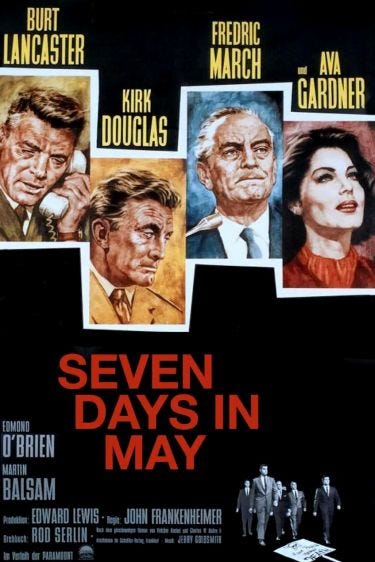
Seven Days in May (1964). Grade: B-
Kirk Douglas is mocked by one of his colleagues for still serving in the military: “I’d have thought you’d become one of those civil liberties lawyers by now.” Clearly, he’s a center-left-leaning, open-minded guy in a military whose brass aren’t known for appreciating sorts like that.
But Douglas’s strident right-wing boss, Burt Lancaster, is at least fair enough to appreciate that Douglas is good at his job. Douglas is grateful for this, and likes Lancaster personally, despite their political differences. So it’s a hard day, indeed, when Douglas has to tell the President what he thinks Lancaster is up to. He thinks Lancaster is plotting a political coup to seize control of the entire U.S. government.
This is based on a 1962 novel by Fletcher Knebel and Charles W. Bailey II (I haven’t read it); both were journalists for publications owned by the same media company. In 1961, Knebel had talked with famously hard-line Air Force general Curtis LeMay, who criticized Kennedy for not offering air support during the failed Bay of Pigs invasion in Cuba. And Kennedy had recently fired far-right general Edwin Walker, a figure who regularly denounced people like Eleanor Roosevelt and Harry Truman as “pinkos” and had distributed crazed John Birch Society literature to troops serving under his command. Knebel and Bailey made their central villain here a combo of LeMay and Walker (and Walker is mentioned by name in the film). Kennedy thought the book had an important message despite the “awful amateurish dialogue” and was happy to see Hollywood giving it a go.
Kirk Douglas bought the book rights and hired John Frankenheimer (from The Manchurian Candidate) to direct; Frankenheimer almost refused when he found out Douglas wanted Burt Lancaster in the movie. Per Jeff Stafford of TCM, when they were filming Birdman of Alcatraz together, Frankenheimer and Lancaster hadn’t gotten along, with Lancaster at one point picking the director up and placing him down in a different part of the set, saying “THAT’s where the camera should go.” But Douglas convinced Frankenheimer that Lancaster would be no problem this time around, and it worked out well; Lancaster and Frankenheimer became friends. (Which annoyed Douglas, who thought the director was copping an attitude.)
Rod Serling of The Twilight Zone was brought in to adapt the book and hopefully improve the dialogue. Since I haven’t read the book I can’t tell you if this dialogue is an improvement or not, but most of it plays pretty well. Except for a lousy scene between Douglas and Ava Gardner, who’s playing an ex-mistress of Lancaster; Douglas is trying to get tangible proof of the affair that he can use as a weapon if need be, and the script has poor Gardner stuck in the role of “unmarried bitter woman ashamed of her past immorality.” It’s a tacky scene; it’s also by Nedwick Young, a writer of mostly garbage scripts.
The plot mostly involves, well, the plot; the plot to take over the government. First we have Douglas getting suspicious, then reporting the suspicions to the President, then the President wanting to find out if the suspicions are correct. Douglas is dispatched to work on Gardner, Martin Balsam to get info about the plotters, and Friend of Blog Edmond O’Brien is sent to see if a secret new military base is really being built in Texas.
I won’t reveal what the coup plot entails — not because it’s a big secret, but because part of the drama here is learning what the plan really is, and if I give that away, it would be like telling you who the killer was in a mystery movie. It seems perfectly believable in 1963 to me. Yes, shooting finished in 1963, even though the movie wouldn’t come out until early 1964. Because Kennedy was a fan of the novel, the filmmakers got permission to stage an angry protest scene in front of the White House, where protesters and counter-protesters get in a fight. Well, in October 1963, the fired General Walker convinced riled up attendees at one of his speeches to attack people at a nearby event featuring Kennedy ally Adlai Stevenson. Per Patrick Kiger, the ensuing melee looked “eerily similar to the one in the movie.”
The acting’s pretty good, except for the Gardner role that’s so poorly written nobody’d be able to save it. (Poor Gardner, only 40 when this was shot, was drinking pretty hard and looks older; she’d complain to Frankenheimer about the way she was being treated, and he doesn’t seem to have been a sympathetic ear.) Douglas can sometimes be grating when he’s being noble, and Lancaster the same when he’s overplaying “evil,” so these are energetic-yet-restrained performances from both. (Douglas, especially, SEEMS like a respectable, cautious and intelligent military officer; this is not a character who would give big histrionic speeches in public.) O’Brien is maybe a little too sympathetic (he’s best when he’s just smart), but I never not enjoy the guy. And taking over for Spencer Tracy (who quit because he wanted top billing) is Frederick March, always at his best when he’s being dogged (like in Les Misérables); he’s got a good Serling-specialty scene where he’s explaining what American principles he absolutely stands for.
Of course, not everyone shares those principles. Whether or not Knebel/Bailey knew it, there might have almost been a coup attempt in the 1930s, where certain business leaders were hoping to depose FDR and install a military general as head of state instead; the supposedly intended General testified to Congress about it and Congress took no further action. (Some think it was more an idea being tossed around than a seriously planned thing.)
And I fully expect a coup to happen between November and January, and I’m 90% sure it will be successful. I think the ruling party will lose badly in the election, and that CBS/Fox News/CNN (which will by then be owned by far-right-wingers) will have 24-hour coverage of “election irregularities” for two straight months. After which the sitting Congress will simply refuse to accept the results, or not ALL of the results. They will stay in power. We all knew this was extremely likely with the 2028 Presidential election; I think it makes more sense to do it now. Fewer people care who’s in Congress. If you thought the last 16 months were nightmarish, just wait until one-party control becomes permanent. I think it’s gonna make dictatorships of the past look mild by comparison.1
Whether I’m right or wrong on that prediction (I’m right), the fact that we can all imagine something of the sort takes away some of the dramatic oomph of Seven Days in May; that plot doesn’t seem as bad as the modern one is. What was a shocking concept at the time is almost commonplace now; even pre-election, the current Immortal God Emperor and his minions are violating the Constitution multiple times a day. And while the Lancaster character’s got a vastly inflated sense of his own importance and rightness, he genuinely cares about the country. He thinks he’s the only one who can save millions from dying in nuclear war. The current far-righters WANT millions to die from a shredded health care system, from overwork, from pollution and climate change. They protect nobody but themselves.
Also lacking in dramatic oomph; the movie just ends. Evil is defeated, good survives, and the movie quickly stops. The original script had the Lancaster character dying in a car crash that could be an accident or could be suicide. That’s actually not a very good ending either, but they should have tried harder to improve on this abrupt one. At least there’s a scene that’s nice to Gardner for once, it helps.
This isn’t a great movie, but the acting is good and the pacing mostly decent and the confrontations are the right kind of speechifying, the kind that’s actually giving us some information about who the characters are. Frankenheimer’s direction is once again really sharp during a live TV moment, and the rest of the time it’s quite competent. As is the Ellsworth Fredricks cinematography and Jerry Goldsmith score (not one of his best just because he’s one of the best; most writers don’t have ten classic scores to fall short of).
This won’t edify you and it won’t waste your time either; it’s solid for what it does. It’s comparable to The Best Man, another 1960s political move that maybe won’t thrill you to your bones, but it’s got some brains behind it. When’s the last time an American political movie was halfway bright at all? Heck, the smartest political thing I’ve seen in years was an episode of Borgen, a show about the Danish government. It’s an up-and-down show, but a good Season One episode was about how the government had a responsibility to give more power to the people, not impose it from above. And especially not in Greenland. (The creator of the show said this January that if he’d pitched U.S. threats about annexing Greenland, he’d have been laughed out of the writers’ room.)
One intelligent writer thinks that that’s impossible and that extremist regimes always flame out before too long. I believe that’s wishful thinking, but he certainly makes a thoughtful case, check it out if you like.