
Sabotage / Saboteur
Good early and lazy 1940s Hitchcocks.

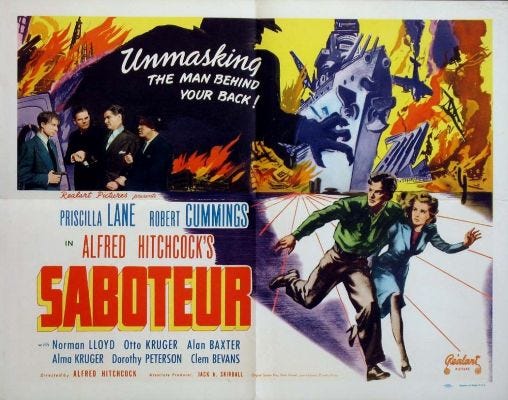
Sabotage (1936). Grade: B-. Saboteur (1942). Grade: C-
I shoulda paid more attention to Wiki! Right on the top of the page for Saboteur, it says “Not to be confused with Alfred Hitchcock's 1936 film Sabotage.”
Well, that’s exactly what I did. So I requested it from the library, and got a whole box set, with turdburgers like Rope, Marnie, Torn Curtain, Family Plot, Topaz… fortunately, I had seen all of those some time in the past, so I’d forgotten everything about them except that they are Very Very Bad and I should never watch them again. But I did enjoy Shadow of a Doubt and, especially, North by Northwest. Saboteur? Not so much.
Your plot is, there’s a airplane-making factory. Presumably for the war effort. And black smoke starts-a-billowin’. What is it? It’s such a mystery! Or, it would be, if we didn’t know the title of the movie we were watching. Yes, there’s a saboteur. A truly nasty one, who not only started the fire, but filled a fire extinguisher with kerosene and handed it right to a guy.
Actually, the guy shoulda known not to even bother trying to put out a blaze that huge with a measly fire extinguisher, but it’s not his fault if he never had a fire safety course. Unless he skipped it, in which case it IS his fault and he deserved to get all burned up.
Unfortunately, the guy’s buddy, Robert Cummings, is wrongly blamed for the arson, and now target of a manhunt. He figures the only way to clear his name is to find the real baddies himself. So he sets off pursuing them while the cops are pursuing him. At one point he finds himself surrounded by baddies at a rich people’s shindig and manages to summon the F.B.I. to save his a**. Finally, there’s a chase scene that ends on top of a national monument.
If you think to yourself, “hey, isn’t that exactly the same plot as North bu Northwest, more or less,” you’d be correct. But that movie has a lotta humor, and Cary Grant and James Mason; this one doesn’t have a single joke, and both the good guy and bad guys are borrrr-ing. About the only thing that’s interesting is swiped from Bride of Frankenstein and Freaks, anyways.
Cummings, on the run, can’t trust anybody but oddballs, societal outcasts like himself. For example, a blind man (just like in Bride), played here by Vaughan Glaser, who senses the good in Cummings’s heart. It’s a barfy role, although Glaser gives it dignity.
Better yet are the sideshow performers (just like in Freaks) who agree to let Cummings hide out; Pedro de Cordoba, Billy Curtis, Marie LeDeaux, Anita Sharp-Bolster, and Laura Mason/Jean Romer as Siamese twins (billed as having the same last name, as if they’re really Siamese twins; they aren’t). They’re not all sickly sweet, like the blind man was written to be; there’s a staunch conservative, a staunch liberal, and one’s undecided. So they vote it out, American-style (or, what was American-style and probably won’t be any more); democracy wins.
There’s a love interest, Priscilla Lane; she’s lovely and can act a little, yet doesn’t have much in the way of personality (so she and Cummings are perfect for one another!). Equally bland Otto Kruger played the baddie. Supposedly, Hitchcock had wanted Gary Cooper and Harry Carey for the goodie/baddie, respectfully, but Cooper wasn’t available and Carey’s wife didn’t want him playing a Nazi. Valid reason!
Or, it could be, they saw the script, by Joan Harrison, Dorothy Parker (!), and Peter Viertel. David O. Selznick, who Hitchcock was under contract to at the time, thought it was a trash script; Selznick made his share of mistakes, yet he was sure right on this one. (Per Wiki, Cooper was simply uninterested; maybe he HAD seen the script. Barbara Stanwyck was unavailable, too.) Once the project went to Universal, the budget went down; you can see it, too.
There’s a few interesting bits. The opening huge factory that tons of workers are walking into; well, they did have a building that big. There’s some neat stuntwork in the Statue of Liberty climax; no, it’s not actually on the Statue of Liberty, and they had stuff beneath them if they fell, yet it’s nice stuntwork all the same. And a spooky shot of a real overturned oceanliner that the saboteur supposedly destroyed. It was actually a boat that caught fire during a welding mishap while it was being converted into a troop carrier; the Navy objected to the shot in the film, because it suggested they were vulnerable to sabotage attack. Hitchcock kept the shot anyways.
Those tidbits and the misfits who take Cummings in are the only parts in this worth watching; it’s a snoozer. Not as bad as Topaz, though; I mean, what possibly can be?
We’re on MUCH happier ground with Sabotage. Not happy in terms of story! It’s actually quite dark. But happy in terms of “you can actually enjoy this movie.”
Wonderful Sylvia Sidney is married to German-accented Oskar Homolka, while striking up a friendship with handsome John Loder from the grocery store next door. But little does she know, Loder is actually an undercover cop. Somebody has been targeting London with terror attacks, and the cops are suspicious of Homolka & his associates. They’re right to be; within the first ten minutes we see Homolka sneaking back into his room after a sabotage attack. He did it, all right. It’s just that Sidney doesn’t know it, yet.
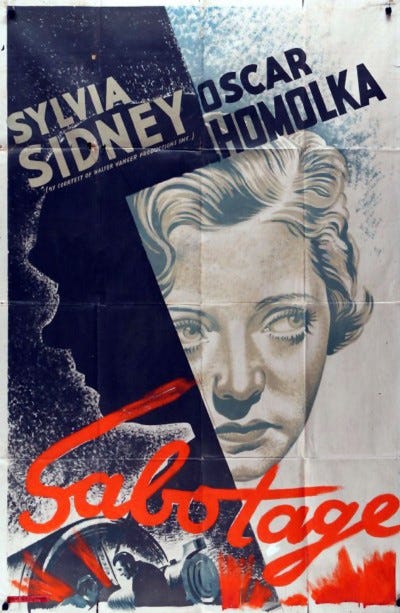
Odd background to this one. It’s actually based on Joseph Conrad’s 1907 book The Secret Agent, with only a tiny bit of the original novel remaining in the story (a vicious bombing and some character names). Meanwhile, there IS another 1936 Hitchcock film called The Secret Agent, and that’s based on some W. Somerset Maugham stories; it has no relation to this movie or the Conrad novel. Weird, huh?
Conrad’s book expresses the author’s innate conservatism (in the old sense, not the modern crazy-right-wing sense); the secret agents are all anarchists who want to tear down society to build a newer, juster one. In Conrad’s view, revolutionaries may start out with idealistic principles, yet they end up worshiping violence and chaos for their own ends; one of the characters carries a huge bomb on his person at all times, and his meaning in life comes from knowing that everyone around him could die at any moment. It gives him a thrill.
All of that’s thrown out for the movie; it’s implied that the terrorists are simply agents of a foreign country (it’s not mentioned which) who want to undermine England. The name of the main character is changed from Adolf Verloc to Karl Verloc, to avoid implying any specific country is responsible. (The actor, Oskar Homolka, had actually fled Adolf and the Nazis after they took power.) The other baddies are an international bunch, with interesting faces; Peter Bull, Wiiliam Dewhurst, J. Hubert Leslie, Torin Thatcher, and, all too briefly, the great Martita Hunt — the magnificent Miss Havisham in Great Expectations.
Homolka is quite good, here, the way he goes from sleepy burgomeister to nervous plotter to a rather Mean Grownup to, at the end, silently quite scary; he’s got a great baddie face and he knows how to use it. While Sylvia Sidney, as always, is a delight; when her heart’s broken by events, you really feel it. You want happy Sidney to come back.
Unfortunately, while Hitchcock wanted Robert Donat (so entertaining in The 39 Steps), he wasn’t available because of health reasons (he had lifelong asthma and was suffering from bronchitis at the time). So the movie got stuck with John Loder, who TCM’s Jeff Stafford describes as “a then-current screen heartthrob.” He wasn’t setting hearts aflame with his acting skills, that’s for sure. Hitchcock re-wrote part of the script himself on the set to give Loder some easier lines to play, later saying “the actor we got wasn’t suitable.” Always the puzzler, that Hitchcock! Back then he actually cared about acting! (As he went on in his career, he seemed to believe that his all-encompassing Vision could, through shot selection itself, make the likes of Farley Granger and Tippi Hedren into good actors. Nope.)
Charles Bennett wrote this; he also wrote The 39 Steps and The Man Who Knew Too Much. The success of these Hitchcock movies made Hollywood come-a-calling, and Bennett picked up that phone. Most of what he’d work on in Hollywood was really quite mediocre, but at least the man was making bank for it.
The movie has what Hitchcock’s duller films always lack, a fair amount of humor. There’s a funny crowd scene at the beginning where the saboteur has caused the power grid to go black, and patrons at Sidney’s movie theater are demanding their money back; ticket lady Joyce Barbour ain’t having none of it, and she’s a hoot. Then there’s a later scene where 12-year-old Desmond Tester1 is making a delivery, and gets swooped up by some pitchman selling his miracle products; first Tester gets his mouth full of probably disgusting-tasting toothpaste foam, then his hair full of nasty pomade-type goo.
But there’s tension underlying the scene, too — we know what Tester doesn’t know. He’s carrying a bomb. It’s gonna go off at 1:45. If Tester finishes his delivery before 1:45, somebody’s still gonna die; but it’ll be somebody we haven’t seen before, somebody we don’t already like. If Tester doesn’t finish the delivery, it’s gonna be him and whoever’s in the vicinity. And there’s some very charming others in the vicinity.
That’s the big suspense moment, and while it’s done very simply (mostly with editing and with Jack Beaver’s ticking score), it’s very effective. And there’s a good, spooky moment at the end, too, when Sidney’s feeling threatened. The way her face goes from anger to slowly-dawning terror is pretty great.
I also really liked the scenes involving her movie theater itself; there’s a choice of Disney cartoon that’s very poignant. And a detail I always love seeing in movies; I don’t know about modern theater screens, but in older ones (like the theater I worked at), if you go behind the screen, you can see a reversed image of the movie. It looks very cool here (competent Bernard Knowles doing the cinematography). What no movie I know of has shown is, there’s little pinprick holes in the screen. So if you put your face up to it, you can see the audience behind, in the light reflected from the screen, and they can't see you. It was sometimes fun to watch people respond to frightening scenes from the other side of the screen. (I’m sure Hitchcock himself would have approved of that.)
Hitchcock’s daughter, Pamela, wrote that this was “one of my father’s darkest films.” It certainly is, yet it’s not oppressively dark like some of the later ones; it’s not the mood all throughout. The dark moments just kinda sneak up on you. I find them more effective, that way.
There’s quite a few puzzlers in the script. Sidney is married to Homolka, but Desmond Tester isn’t their kid, he’s her brother. Why is her brother living with her and not his parents? It’s not explained. And the end involves an explosion, and we’re left wondering how the heck that could have happened; was it an attempt to cover up evidence that went wrong, or what? While the opening sabotage uses sand to black out, seemingly, all of London; I don’t think you can actually use sand to do that.
Yet this is still a pretty entertaining film, and Sylvia Sidney makes for a nice Hitchcock heroine, although, alas, one whose romantic counterpart is quite the bore. We did get a good laugh, though, out of Loder at the end going “I know now might not be the best time to say it,” then professing his LUUV. Dude, your instincts were right in the first place!
So, this one is definitely worth checking out. But don’t make the mistake I made and get Saboteur, instead! LISTEN when Wiki warns you against such things. On things I warn you about, you’re free to ignore me.
Actually 17 when this was shot, but looks 11 or 12.
I've never seen Sabotage, but I have Saboteur at 3/10 stars--pretty close to your C- grade. From my IMDB review:
"Sadly, though, the overall plot is about as stale as they come. It is a scenario that is almost "too easy" for the genre and provides no true suspense or meaningful character development. I suspect that a film like "Saboteur" was made with a strong eye towards propaganda instead of overall quality."