
North by Northwest
Wonderful, entertaining; Hitch, Cary, Mason deliver the fun.

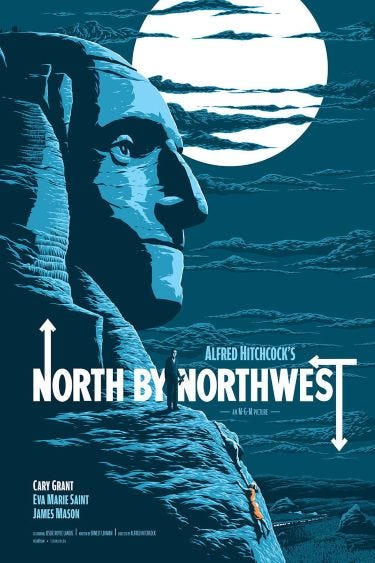
North by Northwest (1959). Grade: B+
“I am but mad north-northwest,” says Hamlet in act 2, scene 2 of the play; “when the wind is southerly, I know a hawk from a hand saw.”1
I’m pretty mad, all the time, these days, both in the “losing my sanity” sense and the “furious/outraged” sense. And the wind is definitely “southerly”; the forces of evil which shaped Confederate ideology are seemingly unrestrained, unaccountable, and unstoppable. So it is a bit harder to write about movies than usual.
But, what the hey, at least a few people like these posts. So let’s go with something that’s justifiably paranoid (they ARE out to get you) and also delightfully silly. It means nothing, it matters nought, and it can make one happy for 136 minutes. Why not watch North by Northwest.
Right off the bat, let’s go with one of the more enjoyable and fairly famous flubs in movie history. I present to you, The Kid With Fingers In His Ears:
(Don’t worry, Cary Grant isn’t actually shot in this scene, it’s a ploy to throw off the baddies.)
Now, if you watch carefully, you’ll see this kid in the background.
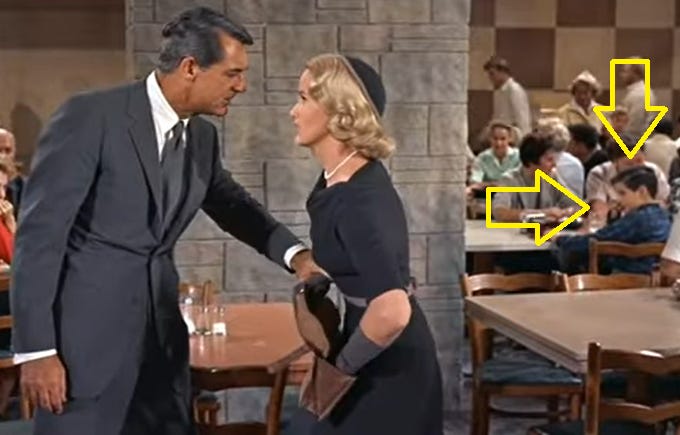
Watch the clip. A few seconds before Saint fires the gun, the kid sticks his fingers in his ears. Who can blame him? He didn’t like the loud noise. Fair enough!
That’s the silliness of North by Northwest. It’s a movie with a goofy plot, a background extra kid sticking his fingers in his ears, Cary Grant acting as smoothly as he ever did, James Mason and Martin Landau totally having a great time as the baddies, a terrific score, what’s not to like?
I actually didn’t like this when I first saw it, at age 11/12 or so. I’d been on a Hitchcock kick ever since seeing Rear Window, and I was wanting more of that kind of spookiness, that kind of tension. When Grace Kelly is in the killer’s apartment, and we see the killer coming close to catching her, and we’re deathly afraid.
Well, nothing in this movie comes close to that in terms of “suspense.” You won’t believe, for an instant, that some wobbly biplane is gonna propeller-chop Cary Grant up into little bits. But the movie’s better for it; you don’t have to be nervous about anything. You can just sit back and have a good time.
Your plot; Grant, a Madison Avenue ad exec, just as perpetually lubricated as the ad execs on the Jon Hamm show, is in a restaurant with some ad exec pals, and he thinks of a telegram he wants to send. So he signals the Telegram Teen. (I guess, in swank restaurants, in the olden days, they had Telegram Teens waiting to deliver messages. Who says people now are more distracted during their meals by their dumbphones? People were distracted sending/receiving texts in 1959, too!)
The thing is, at the moment when Grant signals the Telegram Teen, that teen has been asking around for a “George Kaplan.” And two baddies are standing nearby, waiting to see who Kaplan is. They know his name, they know they wanna get ‘im. They just don’t know what Kaplan looks like.
So, the second Cary Grant raises his had to signal the Telegram Teen, they think that Grant must be Kaplan. He isn’t, but that’s what the baddies think. So they grab Grant. He’s taken, at gunpoint, to the mansion of smooth James Mason and his henchman, Martin Landau. Who demand that “Kaplan” confess how much he knows about the Evil Baddie Plans.
Grant protests; he’s not Kaplan. He’s never even heard of Kaplan. He’s got a wallet full of cards to prove he’s not Kaplan! And Landau says, sure you have the cards. “They provide you with such good ones.”
This is actually one of my favorite scenes in the movie, with Mason, perfectly sure of himself (and wrong), going up against Grant, who’s equally sure of himself (as a screen presence, and he’s right). The other is Grant at an auction, behaving in a way he knows will completely annoy all those polite attendees. And the way Grant delivers his slick aside to the would-be killers on his way out; “sorry, old boy, keep trying.” There’s a ton of these sly Grant moments all through the movie, like when he accidentally startles a young woman in her hospital room who yells, “stop!” Then, hopefully, says, “stop.” And Grant just waves a finger at her; now now, mustn’t dilly dally, gotta go further the plot.
The plot’s a dizzily-constructed bit of dumb fun, concocted by Ernest Lehman with Hitchcock over the course of a few months. (Most of the production information I share here comes from this entertaining article by Chick Frownfelter at CinemaScholars.com.) Hitchcock intended to film an adaptation of a recent bestseller, The Wreck of the Mary Deare, and Bernard Herrmann, who’d scored Hitchcock’s last movie, suggested his friend Lehman. Lehman had absolutely no luck with Mary Deare, and told Hitchcock he wasn’t able to do it. So Hitchcock said, that’s fine, we get along well, let’s just make something up.
Hitchcock had always wanted to do a movie that had someone up the nose of a President on Mount Rushmore, and he and Lehman would bounce random plot ideas off each other, including a murder at a Detroit auto plant, a struggle in Alaska, a killer attack tornado and a sleepy U.N. delegate who, it turns out, ain’t just sleepy — he’s been murdered! The U.N. delegate stayed in a modified form, the attack tornado became an attack cropduster, and a third element came from something Hitchcock heard at a cocktail party; about American spies creating a fake spy to throw off the Soviets.
(Something like this had happened in WWII, where an unfortunate dead poor guy was dressed up as a commando and given “secret” papers to deceive the Axis powers; that story eventually became a British film called, as the real plan had been, “Operation Mincemeat,” which sounds to me like a really callous name for something involving the body of a dead poor person.)
I gotta admit, there’s a side to Hitchcock which always baffled me — his ability to work well with good actors, mixed with his surprising tolerance of terrible ones. (Like, what ever possessed him to work with Farley Granger? Twice?) But, aside from the incredibly-dull gunsels here, he’s got a fantastic cast this time. Mason, and Grant, and Eve Marie Saint who is sexier giving Grant grief than she is playing smoochy-face. Martin Landau as what Gore Vidal called the top stereotype of 50’s/60s spy stories, the Fag Villain. Leo G. Carroll as a rather callous spymaster.2 And Jessie Royce Landis as Grant’s annoyed mom, who’s all of seven years older than Grant was (in real life); hey, maybe she’s his stepmom?
The cinematography by Robert Burks is well, bland as heck; some of the set design by Robert F. Boyle/Henry Grace/Frank McKelvey is pretty slick, though (including a neat mock-up of the interior of the U.N.).
You may be disappointed to learn that, in fact, there are no Frank Lloyd Wright houses on the top of Mount Rushmore. You may also be disappointed to learn that Mount Rushmore is sort of a semi-secret fan destination for KKK wannabes, as the sculpture was designed/executed by one Gutzon Borglum, the creator of several large Confederate monuments. A southerly wind in North by Northwest which I’m sure none of the film’s creators remotely intended. They just liked the idea of people climbing over the monument.
Actually, the people climbing over the monument stuff got the National Park Service’s undies in a twist, even though it was almost all gonna be done in a studio. Still, they didn’t like the idea of MURDERRRR happening at the monument, so they made getting the few shots of the real Rushmore from the observation deck a total pain. In revenge, Hitchcock took the customary “this movie was made with the cooperation of the National Park Service” outta the credits, since they weren’t cooperative at all.3
Bernard Herrmann really outdoes himself with the score, here. Sure, there’s a few generic moments, and maybe too much repetition of the main theme, yet there’s also terrific humming ominous strings where appropriate. It’s really a delight to hear, most of the time, and the repetitive parts won’t annoy you. And the main theme’s been stuck in my head for a few days now!
The end of the climax might annoy you — it’s a bad, lazy jump-cut. As if Lehman just held up a sign for the audience saying, “damn it, I’ve already given you two+ hours of fun plot twists, OK, I’m just gonna wrap this up fast.” Some of the smoochy-face stuff on the train gets stretched out longer than it needs to be, losing some of the terrific momentum of the first third. (It might also be a signal to the audience, “take your pee break now, once we pick back up again you won’t want to miss anything.”)
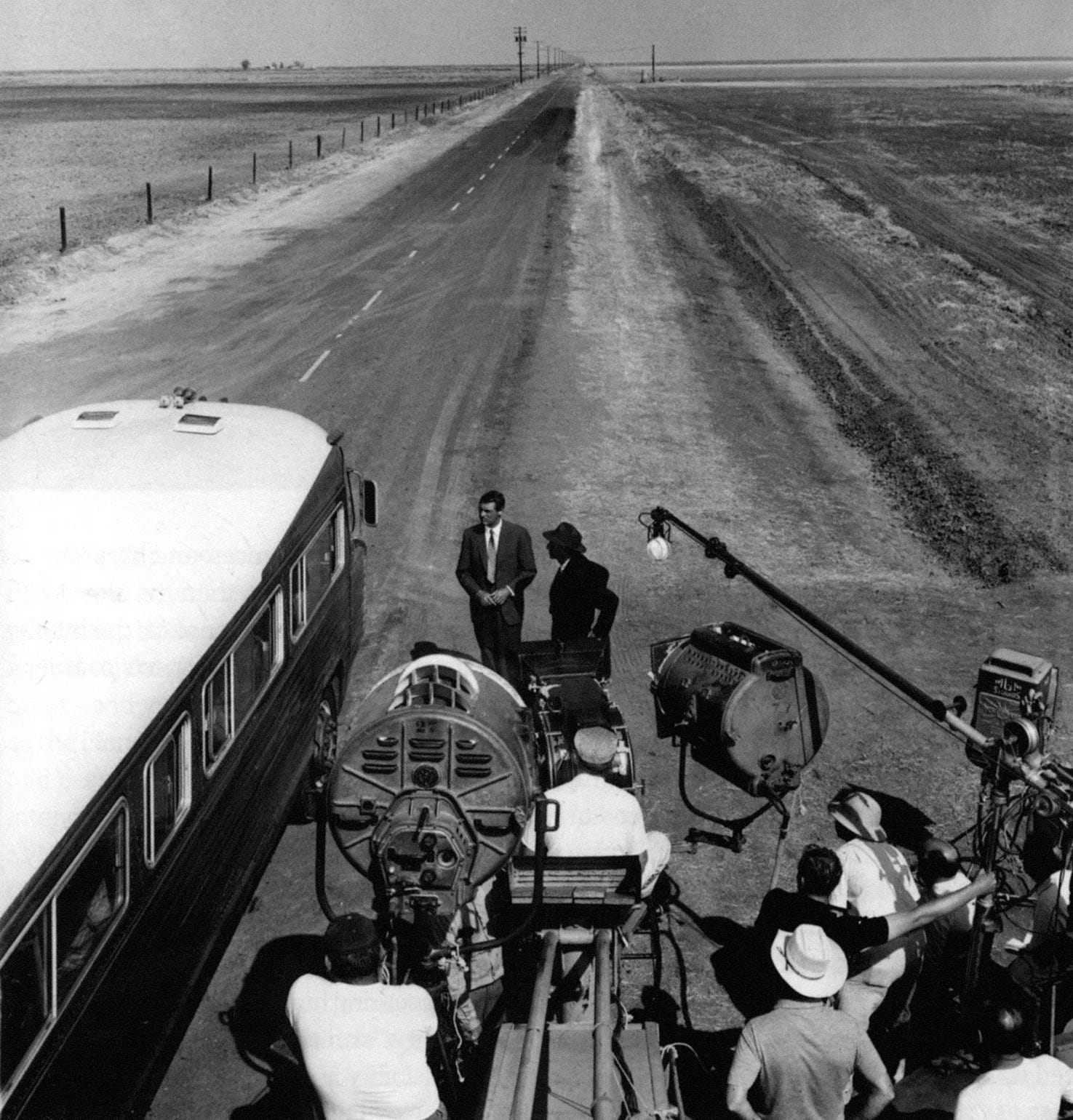
And there’s about a zillion plot holes here — like the way that baddies go to these elaborate methods of bumping off Grant (biplane machine gun?) while not giving a rat’s poop about publicly knife-throwing a U.N. diplomat to death. But the plot holes are part of what I like about this; it doesn’t take itself remotely seriously. At one point, a C.I.A. strategist (well, the “National Intelligence Agency,” but who’s counting) says, “it’s all so horribly sad, so why do I feel like laughing?” Exactly. Even the fact that the C.I.A. doesn’t really seem to care about almost anything it’s responsible for is part of the tossed-off nature of the story.
I might like this most of all because Hitchcock purists don’t like it. In the late 50s and early 60s, a group of film critics, first French, then American, rebelled against the notion that the best movies were all the big Hollywood “prestige pictures”; From Here to Eternity, etc. Fine by me! A lot of those prestige pictures were purest gunk, like Gone With the Wind (or From Here to Eternity, for that matter; there’s several other Fred Zinnemann movies which are much better).4
These critics insisted that there was just as much, or more, artistry and personal feeling put into things like gangster movies and Westerns (and, in some cases, when those movies had snazzy scripts and good actors, they were better). Then these critics began to insist that they could identify great film artistry by noticing certain recurrent themes in the movies by certain directors. This became known as the “auteur” theory. And while it was useful in toppling various ideas of what made quality, it also began venerating directors who repeated themselves in bland, obvious ways.
This inevitably led to Hitchcock worship, because he did repeat certain bland, obvious things (for the simple reason that they’d made money in the past). I’m not going to go into the “themes” of Hitchcock’s work, they don’t impress me much. There’s a ton of criticism written along these lines, it’s easy enough to find. I will say that if you see the word “auteur” mentioned by modern critics about a modern filmmaker, it’s probably a sign that filmmaker’s work is close to useless. And probably a sign that critic’s writing is useless.
Hitchcock purists tend to ignore his snappy, earlier movies like The Lady Vanishes and The 39 Steps; they grudgingly accept how well made Rebecca and Notorious are. What they really love are Vertigo and Psycho (easily two of the most overpraised movies in history), and the truly abysmal Hitchcock offerings of the late 60s/early 70s; Family Plot, Marnie, Torn Curtain, Topaz, etc. Trust me, you should never watch Topaz! And the purists don’t like North by Northwest. They see it as not having enough of the Master’s deep, dark obsessions.
Well, since The Master’s deep, dark obsessions basically involved wanting young starlets to turn him on, I’m not impressed as much (that’s been a Deep obsession of basically 75% of directors and 95% of producers in movie history). Gimme Cary Grant instead, saying, “I've got a job, a secretary, a mother, two ex-wives and several bartenders dependent upon me, and I don't intend to disappoint them all by getting myself slightly killed.”5
There’s a few disappointing things here, like an over-reliance on rear projection and a rather disappointingly fake forest after the fun stuff in very real New York. (Hitchcock complained to a local reporter that the cops weren’t protecting the set well enough, so the cops got pissy — they’ll do that — and provided even less protection afterwards. So the hustle and bustle you see behind Grant is real NYC hustle and bustle!)
But, for the most part, this is one of my favorite Hitchcock movies; there’s a lot to laugh at, here, and Mason/Grant are a match made in heaven. The movie knows this so much, it doesn’t even bother bumping Mason off, as Hitchcock movies usually did to the Head Baddie! He’s just arrested by park rangers and gets to say a last bad line. It feels right. And so does the movie.
Which is not where the title came from; writer Ernest Lehman said it simply came from the plot going from Chicago to South Dakota, hence northwest. Wittily, the characters get there flying Northwest Airlines, so they could have also titled the movie Northwest by Northwest, except that title would suck.
Scott McGee and Lang Thompson at TCM point out Carroll’s resemblance to Alan Dulles, the even more callous real head of the C.I.A. at the time.
But we like the National Park Service today! Support the Park Service! They're great, and in trouble from the real-life baddies!
The Sundowners and A Nun’s Story, to mention two.
Which actually ISN’T my favorite line in the movie, as good as it is. My favorite line will make no sense to anyone else, but in the spirit of true honesty, here it is.
Early in the movie, Grant gets into a taxi and starts telling the cabdriver which route he should take to the destination. As a (sometimes) professional driver, lemme tell you, this sort of thing is really annoying! Yeah, passenger, you’ve been where you’re going lots of times. You KNOW routes, and you want us to know you know. The professionals know them better than you! Not Uber drivers, not always, but actual pros, they know better.
Later, once Grant’s gotten in real trouble, he gets into a different taxi, and this exchange occurs:
“There’s a car following me. Can you do anything about it?”
Cabdriver (without missing a beat, or looking behind): “Yes I can.”
Grant: “Do it.”
Grant’s learned! The professionals know more than he does!
As it turns out, it doesn’t make any difference, the baddies know where Grant’s going, anyways. But I love the respect for the skills of drivers!
Actually, if I ever drove someone who asked me if I knew how to shake a tail car, I’d say, “sorry, I don’t.” But still, it’s the thought of respecting drivers that counts!
BTW, I just confirmed my next summer baseball trip: Washington, D.C. in May for Twins/Nationals (and all the monument stuff--I've never been there)!
You'll roll your eyes, but this will 100% get a viewing before I leave:
https://www.youtube.com/watch?v=17MyPrAEQ28
The most amazing part of this post to me is that another 12-year old kid was "going through a Hitchcock phase"...I thought I had the market cornered on that :)
As should come as no surprise, I far prefer "Stewart Hitchcock" to "Grant Hitchcock". I do have NXNW at 7/10 stars on IMDB--in all honesty I would have guessed lower (been a while since I've watched that one). I pretty much agree with all your critiques here. It's really a silly movie from a plot perspective, but it bores along at such a steady pace and has enough of Hitch's eye behind the lens that it's never truly "boring" even if you don't ever really know what is going on--or care all that much in the end.
My favorite Hitch film is Psycho, followed closely by Rear Window. Vertigo, Rebecca, The Man Who Knew Too Much (Stewart remake), The Birds, & Strangers on a Train are the next tier down for me.