
Rear Window
A slog through the first half has a tremendously exciting finish.

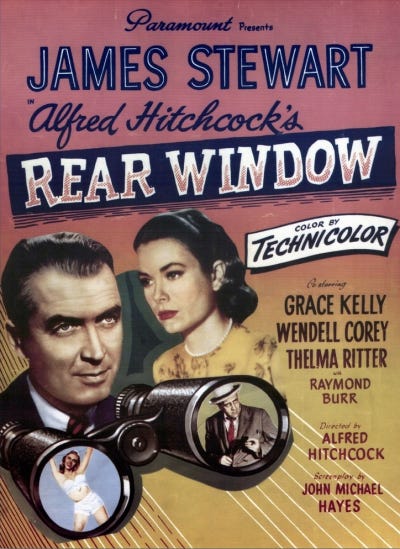
Rear Window (1954). Grade: B
Much has been made about how this movie turns audiences into “voyeurs,” a French critics’ word for “peeping Toms.” (And American critics appropriated French critical terms to make themselves sound Deep.) Way, way too much has been made about “voyeurism” and Rear Window and Hitchcock, in general. As though the movie reveals a twisted soul inside us all.
Newsflash; it’s really not uncommon for New Yorkers, Manhattan residents in particular, to have a set of binoculars or a small telescope by their windows. And anybody in Manhattan who walks around their apartment in their underwear with the curtains open is well aware of this. It’s really not that much of a big deal.
Actually, the twisted part comes in the back half of the movie, where the injured protagonist sends his girlfriend into extreme danger, basically by goading her into it on the threat of dumping her. Kind of a jerk move, that!
Your plot, probably known to everyone by now, is how James Stewart plays a photographer with a broken leg; he broke it jumping onto a racetrack in the middle of a race, a rather foolish thing to do. Stewart’s a tall guy who’s been all over the world as a photographer (so, kinda like baseball player Randy Johnson); it’s not just his job, it’s his life.
And this is causing some domestic problems with gorgeous socialite/fashion designer Grace Kelly, who looks 24 because the real Kelly was 24, and Stewart looks 54 even though the real Stewart was 45. The age difference isn’t even mentioned as a problem in the movie, although Stewart keeps getting all these envious looks from his equally middle-aged buddy Wendell Corey, which I’m sure got a lot of naughty chuckles in 1954.
(It wasn’t uncommon for poor women to marry much older rich men in that period, since women had so few options to pursue satisfying careers; but the Kelly character is rich and has a fun career. Why is she drawn to this old grouch? Because the script says so, that’s why. In pre-Code movies, the only women who went for guys this grumpy and old were labeled “gold diggers” and the plots were played as comedies.)
It was either very savvy or very lucky for Hitchcock to land James Stewart, here, an actor who’d built up a lot of audience goodwill over the years. Because the guy he’s playing really is a s**t. If the character was played by any of the real dullards cast as romantic leads in recent Hitchcock movies, like Robert Cumming, Farley Granger, or Michael Wilding, this would be remembered as a technically astute movie with a really off-putting main character.
The Stewart character makes excuses to Kelly why he can’t marry her. Yet, as he tells another character when Kelly’s not around, he merely thinks “she’s alright.” He likes the sex and enjoys her company, but he also wants to go globe-gallavanting whenever he feels like it. When she offers to go with him on his next adventure, he mocks her and tells her she’d never be able to handle it. (Um, she’s 24, I knew several 24-year-old women from fairly rich families who loved going world adventuring, when I was that age.) Basically, this guy has a gorgeous, funny younger girlfriend and he’s blowing her off, and she keeps coming back. He’s a damn idiot and sooner or later she’s gonna stop being one herself, and dump him for good.
But then comes the plotty stuff, where Stewart suggests he’s seen enough through the courtyard window to indicate foul play. And because Kelly is 24, and eager for adventure, she gets swept up in it. And when she’s risking her neck to do so, it’s only half youthful impetuosity — it’s also pride, in showing Stewart “see! I can be brave, I’m no delicate flower like you thought!” Which puts her in terrible danger of being killed.
And we in the audience are NOT rooting for this to happen. We’re enjoying the suspense, since we’re reasonably sure that the filmmakers are going to have good taste here and not do anything dreadful; they’re going to keep this at the level of entertaining melodrama. Which is no more “voyeuristic” than watching a 1930s horror movie, in some cases even less so. So, really, all the critical blather about Rear Window and voyeurism is so much horse pucky and you can ignore any critic who goes on about it.
Because the other characters we see through the apartment window (and Stewart’s telephoto camera lens) are quite dull. They’re a stock collection of cliches. We’re not watching them because we’re natural voyeurs, we’re watching them because the movie is making us do so; they’re certainly not interesting, except a very sad lady suffering from massive depression. And there’s a couple that puts a mattress on their balcony on a hot night to sleep outside, and then they get rained on, which would be kinda funny if you saw it in real life.
That rain was quite the undertaking, by the way; this all takes place on a big soundstage. There’s two decent articles I found on the making of this movie; this one, by David Atkinson in American Cinematographer, has a lot of technical detail about the types of lighting used. This one, by Nathan Smith in Architectural Digest, is about how they scouted and built the ginormous set. They had thought about shooting it on location, and chose a real location to duplicate (which is still there today), but the difficulties of matching real sunlight with artificial light and blocking out NYC street noise would have been technically daunting. (To low-budget filmmakers today, those challenges are still technically daunting.) So they built a humongous set, extending beneath the floor of the soundstage; it was far and away the movie’s biggest budget expenditure, and took almost two months to build.
To keep costs down, Stewart agreed to take a share of the movie’s profits, instead of his normal salary — this was a huge hit, so he made out like a bandit on that deal. Kelly didn’t get quite as much cash, and missed out on an Oscar — which went to Eve Marie Saint, who’d replaced Kelly in On the Waterfront when Kelly pulled out to make this, instead. But Kelly eventually did alright, marrying one very wealthy Prince Rainier, whose family owned a famous brewery. Here’s a photo from their wedding:

The set was so big that one time the heat from all the lights turned on the studio’s fire sprinklers; Hitchcock dryly asked for an umbrella. There were all kinds of challenges in lighting the individual apartments so that they could be vividly seen, from a distance, even though the bright overhead lights were constantly shining in the day scenes. There were 31 apartments in all, and 12 were fully furnished; Georgine Darcy, who played “Miss Torso,” a frequently-scantily-clad dancer, joked that she actualy lived in her “apartment” during filming.
(The original cut submitted to the censors included a shot were Darcy seemed to be topless; this was on purpose. Give the censors something to gripe about, and they’ll often be happy to claim a win when you cut it out. In fact, the filmmakers had already shot the scene with Darcy wearing more clothing, and planned to use it all along. This “give the censors something to cut” trick was often used then, and still is today.)
The shots where you see the other apartments reflected in Stewart’s binoculars and camera lens were done by blowing up a transparency of the opposite apartments and shining a light through the transparency; that’s what you see reflected in Stewart’s lenses. The opening shot, a rather elaborate moving-camera one introducing us to the courtyard, the neighbors, and finally Stewart’s broken leg, took a lot of rehearsal, as you’d expect; they nailed it in half a day, which is faster than I’d have guessed.
The script’s based on a 1942 Cornell Woolrich short story, It Had to Be Murder (you can read it here). When Hitchcock was looking for a new studio contract (Warner Bros was having money problems and cutting budgets), Paramount offered him a fabulous deal, on the condition Hitchcock film one of Woolrich’s stories; they owned the rights to several. Hitchcock picked this one.
Hitchcock’s agents suggested screenwriter John Michael Hayes, a radio veteran who’d recently switched to screenplays; his rough story draft convinced James Stewart to sign, and Hayes was hired to write the full script. (He’d later work on several more Hitchcock movies, all of them snoozers.) Hayes sticks reasonably close to the format of the story; a guy with a broken leg spying on neighbors, who thinks one of them might have committed murder. The broken-leg guy has a male nurse who shows up daily, and he pays the nurse to deliver a message, then later hunt for clues. Eventually the killer comes to the broken-leg guy’s apartment.
What Hayes improves the most is in changing the nurse into the Grace Kelly character; if it was simply somebody Stewart had paid, those tense scenes wouldn’t pack as much punch. The nurse instead becomes sassy Thelma Ritter, and she’s playing one of Hitchcock’s stock characters; the mild-mannered person who’s fascinated by real-life killings. I’ve met such people. I avoid them.
The actual climax is also a huge improvement; Woolrich’s doesn’t make much sense. (To be fair, writing action scenes is really tough, and few prose writers can do it.) Now, how much of the improvements to the story came from Hayes, or Hitchcock, or Hitchcock’s wife, Alma Reville (who frequently made script suggestions on his movies), I don’t know; I’m sure somebody has figured that out. It’s largely unimportant. You’ve basically got the original story’s plot with a love story added and some dull side characters. The smartest decision in the whole process was picking this Woolrich story to film; the observer being mostly powerless to stop something awful from happening is a stand-in for the audience who’s similarly trapped in their chairs. (Except for bathroom/popcorn breaks.)
The movie was a huge hit; and hit films were generally re-released every few years to make a little extra cash. However, after a 1968 re-release, there was some battle over who had the rights to the original Woolrich story, and the film was pulled from circulation for over a decade, finally re-emerging on home video in 1983. Which would have been about when I saw it; age 11 or 12 or so.
Parents who’re interested in introducing their kids to older movies might give this one a try. I think I was already into the Bogarts at that age, but some children might be resistant to watching movies in black-and-white. This one’s in color. Yes, it’s fairly ugly 1950’s Technicolor, but kids won’t notice that. (If it’s not shot beautifully, it’s at least shot very precisely; cinematographer Robert Burks was known for his technical skill, which certainly would have been key to a complex shoot like this.) Kids with shorter attention spans might find the introductory scenes fairly boring (and they’d be right), but you never know, with younglings; I think at around that age I had a high tolerance for boredom if I was promised that the story got better. Heck, I sat through entire Perry Mason episodes just to get to the final courtroom confession that finishes every one.
Perry Mason himself is in this, Mr. Raymond Burr; he’s mostly seen from afar, but in the few shots where we see him in close-up, he’s got a great glower. Wendell Corey’s B-movie presence doesn’t bring anything much, and he’s more than a little smarmy. Thelma Ritter’s oh-so-Brooklyn schtick is either something you enjoy or something you barely tolerate; I preferred her as a tough informant in Pickup on South Street.
This is primarily Stewart and Kelly’s movie, and they’re both quite good, after Stewart gets over his drawly bickering in the first third. Generally, if Stewart’s not in a comedy, you want him to be smart and intense, and that’s what he gets to do here. The way he uses the wheelchair and cast is neat; he’s got the single-mindedness of a photographer crouched down low trying to get the best angle past an obstacle. While Kelly shows some crackle as she gets excited by the mystery; it’s a mistake at the end to suggest she’ll always prefer fashion magazines to adventuring. You’d think the thrill of getting away with danger might have stirred something up in her, instead.
The music’s by veteran composer Franz Waxman; besides some credits gunk, the vast majority of the music we hear is coming from people’s radios and musical instruments, like a piano. One of the apartment neighbors is a songwriter, and we hear him working on a new tune during various parts of the movie (Waxman wrote it); by about halfway through, whenever the song started again, Mrs. twinsbrewer would say, “dump it, your song sucks.”
I’d imagine most people have seen this a few times by now, but if you haven’t watched it in awhile, it’s well worth revisiting. It’s fascinating how it goes from somewhat tedious (and somewhat annoying) to mildly intriguing to absolutely gripping in the last third. Although I must say it used a very hacky plot trick for getting us into the higher stakes of the final act; throw in a dead dog.
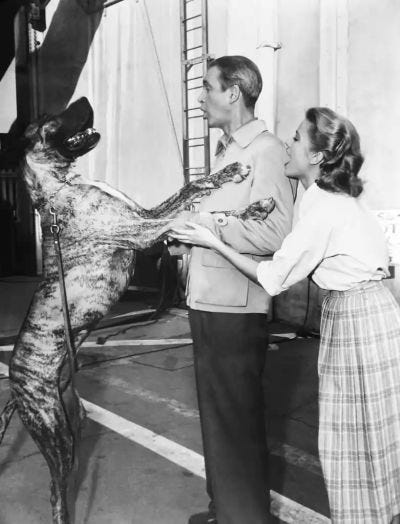
No dogs were harmed in the making of this motion picture, and at least one seemed to have a very fine time. This odd behind-the-scenes images post from Woman’s World (yup, that still exists!) says that singer/actor Rosemary Clooney (George’s aunt) was under contract to Paramount at the time, and would hang around the set on occasion with her little froo-froo dog:
Anything else? I suppose I should check over at TCM (who’ve improved the navigation of their site tremendously in the last year; which means I’ve got a bunch of dead links in earlier posts, but I’ll live with it).
The censors objected to the strong suggestion that Kelly planned to spend the night at Stewart’s place; but, according to this TCM post by Rob Nixon, original Censor Lord Joseph Breen was nearing retirement and his replacement, Geoffrey M. Shurlock, had less of a bug up his butt. Nixon also says in this post that Hitchcock had the Burr character wear a haircut and be a heavy smoker like David Selznick, Hitchcock’s first studio boss in Hollywood; they didn’t, always, get along. But studio bosses weren’t the only big egos around. Screenwriter Hayes was promised a bonus if the movie became a hit, which it did; Hitchcock kept putting it off and putting it off. Finally, “when Hayes showed Hitchcock his Edgar Allan Poe Award for writing the screenplay, the director shoved the ceramic statuette back across the table to him dismissively, saying, “You know, they make toilet bowls from the same material.’”
This isn’t as fun as North by Northwest or The Lady Vanishes, nor as gorgeously-shot as Rebecca or Notorious, but in terms of giving you a good, stark scare, this is probably the best thing Hitchcock ever made; that last third has a sustained level of tension he’d never match again (he usually only achieved it during some isolated sequences in a movie, not a whole set of scenes). In fact, after seeing this as a kid — and I think it was my first Hitchcock movie — I was disappointed that the other ones weren’t as scary! But I did get over it.
I even like the quasi-remake of it for 2000s teen audiences: "Disturbia" (with Shia LaBeouf).
On the subject of voyeurism, this doc (based on a book) is fascinating: https://www.imdb.com/title/tt7588790/?ref_=nv_sr_srsg_0_tt_8_nm_0_in_0_q_voyeur
In short: a hotel owner creates a crawlspace above his rooms to spy on unsuspecting patrons. Partially a sex thing, but perhaps more fascinatingly he'd simply watch people "existing", so to speak. Though obviously massively illegal and probably a little psychotic, his notes are the experience are grotesquely interesting. Because we all know that we act differently when being watched versus when we think we are alone.
My second-favorite Hitchcock flick--just behind Psycho. Some thoughts from my own review:
"In terms of cinematography, I'll call Rear Window Hitch's outright best worked. Paired with frequent DP Robert Burks, the duo produce a film cut that is a sight to behold on the big screen. Every scene is filled with interesting movement or visuals and not an ounce of any frame is wasted. Again, mind-boggling to think this was created in 1954.
About the only criticism I have of this film--dropping it from 10 stars to 9 --is that it might be 15-20 minutes too long. The build-up is superb and the climax is thrilling, but there is a period in the middle where both the character development and plot motion sag a bit. In a film otherwise so expertly constructed, this "sitting in neutral" is apparent.
But for the most part, that is mitigated by the relevance of the film's overall themes. Though originally constructed as commentary on tenement housing situations and their cramped quarters allowing for voyeurism, Jeffries' peering into other lives while neglecting his own is just as relevant in, say, the social media era. When Thelma Ritter says "we've become a race of peeping Toms--what people ought to do is get outside their own house and look in for a change", it is a true punch to the gut. That, to me, is the reason why Rear Window can still play in theaters nearly three quarters of a century after its premiere."
That last paragraph was something I really noticed after seeing a theater screening of it just after the main portion of the pandemic had wound down.