
Grass (1925)
Stunning documentary about a Persian tribe's seasonal journey.

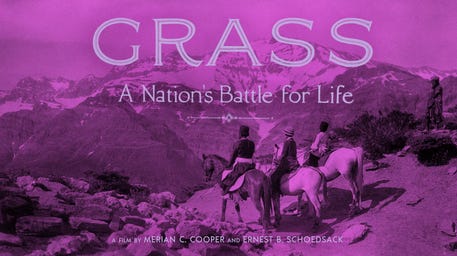
Grass (1925). Grade: B+
WWI vets, world travelers, and all-around adventure-seeking weirdos Merian Cooper and Ernest Schoedsack1 met each other while in Europe right after WWI. Cooper also met socialite/journalist/spy/traveler/weirdo Marguerite Harrison around the same time. After various goings on and mishaps (including some nasty time in Soviet prisons for Cooper/Harrison), the three agreed to work on a Middle Eastern travel/adventure film together. (The word “documentary” hadn’t been thought up yet.) Each of the filmmakers may, or may not, have already seen Robert Flaherty’s 1922 Nanook of the North, about an Inuit man in the Canadian Arctic.
Harrison may or may not have put up half the funding for the project; maybe Cooper did, or Schoedsack did, or whoever. In any case, they had $10,000 to work with, and headed for Turkey. The idea was to make a film about the rugged life of Turkish Kurds.
They weren’t getting a ton of good film material, until one of Harrison’s contacts steered them towards the Bakhtiari people of Persia (now Iran). The Bakhtiari, back then, made a six-week journey twice a year with their livestock, from valley lowlands in the winter to mountain highlands in the summer.
The film Grass roughly follows this same structure. The first half-hour or so doesn’t have much of note in it, besides some cute doggies (and one brief, astounding hunting rifle shot). Harrison is shown with extremely long hair — wouldn’t it have been easier to cut that for a long desert camel ride?
But as the movie heads into more jagged terrain, it starts getting much more interesting — camels in a mountain blizzard. Then the filmmakers catch up with the Bakhtiari, and things pick up fast. As in raging river fast.
There’s a long, daunting, deadly sequence where, yep, 50,000 people and their vast assortment of animals have to ford a very large, very swift-moving, very cold glacial runoff river. (Tiny bits of rock ground to dust underneath the glacier’s weight are suspended in the water, making it a dull white like the Ouzo effect.) How the hell can they possibly get across this thing without drowning?
The answer is, inflated goat skins. And drowning.
Mrs. twinsbrewer was very disturbed by this, since we see several instances of heads being pulled underwater. We’re shown one being rescued; not all. She wondered if it was wrong to be bothered by footage of animals drowning more than the written explanation that several people drowned.
I responded no, that’s not wrong, at all. Because we don’t see any people drown. At least, I THINK we don’t. There are some shots where the black speck disappearing in the whirlpool is so far away, you’re not quite sure if it’s a person or a calf. (Only horses seem unpeturbed by the crossing.)
Finally, the river crossing ends. What a relief. Now it’s an easy hike to… the 13,000 foot craggy ice mountain. Time to climb the ice mountain!
Barefoot.
If you’ve ever gotten vertigo watching rock climbers in a modern documentary, you certainly will here. Schoedsack (who did almost all the camerawork) must not have gotten vertigo; he’d frequently travel ahead to get eye-widening long shots of the tribe on the mountain. From VERY MUCH HIGH UP. I guess you feel immortal at 30?
This second half of Grass is an amazing achievement. The first half isn’t bad (the doggies and the hunting shot), but it does have some lousy title cards (by film critic Terry Ramsaye) that none of the filmmakers liked much, and which have some really gloppy stupid s**t about how the people shown onscreen represent our Noble Aryan Past. To which all I can say is, it was 1925, there was a lot of this junk going around.
Accordingly, there’s some writing you can find on the terrible ethnocentrism of this film. Listen, I have no doubt there was some of that here. And there probably was with Nanook of the North, too (where Flaherty staged a lot of the material he recorded; nothing about this river crossing or mountain climbing is staged at all). And if you take any movie made about any culture today, it will probably seem terribly ethnocentric in 100 years. (Assuming there’s anyone around watching films in 100 years, which… I give humanity about 20% survival odds at this point.)
I don’t think there’s any way that Schoedsack got the images he did here without developing at least a grudging respect for the people he was filming. Maybe later in life he might have said something different, or Cooper did, or Harrison did. Aside from those awful titles, I’m just not seeing a disrespectful film.
The way it’s framed? Maybe a little cheesy. We’re not told that this is a seasonal journey these people have done for generations. The titles suggest that this was a one-time migration from used-up land to a new home. And that it’s the leadership of One Great Leader who decides this for the tribe.
Yet when you see inflating goat skins to ford a river, or wielding ice axes to make a mountain trail, it’s obvious that many of these people had done this before, and they had experts assigned to various tasks.
It wasn’t something they’d keep doing forever. Eventually, there would be trains and trucks to carry the livestock. And our good buddy, the Shah (Revi Shah Pahlavai) treated the Bakhtari people atrocioucly during his reign. (Guess what that had to do with? It’s a word that rhymes with “toil” and “soil.” And it means “money.”)
Supposedly, neither Cooper or Schoedsack were completely happy with this, at the time, and considered redoing it in later years… but by then, there were trucks. Cooper wanted to have the remade version focus on one specific family.
I don’t think the film needs that. I think it’s better without that. I think that movie would have been condescending, and this one doesn’t feel that way — no matter what the filmmakers may have intended or said. (If a movie intends to show rich people as elegant and they just seem horrid, that’s the effect the movie has on you. If this one intended to show the Bakhtari as “primitive,” that’s an intellectual shortcoming the filmmakers had — but Grass sure doesn’t have the effect of making these people seem “primitive” to me.)
If you like, you can cheat on this one, and use the Internet Archive, here’s the link. (Provided by keen-eyed reader and Internet Archive devotee Mr. Frank.) There’s some other copies on Internet Archive, too — beware of any that are less than 70 minutes long, since that means they’re run at the wrong speed.
The DVD has a new score, composed/performed by Gholam Hosain Janati-Ataie (santur and daf), Kavous Shirzadian (tar, tombak and oud) and Amir Ali Vahabzadegan (Turkish tambur, setar, dohol, daf and voice) — thanks to Pierre Radulescu’s website for listing the names/instruments. Per the box, it’s done in traditional style with traditional instruments, and it’s very good. Silent films were usually shown with musical accompaniment, often provided by a live organist. I’ll bet no theater in 1925 had a score this elaborate — not in America, anyways.
Who would later make The Most Dangerous Game and King Kong together.
Sorry to be away so long! Things have been, well, complicated.
First up, as a long-time Archive geek, may I recommend this 71-minute version of the film:
https://archive.org/details/1925-grass-a-nations-battle-for-life
I look forward to watching this. As I might have mentioned, Andrea and I went through a period of watching silent horror films. It's a mixed bag but some are great even in a modern context.
Have you seen the Documentary Now! episode "Kunuk Uncovered." The joke is that Kunuk is a terrible hunter but turns out to be a genius filmmaker. If you haven't seen it, here's a link:
https://www.youtube.com/watch?v=fvdb2hfugK0