
Frailty
Bill Paxton in daring low-gore horror; this one's about the mood, not the blood.

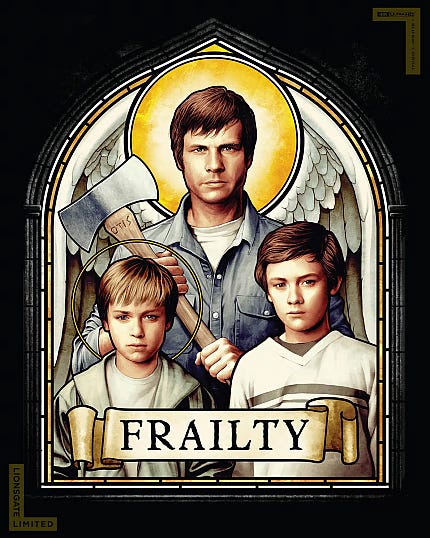
Frailty (2002). Grade: B
Powers Boothe, exuding all the charm and warmth he did on Deadwood (he’s an evil bad man in that show) is an F.B.I. agent here. On a dark and stormy night (mood rain!), he’s summoned into the office, late. Somebody’s just waltzed in and said they have information about the dreaded “God’s Hand” serial killer. He won’t say what the information is; he’ll only say it to the agent in charge of the case. That’s Boothe.
Boothe walks into his office, and it’s Matthew McConaughey sitting there. After a few unpleasantries, McConaughey says he knows who the God’s Hand killer is. Oh yeah?, Boothe responds, sarcastically. So who is he? McConaughey says, “he’s my brother.”
That’s the opening of Frailty, the only movie directed by the late, great actor Bill Paxton, who also co-stars. It’s basically everything I’d avoid in a movie; I hate stories about serial killers like the friggin’ plague (and despite McConaughey’s/Woody Harrelson’s talents, I hated True Detective). Serial killer movies/shows create and feed the overinflated fear of crime. They also tend to be sadistic and vile; in the purported interest of showing how murder and sexual violence are evil, they create and feed the audience’s interest in murder and sexual violence. When many members of a society have an inflated sense of the crime rate, and a suppressed desire to see more violence and cruelty… bad things can happen.1
Well, guess what? This really surprised the heck outta me. When a bound/gagged woman is dragged into a killer’s lair, some preview audiences walked out. (Mrs. twinsbrewer walked into a different room.) And the woman IS murdered. But you don’t see it. The killer raises an axe, and… cut to next scene.
There’s zero sexual violence and not a lotta blood in this one; in terms of the violence shown, it could be a movie made in 1962 or so. (It would certainly have been banned under the Hays code, but the code was losing strength by then.) There’s blood on fabric, there’s blood shown on a victim’s ID card. That’s it.
The movie got an “R” rating, yet the rating came with an apology, says screenwriter Brent Hanley. “They apologized because they said that we had handled all of the violence, so off screen and everything, but the premise itself was R-rated, which you can’t argue with that.” Sure. It’s about how the family that slays together stays together.
Most of the story is told in flashback form. It’s McConaughey telling Booth about his childhood, when he was about 12 and his brother about 10. They’re raised by a single dad, Bill Paxton (their mom died in childbirth). Paxton is a kind, loving father.
But one day he tells his sons something disturbing. How some of the people walking around aren’t people at all. They’re demons. And it’s their calling from God to destroy the demons. It won’t be murder, since demons aren’t people.
The younger brother, Jeremy Sumpter, accepts this unquestioningly. Not the older brother, Matt O’Leary. O’Leary tells himself it was a manic episode, maybe his dad had a brain fit of some kind. Maybe it’ll never be mentioned again. But then his dad brings the woman home, bound and gagged. You see, he’s not just going to kill the demon. He wants the kids to watch. And to help fulfill God’s mission.
Yeah, I think I agree this one should be rated R! The studio, Lions Gate, not as big then as now,2 was worried that the “R” rating would lose them the tween audience. And Haney told them, “well, f**k that. I don’t want the f***ing tweens because I didn’t write this for children. I wrote this for adults.”
Hanley said he was inspired by “‘Leonard Cohen’s song “The Story of Isaac,” the films of Alfred Hitchcock, the film Night of the Hunter, the television show The Twilight Zone, as well as the works of Stephen King and Edgar Allan Poe, and of course the Old Testament of the Bible.’” And yes, I can see all of those here. The most important one is the Old Testament.
For about two thirds of the movie, what you’re getting is a man’s descent into madness, and it’s very well done. There’s logical flaws with how it’s done, and I have a psychological criticism. It’s effective and affecting, though; you feel for O’Leary as he tries to resist Paxton’s increasing rigidity, and grows to hate the “God” that turned his father into this. (It’s a fantastic performance by O’Leary, who stopped acting after 2019. When a kid works with a class act like Paxton, it’s probably a major disappointment as an adult to find that most of Hollywood isn’t anywhere near as good-hearted.)
Yet as the story goes on, the Old Testament angle starts to come into play. I’m not going to “spoil” it here, because seeing how daring this movie is willing to be, how far it goes, is part of the fun. It’s taking the idea of vigilantism to its only logical conclusion. If vigilantes had the unfettered power to eradicate evil. It shows how deeply unpleasant and awful such a world would be. (A world that 33% of Americans deeply want, and I might be lowballing the number.)
Both Paxton and the executive producer, Tom Huckabee, grew up religious in the South. But, Huckabee says, his was the kind of low-key religious family that kept contentious ideas away from the dinner table; Paxton’s wasn’t. “He was raised Catholic and dinners with his family were no-holds-barred riotous affairs, where no subject was off limits. Prudes, ninnies, and twits didn’t last long.”3
This isn’t a movie like Heretic which tries to make the case that believers are dupes (that movie also failed by making its atheist a pedant, too). But it is saying something about the dark side of religion, the ways that sincere belief can be twisted into something destructive. It reminded me a little of Michael Shannon’s part in the movie Take Shelter — in that film, Shannon plays a man who has disturbing apocalyptic visions. Yet the effects shot which ends Take Shelter comes off a little “twist” gimmicky (Shannon’s excellent performance aside). The ending shot here of McConaughey looking numbly into the distance is much eerier. It suggests the damage false prophets can do.
The movie’s a favorite of Sam Raimi, James Cameron, and Stephen King — Cameron, who was friends with Paxton, actually suggested a script change which benefits the movie. Whenever Paxton’s character touches one of the “demons,” he has visions of their “true” selves — the script had the audience see those visions, too. But Cameron suggested that we learn what the visions were at the end. Cameron made the suggestion to make the story more emotionally manipulative, yet the later reveal of the visions fits in with what we learn about the McConaughey/Boothe connection.
That’s from this post on CreepyCatalog by Chrissy Stockton, and it does have a lot of spoilers, so only those who know/enjoy the film should read it; it’s got several interesting film facts. We see Paxton drinking Hamm’s beer during the movie; the producers could only find one vintage 1979 can, so they kept using it over and over. The axe Paxton wields has the name “Otis” carved into it; Paxton gave it that name after he tried giving a homeless person some money and the person refused. So Paxton told the guy he’d name a character in the movie after him; hence, Otis. Less sad is how Paxton remembers shooting on a soundstage next to where they were shooting Legally Blonde: “‘I would come out all covered with blood, and I’d see Reese Witherspoon in her pink Chanel outfits holding her poodle and just say, ‘Hey, how’s work going today?’”
As that story indicates, this was shot in Southern California; the setting’s supposed to be Texas, but for budget reasons, California was easier. It still passes well enough for Texas, though, because Paxton, McConaughey and Booth all were from there and all can do the accents.
The movie made a tiny profit, not much. Lousy marketing probably had a lot to do with it. Originally scheduled to be released in October 2001, the studio balked at releasing a movie after September 2001 which had a character who thinks God wants him to kill. So it came out the next April instead, not a traditionally good time of year for tricky dramas; and check out this really generic, uninformative poster:
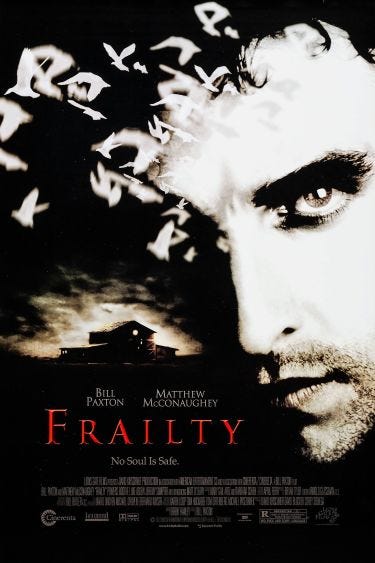
Lions Gate executive Tom Warberg even apologized for the crappy marketing, telling one of the producers “I didn’t really understand what the film was and how it really played. We could have done gangbusters.” I don’t think that’s true — I think this is too smart a movie to have been a big hit — but it’s still a nice thing for a studio executive to say. (They’re not ALL jerks, just 99.9% of them.)
If I have one criticism of the movie it’s Paxton’s direction, yet even that’s a mixed bag. He doesn’t have a very good compositional eye (it’s rare for actors who’re first time directors to have) — neither does Sean Penn, although he’s directed some very good movies. The scene staging could be a little tighter at times. Yet, while both Paxton and Hanley both set out to do a movie that “f***ed people up” the way Psycho’s surprise murder did, I think it’s Paxton’s sensibility which makes the movie more human, hence more disturbing than that. If a David Fincher or Alfonso Cuarón had directed this, the reveal of the visions would have been clearer (it’s a little sloppily done here), but would the acting of O’Leary be as good or affecting? I doubt it.
I mentioned a psychological criticism I’d make about the movie; it’s not a major one. My Dad was a religious fundamentalist and, eventually, suffered dark terrifying visions. No axes were used, but they were mentioned in a letter to my Mom. (Her custody lawyer, who worked pro bono, must have LOVED that letter. It sure convinced the judge.) And our Dad did not go from loving & kind to crazy overnight. He was never especially loving and kind (not of his kids; he originally was a better husband than dad). The religious extremism increased slowly over time; the process took a few years.
Still, the way this movie is framed, the way Paxton comes by his “visions” doesn’t have to be psychologically believable. Just the same way that certain murders go unnoticed which really WOULDN’T go unnoticed; by the end, none of that matters.
The cinematography’s by Bill Butler, who shot The Conversation and Jaws; he’s working from storyboards conceived by Paxton and visual artist David Ivie. The score’s by Brian Tyler, who seems to be channeling Howard Shore; being half as good as Howard Shore is still pretty decent.
I think this one is really worth giving a shot; the mixture of the script’s intelligent anger and Paxton’s basic decency makes it interesting. It’s a movie with some daring ideas about religion which isn’t trying to be controversial to get attention. (Although producer David Kirschner received death threats anyways.) Once you see where the story ends up, you’ll remember all the clues which were pointing that way; a spooky distorted videotape is a neat touch. It’s fine acting by Boothe/McConaughey and great acting by Paxton/O’Leary. The movie’s not perfect, but it’s really saying something original. That’s an achievement in itself.
I'm not referring to people who watch movies/shows about twisted killers for the artistic value; some of those people are gentle souls. But they'll be watching old Italian horror movies, not Law and Order: Special Victims Unit.
The old Lions Gate logo is a lot more low-rent than the new one. OTOH, I have NO idea what the new one is supposed to be about. Is it peeping through a keyhole to see the constellation Leo? What’s with the gears? It all makes no sense.
Hanley grew up around religious fundamentalists in Texas and hated it; at one point he turned to his wife and said “baby we gotta get out of here or we’re going to die.” They moved to Boston. Hanley’s wife’s name, by the way, is “Faith.”