
Ed Wood
Decent movie about odd director; with a mugging main performance.

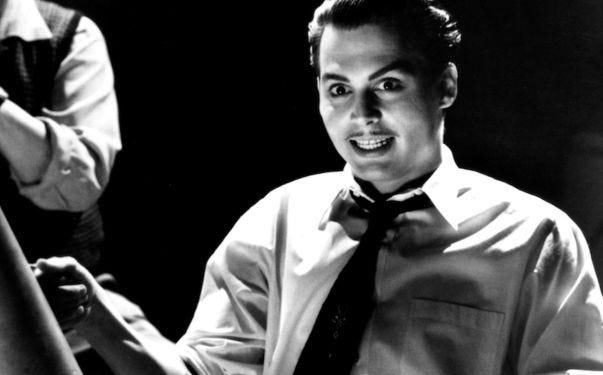
Ed Wood (1994). Grade: B-
I don’t, generally, stop liking art made by people who turned out to do Very Bad Things. Somebody told me once, “if your music collection has only 100% nice people, you have a shi**y music collection.” It wouldn’t be shi**y — you’d have some artists I enjoy a lot, like the Indigo Girls and Pete Seeger. It would, however, be very small.
But boy, does Ed Wood have a rap sheet going on. There’s actor Jeffrey Jones, who was convicted of stuff so heinous I’ll make you look it up if you must know. Bill Murray, who’s been credibly accused of some pretty inexcusable behavior. And Johnny Depp, who might/might not have done some of the worst things he was accused of… but the way the worst misogynists on the web came screaming to his defense was truly nauseating. (Plus he’s been associated with a zillion other rotten things.)
While Sarah Jessica Parker may, for all I know, be a lovely and kind individual; she’s never been accused of anything criminal in the slightest, and is married to nice Matthew Broderick. But she WAS the star of a hugely annoying princess fantasy for yuppies, playing an “influencer” before we had a term for those irritating people. (That’s not Parker’s fault; she didn’t create the show, and actors gotta act.)
So, how does all that affect my viewing of Ed Wood, a movie I loved when it came out?
Eh, not too much. The fact is, I was never crazy about Depp to begin with.
Teen idols are not my favorite people, and while Depp has some talent, I’m not sure I’d call it “acting.” It’s more like being a gifted mime. He can make his face very expressive when he wants, yet it’s usually expressing not much more than a skilled mime would. Happy, sad, confused, angry, etc. About the only time I remember seeing Depp give something close to an actual performance was in Donnie Brasco; but that might just have been Mike Newell’s direction and Al Pacino’s terrific work. Pacino was so strong at playing someone so betrayed, maybe anybody would seem to have conflicting feelings about the betrayal.
The other actors in this movie with troubling real-life incidents? Well, they’re not playing people you’re supposed to like. One of the problems with watching an old Woody Allen movie today is that it’s, always, all about HIM; how funny we’re supposed to find him, how we’re supposed to identify with his pain and his smug superiority. (Frankly, that was a problem with Woody Allen movies BEFORE we knew anything yucky about the guy.)
Jeffrey Jones here is playing an utter fraud. Bill Murray is playing the world’s biggest drama queen. And Sarah Jessica Parker’s just poorly used; watching this or the later TV show, it’d be hard to guess the same person gave such lighthearted, embracing-the-silly performances as Parker did in L.A. Story and Honeymoon in Vegas.
What’s good about this movie is the excellent black-and-white cinematography by Stefan Czapsky, a wonderful hammy turn by Martin Landau, and a very entertaining script by Scott Alexander and Larry Karaszewski.
Alexander/Karaszewski met in film school; they were roommates at the University of Southern California. (They had a better roommate experience there than I did, although I met a very nice friend across the hall.) They had a success with their first produced script, Problem Child, but Alexander/Karaszewski didn’t like the finished film; it was meant to be an intelligent dark comedy, a parody of movies where “cute kids teach cynical adults how to love,” as Wiki puts it.1 Instead, Universal turned it into a comedy for idiots; since they understood their country well, the movie was a hit. Alexander/Karaszewsi quickly wrote a sequel for money and tried to think of what else they could do with their careers.
They both loved trashy genre filmmakers like Herschell Gordon Lewis, and, while at U.S.C., had heard stories about Bela Lugosi’s last, sad, declining years; how a curious transvestite who made super-cheapie genre movies helped take care of the ailing Lugosi. Both writers had worked on super-low-budget movies before, where the point wasn’t about creating a masterpiece, but just getting the dang thing done. And that’s how they approached writing a story about “worst director ever” Ed Wood. (A perceptive film writer I know points out that if Wood had the kinds of budgets Michael Bay had, his movies probably would have had a similar quality to Bay's… or maybe, better. It’s hard to imagine a single director who’s ever been stupider than Michael Bay.)
Alexander/Karaszewski based their biogrphical information on Rudolph Grey's 1992 book Nightmare of Ecstasy: The Life and Art of Edward D. Wood Jr (I haven’t read it). They pitched the script to Michael Lehmann, a then-popular hack director the writers had known at U.S.C.; Lehmann had just made an expensive flop called Hudson Hawk. Karaszewski joked that the press would have a field day with “the director of Hudson Hawk and the writers of Problem Child making a film about the worst filmmaker of all-time!” Tim Burton became interested because the relationship between Wood/Lugosi reminded him of the friendship he had with his childhood idol, Vincent Price. Everyone involved decided that the involvement of Burton would mean a much better chance of getting the movie made, so Lehmann stepped aside.
Once Martin Landau was set as Lugosi, expert makeup specialist Rick Baker tried all kinds of prosthetic trickery to make Landau look more like Lugosi; nothing was working. (For one thing, Landau looked too healthy.) Until one day, doing test shoots, when cinematographer Stefan Czapsky walked over and switched the monitor from color to black-and-white; presto! (Since we never saw Lugosi in color, that makes sense!) That decision was made. It got the studio nervous and they pulled out, but Touchstone picked it up quickly enough.
The story deliberately focuses on just a short portion of Wood’s life and career; it doesn’t get into his childhood, his later alcoholism/production of cheap pornos, or his early death at 54. It’s a wise decision… although, maybe, it would have been ghoulishly appropriate to include a recreation of one of the first films Wood made, when he was 12, with a Ciné-Kodak Special; an airship passing near Wood’s home in Poughkepsee, NY. It was the Hindenburg, on its fatal flight. (So Wood would claim later.)
The movie begins with Wood directing The Casual Company, a play he wrote about his experiences in WWII; it’s a flop. He’s living in Los Angeles by then and trying to break into the movies. Eventually, Wood finds out that a producer is planning an exploitation film based on the life of the real Christine Jorgensen (the first American to be widely-known for having a sex change operation, which Jorgensen had in Copenhagen). Wood tells the producer he should direct it, because he knows what it’s like to feel different; he’s always had a thing for women’s clothing. The producer’s not interested.
But then the dejected Wood chances to meet Bela Lugosi, former star of Dracula, who’s out shopping for coffins; Wood listens to his stories, and they become friends. So Wood goes back to the producer and says, hey, if you hire me, I’ll get Bela Lugosi to be in the movie; that’ll sell more tickets. And we can get him cheap.
From here on, we’ll see Wood shooting three of his most famous movies: Glen or Glenda, Bride of the Monster, and Plan 9 From Outer Space. After Glen or Glenda bombs, Wood has to struggle to raise financing; he does so through hucksterism and sheer guile. Wood and Lugosi grow closer as Lugosi gets sicker and sicker; and Wood picks up a kooky entourage of oddball performers along the way. That’s essentially the plot.
And it’s not a bad plot. Alexander/Karaszewski wrote four more biographical movies after this, all based on the lives of quirky characters: The People vs. Larry Flynt, Man on the Moon (about Andy Kaufman), Big Eyes (about kitsch painter Margaret Keane and her abusive husband), and Dolemite is My Name (about comedian and blaxploitation filmmaker Rudy Ray Moore).2 Each has a good story behind it; each has a good amount of humor. The movies, to my mind, work as well as the humor works. I’ve never been a big fan of Murphy, so that one didn’t blow me away. But Ed Norton and Woody Harrelson are very funny in Larry Flynt, as is Paul Giamatti in Man on the Moon and Christoph Waltz in Big Eyes (making a fool out of himself in a courthouse scene; before then, he gets quite scary). So those are all pretty good.
And many of the performers are funny here (especially Landau when he gets cranky). Unfortunately, the star isn’t one of them.
Depp is fine when he’s playing this material straight; his best scenes are the ones with Lugosi, or when he’s explaining to various people in his life that he likes sex with women just fine, he just also likes wearing women’s clothing.
When Depp’s trying to be manic, though, he’s terrible. He said he studied the performance of Jack Haley as the Tin Man in The Wizard of Oz, and you can kinda see that in his quiet moments. But he also studied the acting of Mickey Rooney and Ronald Reagan. Reagan I’m not seeing here; Rooney, unfortunately, I’m seeing a LOT. Why would you ever consciously try to duplicate Mickey Rooney? To indicate that the character you’re playing is a idiotic egomaniacal buffoon? That’s not what Burton or Alexander/Karaszewski had said they were trying to do, they were trying to respect Wood’s enthusiasm for moviemaking. Making him into an idiot makes your main character a dolt who’s annoying to watch. Every time Depp makes his stupid face like he does in the header image, you want to tell him to cut it out… but then again, given Depp’s reputation, you probably wouldn’t want to say anything that could set off his temper.
Unfortunately, the funny Parker isn’t allowed to be funny here; she’s basically a scold, telling Wood she can’t handle his cross-dressing. The real Fuller said that while she enjoyed the movie, she “wished they could have made it a deeper love story because we really loved each other.”3 The movie has a few more, less crucial inaccuracies; Lugosi never cursed, had small dogs, or slept in coffins. Sure, but it makes the character funnier and makes us like him more, so that doesn’t matter.
Landau’s daughter Juliet Landau has a small role as a woman Wood mistakenly thinks has tons of producer money; she’s fun. So’s Mike Starr as the crass Glen or Glenda producer. Jeffrey Jones and Bill Murray were always pretty funny, whatever you think of them today. Particia Arquette, so wooden when she plays Big and Dramatic, is quiet and happy here; it suits her much better. Burton’s then-girlfriend Lisa Marie does a very nice Vampira, and George “The Animal” Steele grunts as per his nickname; he certainly seems like the reincarnation of C-movie actor Tor Johnson.
While Landau really is wonderful. The movie courts pathos a little too much with the health issues, yet when Landau’s feeling fine, he’s a hoot. He beefs on Boris Karloff (actually a very good actor in his own right), he’s cynical about moviemaking, yet this character loves Grand Acting, the kind he did on the Hungarian stage; when he recites a speech in front of a small group of onlookers, and they applaud, you know they mean it. During Landau’s grandiose moments, Howard Shore’s score gives us a little hint of some famous classical music piece; I recognize it, but I can’t name it. I’ll bet it’s Hungarian! And Stefan Czapsky’s cinematography is magnificent. I wish more filmmakers would use black & white; done right, it looks so gorgeous.
I think the movie doesn’t hold up quite as well as it used to, for me, because Depp’s unfunny clowning annoys me more than when this came out; everything that’s slovenly in movies annoys me more than it did when I was young. I’ve also grown a little tired of Burton milking his “lonely outsider chic” schtick so hard over the years; a guy this rich and successful has little in common with any real outsiders I’ve known.
The best thing in the movie, besides the Wood/Lugosi relationship, is the ragtag bunch of kooks which assembles alongside Wood. It’s like the old concept that people from families who didn’t accept or love them for who they are could create new families of their own, among their friends. Which is still a good concept; I happen to believe in it myself. (My brothers are nice, my mom was nice, my dad was not.) Tim Burton’s not really the best one to deliver this message, yet it still works. (He still shows a good eye and feel for the performances, when he’s not indulging Depp’s little joyride.)
So, come for the very good, somewhat-true story; stay for Landau and the humor and the cinematography. Depp, well… you’ll just have to deal with. He’s not ALWAYS awful here; when he’s directing at lightspeed or glad-handling moneymen, he’s tolerable. Just remind yourself that those scenes will come back when the awful ones show up.
And wait for the great, very brief performance by Vincent D’Onofrio near the end; it’s a hoot. With a voice dubbed in by Pinky and the Brain’s Mauriche LaMarche. The vocal impression by LaMarche and the facial impression by D’Onofrio are absolutely spot-on. The dubbing itself is… it’s not done very well. You can immediately tell it’s a dubbed voice, even if you don’t know what D’Onofrio sounds like. Maybe it was done near the end of production, when they were in a bit of a hurry.
Because that would PERFECTLY fit a movie about Ed Wood.
And, as Wiki mentions, there were a LOT of these at the time. You can probably name several yourself, once you get rolling. Baby Boom, Kindergarten Cop, Look Who's Talking, Mr. Mom, Parenthood, Three Men and a Baby and Uncle Buck.
They also co-wrote the miniseries American Crime Story: The People vs. O.J. Simpson. In which Cuba Gooding Jr. is his usual self. But the rest of the cast is outstanding, featuring Sterling K. Brown, Bruce Greenwood, Nathan Lane, Sarah Paulson, John Travolta, and Courtney B. Vance. Well worth a watch if you can stand the subject.
Oh, and incidentally… Fuller also said that when she saw Parker on the David Letterman show, Parker suggested the only thing Fuller ever did in her life was drink. And when she met Parker at the Ed Wood premiere, Parker told her “I just got through telling everybody that I just played the part of the worst actress in the history of film.” Which stung Fuller quite a bit. So maybe I was right to include Parker on this movie’s rap sheet after all!