
Big Eyes
Amy Adams is very good in true story of a woman whose husband steals her work.

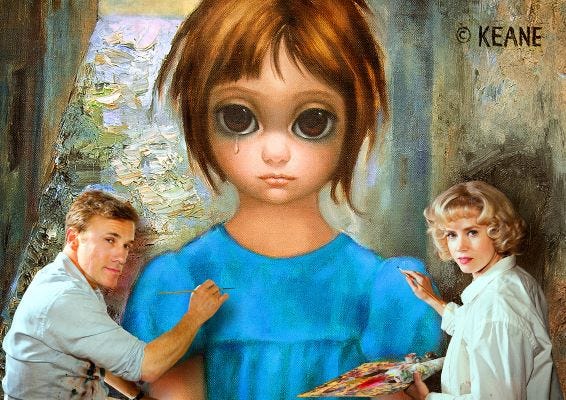
Big Eyes (2014). Grade: B-
For a time, in the 1960s, paintings by Walter Keane were everywhere. “They hung in Woolworth’s, next to the velvet Elvi, or maybe it was Walgreen’s, by the clowns,” as the LA Times put it; “gracing rec rooms and lounges all across America,” as the NY Times did. And all of them featured children staring directly at the viewer, with outsized, sorrowful eyes. “A cheap psychological trick,” one psychiatrist told LIFE magazine about the paintings’ appeal.
In any case, posters of the paintings were very popular — Andy Warhol admired them. And all of this made Walter Keane oodles of money. (Which is what Warhol admired.)
Except he hadn’t painted any of them. His wife, Margaret, had.
That’s the story depicted in Big Eyes, directed by Tim Burton, from a script by the great Scott Alexander and Larry Karaszewski (The People vs. Larry Flynt, Man on the Moon). It’s got creepy/funny Christoph Waltz (Inglorious Basterds) playing Walter, and the wonderful Amy Adams (Enchanted, Julie & Julia) as Margaret.
Adams wows you right away, in the very first scene, where she’s fleeing with her young daughter from a bad marriage. Anyone who’s ever had to emergency flee from a bad relationship is probably going to have flashbacks watching this. We don’t even see the rotten husband, only the fear on Adams’s face, and it’s strong stuff.
Happily, she ends up in San Francisco, with a wonderful friend (the likeable and woefully underused by Hollywood Krysten Ritter). Adams is working as a sketch painter at an art fair for peanuts; Waltz, seated nearby, does far better selling his streetscape paintings. Eventually, the two of them get together, and Waltz manages to get their paintings displayed at the chic Hungry i nightclub.
But the first time somebody buys one of her paintings, they assume it’s by Waltz. He’s good at playing everyone’s imaginary quirky artist archetype; Adams’s Margaret is much shyer. This happens by accident the first time; after that, Waltz convinces Adams that nobody will buy the paintings if they think a woman did them.
Writers Alexander & Karaszewski started working on the script in 2003, with Maragaret Keane’s permission. And she only made one demand; they must absolutely show that she did the paintings. Up until his death in 2000, Walter Keane claimed he’d done all of them, and Margaret was just trying to be a mooch.
This interview of the screenwriters by Steve Macfarlane is really a hoot; they actually toned Walter’s awfulness down for the movie quite a bit. In Walter’s autobiography, Alexander says, “he’s written a bunch of celestial beings floating in the clouds, with pillars like Michelangelo, Gaugin, and at the end of the book Walter is appointed and gets to be up there with the others.” And the courtroom scene at the end is restrained, too — in real life the judge threatened to cover Walter’s mouth with duct tape.
The courtroom scene is the highlight of the movie, and it’s very much needed by that point. There’s a certain fascination in watching Waltz slime his way through this one — just like there was in Basterds. (It was more fun to watch him be halfway decent in Django, though.) By the time he gets to threatening Adams, you’re ready to be done with the guy, and there’s still more of him to come. In court, his lies and bullying don’t sit well in front of a smart judge. (Character actor James Saito, who you’ll recognize immediately without knowing what you recognize him from — because he’s been in a million things.)
This is one of the better roles Adams has ever had, and a tough one — she’s playing a woman who lets herself be walked on for awhile. And someone who paints really kitschy, sentimental art. You need an actor who can play trusting and naive without seeming like a featherbrain. Adams can do that. (Per Wiki, Reese Witherspoon was once committed to the part, and she can do that, too. Also per Wiki, Ryan Reynolds was almost in the Waltz part and… no.)
Interestingly, behind-the-scenes wise, Tim Burton had met Margaret Keane before he knew Alexander & Karaszewski were working on this script! (Even though they made Ed Wood together.) Burton was fascinated with the creepy aspects of Keane’s art, and commissioned her to do a painting of his then-wife, Helena Bonham Carter. (Who was out of his league, by the way.) Keane liked Carter, and Burton liked Keane, saying later “‘she’s the quietest feminist: “I am woman, you can barely hear me speak.’”
I like that Burton was doing something out of his norm, here — that there’s nothing vaguely sci-fi or gothic about this material. (And I’m sorry he’s gone back to that sort of thing.) He doesn’t have quite the feel for the couple’s early pairing; he doesn’t rein in Waltz enough to make him be actually charming in these scenes, rather than just an eager climber. (There’s never been any romance in any of Burton’s movies, really.) But he gets the humor right in Walter Keane’s pretention, and in the courtroom sequence, where the blowhard just makes a fool of himself.
There was an interesting profile of Margaret Keane in The Guardian when this film came out; the profile’s by Jon Ronson (author of So You’ve Been Publicly Shamed). In it, Ronson tells Keane that Walter was diagnosed with delusional disorder, where someone absolutely and sincerely believes something that is positively not true. Keane says she felt guilty she didn’t come out with the truth earlier than she did; that “if I hadn’t allowed him to take credit for the paintings, he wouldn’t have got as sick as he got.” The poor woman! (And his treatment of her was actually harsher than the film shows; he’d lock her in the studio for 12 hours a day or more.)
Most of the film is fairly true to reality, although Walter never attacked a New York Times art critic with a fork. (It’s still fun in the film; Terence Stamp thwarts the attack effortlessly.) The actual court case took place long after the marriage ended, although it’s moved up here for a sensible reason; Alexander & Karaszewski didn’t want the actors to have to wear aging makeup and cast an adult actress as Margaret Keane’s daughter. (The two who play her daughter as a kid, then teenager, are amusingly bright, and Madeleine Arthur has one of the best lines in the film, once her mom finds a friendly religious community for needed emotional support: “does Heavenly Father approve of suing people?” In this case, yes!)
There’s one scene from the actual trial I wish the film had included. Walter, who was representing himself, would call “character witnesses” to testify that they personally knew how good a painter he was. Under oath, none of them were able to do so. And one felt so bad about it that he apologized to Margaret personally, after the trial. He flew out to visit Margaret in his own private plane, and she appreciated his apology.
It was Wayne Newton! The singer! Go figure. Karaszewski said “it took a lot of restraint for us to not write a Wayne Newton scene.” Aw, c’mon guys, you should have.