
Destry Rides Again
James Stewart is a wimpy "dude" Western deputy... or is he?

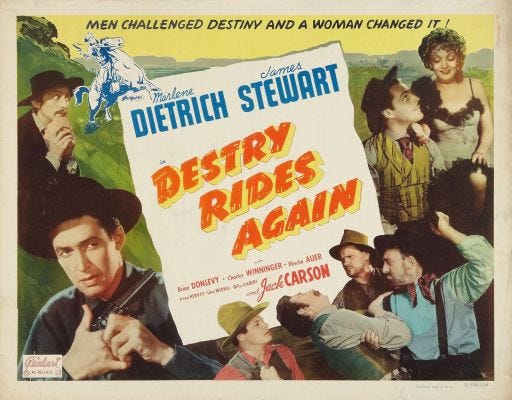
Destry Rides Again (1939). Grade: B-
Among the infinite reasons to loathe the internet is how it’s practically robbed kids of an ability to watch old movies the way I did, growing up. Movies that would show on independently-owned TV stations on the weekends. I devoured anything with action or adventure in it; I would even tolerate a little romance so long as there were thrills. (Like the romance in The African Queen, which I put up with to get to the rapids and the leeches and beating the Germans.)
Not that there isn’t good entertainment being made for kids today; there is and there always has been. But that there’s something particularly fun for a kid, or there was for me, in watching movies that weren’t meant for kids and enjoying them anyway. And a lot of the great all-ages movies are pretty old; I’m sure today’s kids wouldn’t be able to stand more than a few seconds of watching The Adventures of Robin Hood or Destry Rides Again. The old-fashioned visuals would just confuse them.
I never saw Destry Rides Again as a kid, or anytime before now. But I’m sure I would have positively loved it at around eight or so. And it’s a movie that can take you back to being a kid… if you’re old enough to remember watching movies on boxy TVs and thinking those old ones looked perfectly fine!
Your story’s as simple as they come. Bottleneck is the rootin’est, shootin’-est, low down party town in the Old West, and Brian Donlevy is its boss. Or, co-boss, along with saloon chanteuse Marlene Dietrich (with her thick Teutonic accent, and playing a character inexplicably named “Frenchy.”) Donlevy hustles suckers into making huge bets in poker, then Dietrich helps Donlevy cheat at cards to bankrupt the suckers. One guy loses the deed to his ranch this way! He’s so ticked, he asks the sheriff to step in; the sheriff agrees, and disappears into the back room. Bang! Bang! No more sheriff.
Donlevy, flush with booze and victory, tells the corrupt little mayor to appoint a new sheriff; the party boys at the saloon pick hapless Charles Winninger, the town drunk. But Winninger’s actually gonna try to take the job seriously. He’s gonna bring in the legendary lawman Tom Destry to be his deputy, and the de facto REAL sheriff. To clean up dirty Bottleneck and its dirty boss Donlevy. Somebody points out, ain’t Destry dead? Sure, Winninger agrees. But his son, Tom Jr., is alive. And every bit the tough lawman his dad was.
Soon enough, Tom Jr. arrives — it’s James Stewart. Carrying… a parasol? Who heads into the saloon and drinks… milk? And he doesn’t even carry any guns? ‘Cause he doesn’t believe in ‘em? The guy’s a pansy and a pushover! Donleavy and the rest of the rowdies are gonna walk all over this wimp.
Or… so they think.
The title’s from a 1930 novel by Max Brand1 (I haven’t read it), which apparently is about a tough gunman who’s sent up for a crime he didn’t commit; after getting out, he gets even with all of the jurors who convicted him. That’s also apparently the plot of a 1932 movie version starring silent Western star Tom Mix (whose stardom didn’t translate to the sound era).
Producer Joe Pasternak (a Jewish Hungarian who fled Europe before the war) basically just ripped off the title of the popular book/film, and got a whole truckload of writers to cobble up a new story/script; Farran Smith Nehme’s quality (as usual) Criterion essay names at least five different authors, there were likely more.
It’s possible one of them was a FDR liberal, because if you squint really hard, you can see aspects of late-1930s American liberalism in the story. Donlevy, the bad guy, is effectively grabbing up all the surrounding ranch land to gouge all the small farmers; he’s like the bad monopolists of old (and of now). Stewart, the pacifist who refuses to use force unless he absolutely must, could be seen as a stand-in for America on the brink of WWII. In the end, he defeats the bad guys, but it’s only with the help of all the little people in town who stand up to the baddies, too — especially the women.
Yet the rest of the story’s just the simplest kind of adventure narrative you could imagine. The baddies push the kindly good guy, and they push him and push him, until he’s not gonna take it anymore. The end credits of the Criterion release say that Steven Spielberg was a major contributor to the film’s restoration; the Stewart “wimp/nerd” who becomes the hero has its resonance in a lot of movies Spielberg directed (like Jaws) or produced (like Back to the Future).
The other major star in this is Marlene Dietrich, a former sex icon pushing 40 (gasp!) who’d been in a few recent flops (double gasp!); she was living in the French Riviera with her daughter, husband, ex-lover, and current lover, and doing her best to help friends get out of Germany. She was reticent to do a Western, she’d never been in one. The ex-lover was famed filmmaker Josef von Sternberg, who’d directed Dietrich in lavish exotic-settings movies such as Morocco and Shanghai Express. He told her, “I put you on a pedestal, the untouchable goddess. [This producer] wants to drag you down into the mud, very touchable. A bona fide goddess with feet of clay—very good salesmanship.” Dietrich soon left Europe to make this movie.
She always had a weird, warm/icy presence, and she sure does here. When she’s not helping Donlevy cheat at cards, she’s doing things like strutting on the bar singing “See What the Boys in the Back Room Will Have” in her goofy Germanic accent; it’s both sultry and extremely ridiculous at the same time. (The songs are by Frederick Hollander, who wrote songs for some of Dietrich’s earlier hits, and Frank Loesser, who’d later write both Guys and Dolls and the perfectly-innocent “Baby, It’s Cold Outside.”)
How’s her hate/love chemistry with Stewart? It’s alright. He was at his most charming when he was moony over a girl (like in The Shop Around the Corner), here, he’s kinda fending Dietrich off. I didn’t really feel a click, although you can tell they’re having fun with each other.
Apparently, it was much more than that! Per Richard Steiner’s TCM essay, producer Pasternak said “She took one look at Jimmy Stewart and began to cut her hands. She wanted him at once. He was just a nice, simple guy who loved Flash Gordon comics. That was all he seemed to read on set. I remember she did something incredible. When he was in his dressing room she locked the door and wouldn’t let him out. But she promised that she would come back with a surprise. The surprise was a doll, a life-size doll of Flash Gordon. She had persuaded the art department to come in over the weekend and make it up for him. It was correct in every detail. It started a short romance.”
Director George Marshall had done some of the old Tom Mix movies, and would do many more unmemorable movies in every genre later. Probably the most notable thing about his career is that he and famous director John Ford both got their first experience as directors on the same day in 1914 for the same reason; a raging party for the studio’s top bigwigs left the assigned directors hungover, so assistants Ford and Marshall had to take over.
Nothing Marshall brings to the party is especially of note, although he doesn’t muck anything up, either, and there’s some impressive handling of chaotic crowd/fight scenes. The opening shot is quite nifty, tracking its way through town as we see every imaginable kind of Western “lawlessness” on display; Hal Mohr was the cinematographer. (This opening shot shows us rowdies firing their pistols at the roof of the saloon, and the nonchalant gamblers in the room above; what’s that floor made of, Kevlar?) Marshall does encourage quite a bit too much “boisteriousness” from Winninger and Donleavy; Donleavy is better with a leash, as in The Great McGinty. Mischa Auer is, well, a lot (like he was in My Man Godfrey) but at least he’s an unusual sort of weirdo (like his “monkey act” in My Man Godfrey).
Winninger’s town drunk who tries to go straight and clean up the baddies might ring some familiar bells for you; and Marlene Dietrich singing in a sexy/goofy accent sure will: both were totally lifted for Blazing Saddles. Nehme’s Criterion essay points out how many aspects of this one have popped up later, from the saloon singer with the mysterious past to the reluctant gunslinger to the “catfight” between Dietrich and Una Merkel. Merkel said of the fight sequence:
Neither of us knew what we were doing. We just plunged in and punched and slapped and kicked for all we were worth. They never did call in the stunt girls. Marlene stepped on my feet with her French heels. The toenails never grew back. She was stronger than me. She was very powerful and I was very thin. Luckily, I have a remarkable constitution. I was bruised from head to foot when it was over. I looked like an old peach, green with brown spots. And I felt like one too. At the end of the scene Jimmy Stewart came in and dumped a whole bucket of water over us. He did it in long shot. Then he had to do it over for close-ups. Then Life Magazine wanted pictures so they did it over again. He dumped water on us for hours.
Oh, and there’s a moment where a man smacks Dietrich, too, and the one Black person in town is, of course, the maid (respected stage performer Lillian Yarbo, who at least here is shown here as a Southerner, not a dimwit). So, maybe the stuff I wrote up top about this being a great film for kids isn’t so appropriate, after all? Although I’m sure my parents wouldn’t have minded it at all if it came on TV. The only thing my Dad found immoral in movies was showing preachers in a bad light or any two characters having premarital sex (and completely missing how many characters in old movies were strongly hinted at gettin’ it on).
Yet I still enjoyed it in a childish sort of way, that way that Spielberg would put into his movies all those years later; and Dietrich’s last scene is a good one, even if it’s the purest hokum. I like Stewart’s reluctance to use violence (even though, in the end, he does); I wish the script had been cleverer, but it’s alright enough.
And you can simply enjoy the total chaos of the silly fight scenes, in a brightly-lit saloon, at night, in an era before there was indoor lighting. It’s total mayhem in a way that never would have happened in real life, has in many Westerns since, and has everything except a piano player getting out of the way. Although we do have James Stewart getting out of the way of Dietrich throwing liquor bottles and furniture! And, surprise — for a tall guy, he’s pretty nimble at it.
Brand sold the movie rights for $1650; not a small amount in those days, but not a ton, either. After Brand died, his widow tried getting Universal to pony up some of the massive profits they made off multiple film versions of this material (there was a 1954 version, too). The courts ruled against her and Universal didn’t pay one more penny.
What did Brand die of? He’d drunkenly decided to join the war in 1944, despite being above draft age. He wanted some war experience for a novel. He was almost immediately killed in Italy.
I also watched a lot of flicks as a kid off cable TV. My parents were always okay with that because of the built-in editing (so my dad didn't have to create the clean versions himself...hahaha). So, a lot of my "film education" came that way too.
I've never seen this one, but it sort of speaks to how good Jimmy Stewart was as an actor. He basically played the same role in every film (the pacifist, aww shucks, simpleton) who by the end of any given flick must rise above that characterization and do something truly valiant. I see it in It's A Wonderful Life, Mr. Smith Goes to Washington, Shop Around The Corner, and The Man Who Shot Liberty Valance. His Hitchcock roles were a little different, but even they played on his awkward physical characteristics (his bit trying to sit at a low table in The Man Who Knew Too Much is a relatable favorite of mine). I consider him one of the greatest actors of all time because even though he didn't exhibit a ton of range, the roles he did inhabit frequently he usually elevated to iconic status.