
The Great McGinty
The first comedy directed by the great Preston Sturges.

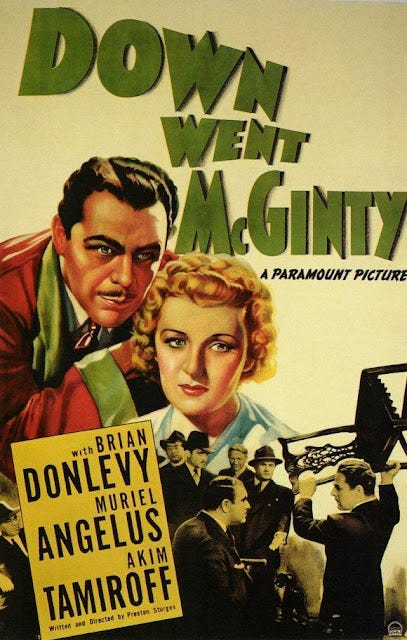
The Great McGinty (1940). Grade: B-
“This is the story of two men who met in a banana republic. One of them never did anything dishonest in his life except for one crazy minute. The other never did anything honest in his life except for one crazy minute. They both had to get out of the country.”
So begins The Great McGinty. We see a guy in a bar who’s practically falling-down drunk (Louis Jean Haydt) and a “sultry Latina” dancer who’s, inexplicably, hanging on the drunk dude. (She’s played by Steffi Duna, who is actually Hungarian.) The guy’s drunk because, back in America, he had a good on-the-way-up career at a bank. Until he embezzled some money. That’s why he’s hiding out in this unnamed country, now.
He tries to kill himself! But the bartender (Brian Donlevy) stops him. And starts telling him a tale, to cheer him up. The guy thinks he’s fallen from a great bank career, huh? Well, the bartender used to be governor of a U.S. state! Look how far HE’s fallen! He used to be Governor McGinty…
By this point Preston Sturges was the highest-paid screenwriter in Hollywood, as several of his scripts had been hits. But he was disappointed in how directors-for-hire handled the acting and the dialogue. He thought he’d be able to do better himself, and offered Paramount the script for $1 if they’d let him direct. The studio gave him $10, a quick shooting schedule, a small budget, and no stars. The idea was to kill this notion of writers getting to direct in the bud — writers were supposed to be “part of a team, like piano movers,” Sturges later recalled.1 Once Paramount saw the finished film and realized it could make some money, they publicized how unusual the $10 deal was. And other screenwriters like John Huston and Billy Wilder soon got their shot.2
Here’s your basic plot. McGinty’s a tramp, down on his luck, waiting in a line for food relief. It’s election night, and some “political fixer” is offering $2 to every tramp who casts a phony vote for a dishonest mayor. So McGinty votes 37 times. He’d like his $74, please! (Depending on the year, that’d be about $1500 today.)
The “political fixer” (William Demarest) is impressed. So he takes McGinty to meet The Boss (prolific Armenian-American actor Akim Tamiroff). The Boss is impressed, too, although he wants to push McGinty around a bit (the two will get in scuffle after scuffle throughout the story). Eventually, he hires McGinty as a musclebound debt collector… then as a city alderman. Then asks him, would he like to be mayor? (The Boss pretty much runs everything in local politics — which was often the case in places like Chicago or New York, back in the day.)
Along the way, McGinty picks up a wife, merely to get the “women’s vote,” since women “won’t vote for a bachelor.” His secretary, Catherine (Muriel Angelus) offers herself as an option. Not for real, just for show. Her first husband ran off years ago, she’s got no interest in another. She’ll just pose for pictures with him and such. McGinty agrees.
Eventually, though, when McGinty’s at the height of his rise to power, there’s a strange senation that comes over him. Something that makes him feel guilty about all his selfishness and empty posing. Something that makes him want to be a better man, and use his political powers for good. (I’ll give you three guesses what that “something” is, and it’s not Christmas ghosts or Pinocchio’s conscience cricket.)
And that’s when everything starts going downhill…
The movie peaks about 30 minutes in, or so, when Brian Donlevy (as McGinty) is being that strongman debt collector. He’s wearing a big loud checkered suit coat, and it’s a hoot just seeing him swaggering around like the world’s flashiest hood in this dumb thing:
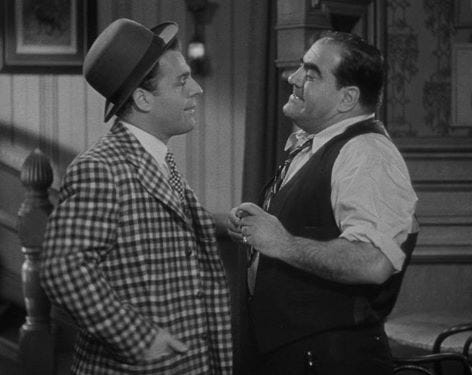
He’s perfectly willing to be both the bad cop and the good cop at the same time, and is clearly enjoying himself at it (both the character and the actor). Most of the debt he’s collecting is back-owed protection money that people haven’t been kicking up to The Boss. One might wonder what a nice-seeming middle-aged lady would need to pay protection money for. Until she says McGinty’s good looking, and asks him to stick around, maybe go upstairs… OH. SO THAT’S WHY SHE PAYS PROTECTION MONEY.
This was a few years after the Hays Code started being enforced, and one thing people really enjoyed about Preston Sturges scripts is the number of ways he could hint at what the code didn’t allow. So, here, it’s suggested that the friendly lady is also a friendly madam. At the beginning, that “sultry Latina” hanging around the drunk dude… she’s probably got him figured for a moron she can seduce & fleece. None of this is stated, so it wasn’t anything the dumb censors would notice. (And Sturges, and some other clever writers or the era, would sometimes put things in scripts they KNEW the censors would notice, so they could say “you got us” and take those things out, sneakily leaving other things in.)
After McGinty gets promoted up from debt collector, the movie isn’t as hilarious, but it’s still chuckle-worthy and easy to watch. Donleavy usually played heroic or dangerous tough guys, so it’s fun watching him play a tough not-so-bright palooka who turns out to have a soft streak. (Sturges had a knack for this; he’d later do somehing similar with Joel McRae.) Tamiroff is always hammy, and he’s enjoyably so when he’s reined in a little (like he is here; Orson Welles didn’t rein him in enough for Touch of Evil). William Demerest is great as the utterly unscrupulous political fixer, and would be in seven other Sturges films.
And Muriel Angelus (who’s English, but you wouldn’t know it) has a nice tough/tender touch as the secretary-turned-political show wife. This was her fourth American movie, and she’d quit Hollywood soon after, realizing Paramount wasn’t likely to give her enough meaty parts. Sometimes it’s best to not believe the promises studios make to you, and she was smart for not buying their bull.
There is an unpleasant element which pops up in movies of this period, and it’s worth being warned about if you’re just starting out in watching these films. It’s how Black people are almost always “the help,” and often shown comically, as if they’re idiots.
In Sturges’s case, I’m reasonably sure this wasn’t because he was trying to perpetuate a stereotype — he frequently shows EVERYONE as idiots. (In one scene, McGinty’s reading a children’s book to his little stepkids, and when they fall asleep he’s gotta finish the book because, well, it’s probably the deepest book HE’s ever read.) But there is one rather dim butler, here, so be aware of it. The Palm Beach Story, which I love, has a bigger “dumb bartender” scene, and I wouldn’t show that to kids until they were old enough to understand what to make of it. (The dumb bartender’s surrounded by even dumber rich guys… still, it’s cringe-inducing to watch.) At least here the maid’s known as being pretty useful — she helps get rid of an unwanted interloper when the time is right.
This is sometimes considered a political movie, because it shows a lot of corruption on McGinty’s rise to the top. Was it political in a smart way, or just in the cynical “ALL politicians are crooks & liars” way? A little of both. The modern poli-sci professor Steven Schier wrote how “as a budding Broadway playwright in the 1920s, Sturges lived in Westchester County, New York. His next door neighbor, Andy Seiler, was a state judge who aggressively pursued cases of political corruption. This good work eventually produced his murder by mobsters. Sturges wrote the script in part to avenge Seiler's death.” Sturges might also have been thinking of former New York governor William Sulzer, who was impeached in 1913.
Still, when you see that the “corruption” here involves taking a piece of public construction projects, you might feel a little jealous — it’s a lot better than our modern political crooks, who just use government to give themselves fat contracts for doing NOTHING. (Or kill government agencies that would regulate their crooked business schemes.) The New Deal wasn’t always effective, but it had a pretty good record at staying corruption-free. Although people had good reason to be wary of it, after how criminal Warren Harding’s administration had been in recent memory. In an earlier script, as critic Brian Darr observes, Sturges had a neswpaper heading reading “ROOSEVELT REFUSES THIRD TERM” — referring to Teddy Roosevelt and gently poking at FDR.
In the end, Sturges is most fun when he IS poking at everyone. (His two morale-building movies during WWII, despite some enjoyable censorship-pushing, are killed by too much rah-rah sappiness. Well, that, and the presence of Eddie Bracken, who is Awful.) As Scorsese pointed out, Sturges’s mom was a successful businessman, his mom an art-loving European sort, and Sturges got the joke of how movies were a blend of artistic talent and raw greed. He didn’t succeed forever at it, and took to some heavy drinking which was hard on his health and his marriages, but at his best he was making something both cynical and charming, a combination that was utterly new.
Incidentally, the cheap library DVD copy we got was from a series called “Universal Classics,”3 and it’s one of the oddest DVDs I’ve ever seen. You pop it in and it automatically starts playing the movie, then automatically exits to your DVD player’s menu after the movie’s over. No special features, no other trailers, no nothin’. Still, it’s a reasonably OK-looking print, and if putting out cheap DVDs was a way to keep old movies in circulation, I’m all for it.4 (Like many old films, this isn’t available for streaming on any of the regular services. There’s a decent archived copy available.)
That cheap DVD had a goofy yellow cover which Mrs. twinsbrewer thought resembled a “Curious George” book cover. What do you think?
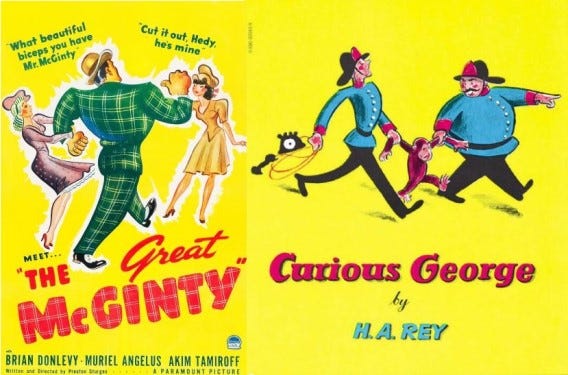
Yup! Very alike! And, ultimately, both characters get in a bit of trouble…
American TV is frequently written this way, with a “showrunner” (who may or may not have written or directed anything on the program) getting all the attention. BBC shows give the writers much bigger credit.
There’d been many directors who wrote or co-wrote their own scripts in the silent era, but this was much less common in the early days of sound. The studios always resented those silent writer/directors, anyways. Some were more interested in making art than money, a Hollywood no-no.
Why is a Paramount movie released under “Universal Classics”? It’s a long, complex story, but the short version is that studios undervalued what a big moneymaker home video would be, and frequently sold off the rights to much of their old catalogue for peanuts. It’s how Ted Turner acquired the rights to so many old movies. So eventually these things just passed hands time and time again. Which is still happening.
William T. Garver’s nice review on a nice website says there’s a Kino Lorber edition with a good commentary by film historian Samm Deighan.