
Capote / Infamous
Why two movies about Capote? Why ONE? Good actors, though.

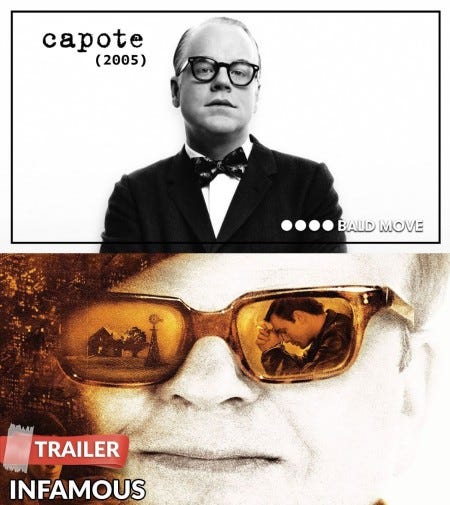
Capote (2005). Grade: C-. Infamous (2006). Grade: C-
Sometimes, in the pursuit of art-for-art’s sake, two Hollywood projects will get the go-ahead about two similar subjects at roughly the same time. It happened with two adaptations of Les Liaisons dangereuses in the late 1980s, from two respected directors (Stephen Frears and Miloš Forman); it’s what happened here.
Where one project becomes aware the other is being made, yet feels compelled to press forward, because their take on the material means so much to them, they’re not willing to just give up and let it go. An admirable, if perhaps somewhat foolhardy, creative impulse. Who am I to say that anyone should give up a passion project, a labor of love, just because somebody else is working on something close to it?
So, which one should you, the viewer, see?
It’s a difficult choice. But, if I had to choose, I’d probably go with Dante’s Peak over Volcano.
These two semi-biopics about Truman Capote and the writing of 1965’s In Cold Blood are, of course, different movies than those disaster blockbusters. These have High Artistic Aspirations; the others were the kind of movies you see while you’re waiting for your plasma to be sucked out of your arm for $25.
But, are these actually any better than the silly disaster movies? Not by a whole heckuva lot! And, in each case, what you’re really there for is to watch some fairly decent actors doing their thing; Tommy Lee Jones in Volcano, Pierce Brosnan in Dante’s Peak, Morgan Freeman being a noble, doomed President in Deep Impact, and… I guess there were stars in Armageddon. (To mention two other similar-themed, same-time movies.) I never saw Armageddon. It’s a Michael Bay movie, I’ve managed to avoid them all so far. But I’m sure it has Stars.
In these, you’ve got two really tremendous actors; Philip Seymour Hoffman in Capote and Toby Jones in Infamous. Both of whom are really excellent in the roles, insofar and so much as they’re able. Because there’s a central flaw in both these movies that’s impossible to overcome, no matter how good the acting is. Two flaws, really.
Truman Capote is not that interesting a person. The only point to these stories is showing how Capote took a gruesome, real-life set of killings, and made it into a book about, really, publicizing himself.
Both movies depict a gruesome, real-life set of killings, and make them into movies about… how great the filmmakers are.
It’s impossible to escape that second conclusion. I guess some people might find Capote an interesting figure, so, for them, there’s that fascination. But you can’t avoid the fact that these movies are doing EXACTLY the same thing they accuse Capote of doing with In Cold Blood. Using tragedy to try and win awards/acclaim/publicity.
Capote begins with a re-enactment of the killings themselves. It’s semi-tastefully done, I guess. I don’t see the need for it. Infamous starts without showing the murders, and I thought that was better — we see Capote touring the house where the murders took place, seeing the bloodstains, and that’s gruesome enough. It lets your imagination fill in the details.
But Infamous will, eventually, get to the murders, and show them to us with loving, detailed attention to the appropriate desperate writhing and screams of the victims. Why? What the fuggever is the point? To make us hate killing? We already hate killing! There is NO NEED for this.
So both movies are doing what Capote did. Maybe in 40 years, we’ll have a movie about two shallow filmmakers making movies about a shallow writer using tragedy as self-promotion. Or two such movies. Or four! Double it every 40 years!
Infamous starts with people addressing the camera in a faux-documentary-style way; we are shown names on screen telling us who these people are. Slim Keith, Diana Vreeland, Babe Paley. Although those aren’t their actual names. They’re the names of famous late 50s/early 60s New York high-society types. We’re watching the actors who are playing these people, filmed as if they’re in a documentary about Capote.
I’m sorry, but do you know, or care, who Slim Keith, Diana Vreeland, or Babe Paley are? No, you don’t. Who would? The one name you might recognize would be Gore Vidal, although the actor playing him (Michael Panes) looks and sounds absolutely nothing like Gore Vidal. (He’s saying lines that sound like something Vidal might write, but he’s not delivering them the way Vidal would.)
Later, we’ll see actor John Benjamin Hickey as Jack Dunphy, Capote’s partner/longtime companion. Talking about he and Capote’s complex sexual relationship. When is this imaginary documentary supposed to be taking place? They all look exactly the same age they do in the movie! But neither Dunphy nor almost anybody else would possibly have talked openly about a complex homosexual relationship to a documentary crew in 1965! It’s a nonsensical device. Writer/director Douglas McGrath can’t think of other ways to have these characters express what they think about Capote, so he’s having them talking to an imaginary film crew. It makes no sense. (They’re also all talking about Capote like he’s dead — he died in 1984, not in this time period.)
The quality TV movie First Day, about the Manhattan Project, did something similar at the end, with actors playing figures like Dwight Eisenhower talking, to the camera, on what they thought about the decision to bomb Hiroshima/Nagasaki (Eisenhower didn’t agree with it.) But it’s not framed as a documentary. They’re just talking straight to the camera, to the viewer, and why not?
The faux-documentary style can be fine as a device for comedy or horror. Or it can feel stale in both, it depends how clever the material is. (It’s used to great effect in an episode of What We Do in the Shadows where vampires start attacking all the faux-documentary crew; it’s scary AND funny.) Here, it just feels stupendously lazy.
Everything writer/director McGrath has ever done sounds, frankly, awful. A friggin’ documentary about super-producer/Hollywood bigshot Jerry Weintraub? Oh lord, barf. An Austen adaptation with Alan Cumming and Jeremy Strong in it? Now we’re talking! Oh, wait… it stars Gwenyth Paltrow, the Goop seller. So, nope. (She sings in Infamous. The style is supposedly meant to evoke Peggy Lee. It does not evoke Peggy Lee. I LIKE Peggy Lee.)
Switching over to Capote for a second, who are the driven creative geniuses behind that one? Well, the script’s by one Dan Futterman, who wrote the tedious and painfully shallow Foxcatcher. It’s directed by Bennett Miller, who did… yep, Foxcatcher. And Moneyball, which also had a good Hoffman performance. (Except there really wasn’t any such thing as a bad Hoffman performance, after about Twister or so.) Even Moneyball, which had a good script and terrific cast… something about it felt rather numb, to me. Like there was some central core missing. (Maybe because the basic notion, that of using stats to maximize the value of a low-payroll roster, is clever, but it’s not exactly FUN. No baseball fan is likely to be stirred by Brad Pitt repeating, as a sacred mantra, “defense doesn’t matter.”)
Neither of these films is poorly-directed, really. Or well-directed. They could easily be Directed By Bot. Cinematographer Bruno Delbonnel gets a few good shots of Kansas into the frame; he’d do a much lovelier job of shooting the outdoors in The bllad of Buster Scruggs. But that movie had at least four stories worth telling in it. These films don’t really have any.
Your basic plot (it’s almost note-for-note identical in the two movies): there’s a brutal home invasion in Kansas, two parents and two children tied down and then slaughtered. Truman Capote, fresh out of writing ideas, reads about the murders, and wants to do a New Yorker article about them. About how their brutality impacted the community. And about himself, how only a writer of Capote’s immense stature could possibly have rendered the tale as delicately, with such perfect prose. (What little I’ve read of Capote did not impress me much.)
So Capote travels to Kansas, along with his longtime friend Harper Lee (author of To Kill a Mockingbird, who met Capote when they were children in the same small Alabama town). The locals and law enforcement are not eager to talk to Capote, who is rather overtly foppish. But his Hollywood anecdotes (he worked on a few movies and TV shows) and Lee’s charm eventually win over the locals.
Then the actual killers are caught, and Capote develops a relationship, of sorts, with one of them, in prison. He uses his own traumatic childhood as a way of bonding with the killer, who also had a troubled upbringing. Capote is at his most seductive and sensitive when talking to the killer, and may have a major crush on him as well. Certainly, the killer takes something of a shine to Capote, and writes him often afterwards. Capote, feeling guilty, rarely answers the letters. He visits the killer briefly in prison right before his execution, but that’s it. He mostly uses his relationship with the killer and with the townsfolk as grist for his well-reviewed novel (I haven’t read it nor will I), but never finished a full-length book again.
There’s not much to actually care about, here. Capote burned his talent out? Or, perhaps, sold his soul? I’m guessing less than 1% of the people who saw the movie read any of his writing. There’s something in Capote’s relationship with Harper Lee that’s interesting, and something about his relationship with the killer that’s got a gruesome, twisted angle to it which some people might find fascinating (I found it pretty gross). That’s about it.
Oh, and Capote hobknobbed with all the wealthy and famous sorts. Who are shown as being oh-so-shallow! Not like really COOL Hollywood people who win awards and hobknob with super-producer Jerry Weintraub. No, the bad kind of rich/famous people.
What a load of horsecrap. This is something Hollywood has done for well over 100 years, now; show us wealthy famous people who “everyone is talking about” and then condemn them for being shallow. Sucking up to the audience’s desire for having money and living in luxury, while congratulating them for not being MEAN like the people who live in luxury. It’s cheap and stupid and just encourages more worship of wealth, not more serious criticism of it.
Mein Gott, there was even ANOTHER Truman Capote project on TV a few years ago, with ANOTHER good actor (Tom Hollander), called Capote vs. the Swans, produced via schlock-by-formula hackster Ryan Murphy. I probably watched half an episode. All this crap is about people who were famous for being famous. There is no reason for anybody to make it.
Is there any reason to watch either of these? Sure. Hoffman and Jones. Jones has the advantage of being a bit closer to Capote physically (Hoffman was just a big-boned fellow), but both do fascinating transformations with the voice. Hoffman focuses more on Capote’s vast need for praise and attention; Jones focuses more on how that need comes from a loneliness inside. The best scene in Infamous is where Capote is describing his miserable childhood to the killer; the best one in Capote is when we see Capote’s writing being praised by a Black porter and Harper Lee calls him out on having paid the guy to say it. (Would a Black person in this period have been more likely to have read Capote or To Kill a Mockingbird? The latter, I’d guess.)
And in both cases some supporting performers are quite fine; Jeff Daniels as local law enforcement in one, Chris Cooper in the other. Catherine Keener seems more authentically Southern than Sandra Bullock does as Harper Lee (Keener was born in Florida, Bullock in Virginia), but the relationship between Bullock and Jones is more pronounced than the one between Hoffman and Keener. (Both movies basically omit that Capote gave Lee very little credit for her help in the book, and that this stung her quite a bit.) You’ve got relatively unknown Clifton Collins as the killer in one, and Daniel Craig in the other; Craig’s much more famous, but Collins is decent enough in the role. (Craig has a little more menace to him). Craig’s ability to do accents always amuses me; the goofy Southern one in Logan Lucky/Knives Out and a harder middle-America one here.
But I can’t like anything about the Capote/killer relationship. It just feels ooky. Even if Capote genuinely had any feelings for the guy (and some writers think he did). I don’t mind it when movies humanize killers, yet these stories humanize their killers in a way that just feels false to me. From what I understand about the real murderers, the killers were just bone-stupid and heartless and mean. That doesn’t mean I don’t feel bad for them — I wish they had had different upbringings and had put their bone-stupid heartless cruelty into something happier, like being wasp exterminators, and that they had decent lives and never murdered anybody. Once they did murder people, I don’t wish the death sentence for anybody. Maybe Dick Cheney and Henry Kissinger, but they’re already dead.
Are the movies basically true to the facts? Largely, yeah, sure. (Although I did find this article by an author who proves that Capote was actually singer Bing Crosby who was actually the king of Belgium, that Capote made up all the Kansas murders, and that Wikipedia is controlled by the Jews/Jesuits/Templars. We’ll ignore that one.) The main thing that both movies do is imagine that Capote’s relationship with the killer devolped over a long period spent visiting the prison; they only actually met six times. And, as stated, I dislike all of this relationship anyways, so the “truth” of it doesn’t matter to me.
Are the movies worth seeing? Um… they’re not atrocious? But when we have Hoffman in Doubt and Jones in Mr. Bates vs. the Post Office, why would you want to see these? The only real reason I can imagine the movies being truly worth sitting through (besides the actors) is if one is REALLY a huge fan of the book In Cold Blood. And there aren’t going to be many of the sort out there.
Bottom line is, I’ve seen worse movies, and worse author biopics, and these are both very great actors pulling off an amazing impersonation of a writer I don’t especially care for. I’d rather see Elisabeth Moss playing Shirley Jackson again… or, for that matter, Professor Marston and the Wonder Women again — about the rather unusual personal/domestic situation of the guy who came up with the Wonder Woman comic. Three people who lived in a polyamorous relationship in the 1940s, not an easy thing to do! That’s more interesting than Truman Capote’s crushes and his gossip.
And studios… you really should coordinate these things better. As it turned out, audiences weren't interested in seeing the second one. If I'd run the studios, I would have released them on the same day. And ginned up some fake feud between Hoffman and Jones. Have them say nasty things about each other. And then, on Oscar night, have them do an interview where they both laugh giddily over how baloney the whole thing was. And talk about how Hollywood used to make up crap about “feuds” all the time. I'll betcha a bunch of people would have bought tickets for both, and had Strong Internet Opininons! It might have ticked some people off that they were duped. I'd have found it pretty funny.
I started watching "Armageddon," but stopped after about 5 minutes. I don't have much tolerance for that sort of thing. Michael Bay can take a good idea and destroy it. See, for example, "The Island."
When I was young and dreamed of being a writer, I loved Truman Capote. I think "Other Voices, Other Rooms" is a masterpiece. But it raises questions that I have my own answers to. Basically, he grew up in the shadow of William Faulkner. He was basically a savant. He came into this world just knowing how to write. And he was rightly loved for it. The problem is that he was, at base, a silly man. He didn't have anything of substance to say. And I think "In Cold Blood" shows that. It was really just a cash grab. Since his soul was basically empty, he turned outward instead of inward. Good choice (for him)! But I wasn't able to finish the novel and I tried a couple of times. If I want to read his kind of prose, I read Flannery O'Connor who ws as good a writer and who actually did have something to say.
I wrote about these two films years ago (originally on Frankly Curious, but I moved it to my "shame" section on Psychotronic Review). I don't especially care about either film. But the way critics dealt with them is very interesting. I like that you give them both C-. They are more or less the same film. And it exposes this idea that filmmaking is so creative. Given the same source material, two groups of professionals made almost exactly the same film. On the other hand, if you had given some college students $100,000 (roughly 1% of what each of these films cost), you would have gotten something that was at least DIFFERENT!
Here's my article:
https://psychotronicreview.com/shame/capote-infamous/
It features quotes from two critics who say the exact opposite thing about the two lead performances!