
Winchester '73
Gritty(ish) James Stewart Western about hate, murder and revenge.

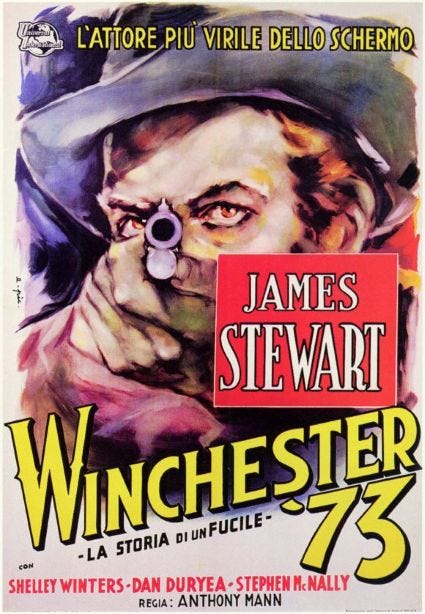
Winchester ‘73 (1950). Grade: B-
Y’all remember the shooting contest in Robin Hood, don’t you? Either the Errol Flynn version or the Disney or the Costner or the Ridley Scott one… nah, nobody remembers that. Probably not even Russell Crowe, and he was in the thing.
Anyways, if you’ve never seen it or you’ve forgotten: the dastardly villains want to find good ol’ Robin Hood, so they stage a super-duper archery contest. Everybody who is anybody in archery is gonna show up to prove they’re the best. Even Robin Hood; even in disguise.
The contest is pretty close… until Robin Hood pulls the ultimate badass move. He doesn’t just hit the bulls-eye; he hits an arrow that’s stuck right in the middle of the bulls-eye! Slits it right down the shaft like a Master Archer (phrasing!).
So in this movie, they do exactly the same thing. But with rifles.
Hey, there’s nothing wrong with stealing plot points! Especially if it’s just the introduction to your movie, and the rest of the plot’s totally different. Which it is here.
Here, there’s a shooting contest in Dodge City. And it’s not being staged to catch any bad guys. It’s just for fun, and to stimulate the local economy with tons of gambling. But James Stewart is gonna use the contest to find the bad guy.
You see, Stewart’s got some kind of grudge against bad guy Stephen McNally. He’s been on his trail for some time. It’s not 100% clear why, but we soon find out that they both learned shootin’ from the same mentor… and McNally prolly murdered the mentor. So Stewart’s gonna revenge murder McNally; he just needs to find him first. And he KNOWS McNally’s gonna show up at the shooting contest.
That’s where things get all Robin Hood. I won’t spoil how it goes down, exactly, because it’s fun. But, basically, the two of them end up finalists in the shooting contest and Stewart wins via his super-impossible accuracy.
Which is nice for him. Yet his real goal was to find McNally; now he has. He can’t kill McNally in town (the town makes you check your guns with the marshal upon entry), but once they both leave town, it’s Murderin’ Time.
But, oh noes! McNally jumps Stewart in his hotel room! They struggle, and Stewart’s buddy figures out what’s going on and starts shootin’ through the windows (this makes ZERO sense), so McNally bops Stewart on the head and makes a getaway. He’d have killed him, but there just wasn’t time.
There was time enough to grab Stewart’s trophy from the contest, though. A very special rifle. A Winchester ‘73, in fact! That’s why the title of the movie wasn’t Shiny “Best Shot” Ribbon.
You see, out of every 1000 guns or so the Winchester company makes, one’s just out-and-out perfect. This is one of ‘em. And we’re gonna follow it from person to person.
Remember, McNally had to check his guns with the marshal in Dodge City. And he left Dodge in a hurry. So he’s got a few bucks for some roadhouse bar beverages (sorry, “trailside tavern tipples”), and that’s it. No pistols, no cartridges for the Winchester. And he knows Stewart’s gonna come after him soon.
McNally and his henchmen meet up with a sharp trader; the trader can see that McNally’s in a bind. (The trader's John McIntire, and he is fun to watch.) So he offers McNally all the pistols and bullets he could want… if McNally gives him the Winchester. McNally has no other options; the deal is made.
And before too long, the trader will lose the rifle to someone else… who will lose it to someone else. Think it ends up back in Stewart’s hands by the end of the movie? I dunno! Take a guess!
Unfortunately, you WILL have to guess when it comes to “hey, who came up with that nifty framing device?” Because I can’t find out for sure; we’re in that annoying territory of “who did what on a movie” which is never worth putting more than an hour or so of effort into.
This was originally a project Fritz Lang was attached to, but (per Wiki) Universal didn’t like how Lang wanted to make it through his own production company. Universal was figuring out what to do next when the studio head, William Goetz, started chatting up James Stewart’s agent, Lew Wasserman, at a Hollywood shindig (per John Miller at TCM). Wasserman mentioned how eager Stewart was to star in a movie version of Harvey (a hit Broadway show where Stewart played an odd fellow who’s friends with an imaginary rabbit). Wasserman wanted more money for Stewart than Universal could afford, though.
So Wasserman/Goetz worked out this deal; if Stewart appeared in Harvey and Winchester ‘73 for a percentage of the profits, he wouldn’t ask for a big salary up front. This proved to be a HUGE windfall for Stewart, by the way; Harvey wasn’t a hit movie, but Winchester ‘73 was, and Stewart made 50% of the profits! That was an unheard of deal at the time; Abbott and Costello made a percentage, but nowhere near 50%. Well played, Stewart. (Who later said about it “I'm a very poor mathematician. I kept flunking algebra,” no doubt in an aw-schucks drawl.)
Stewart had appreciated an early cut of director Anthony Mann’s Devil’s Doorway, a movie about anti-Native American prejudice (Stewart had just acted in another movie with the same theme, Broken Arrow, although it came out a little later than this one did). So Stewart suggested Mann for Winchester ‘73. (Universal probably liked Mann’s attitude; after working with Erich von Stroheim on a 1945 film, Mann said Stroheim “drove me mad. He was a genius. I'm not a genius: I'm a worker.” Studios love hearing that!)
Mann apparently didn’t like the existing script, by future blacklist target/whiskey moonshiner Robert L. Richards, from a story by wrestling promoter and (historically inaccurate) Western writer Stuart N. Lake. (We got wrasslin’, we got moonshinin’ — it’s too bad this movie didn’t also have long-haul truckers.) So Mann worked out a new script with Borden Chase (he’d written the recent hit Red River).
So who came up with the “follow-the-gun” framing device? Beats me! Criterion essayist Imogen Sara Smith suggests that it was Chase. That was sure worth a hour of my time! Hope it was worth 30 seconds of yours!
Smith also writes that the Mann/Stewart Westerns are “honest about the cost of violence — how painful, exhausting, and morally corrosive it is. The men who enjoy it are vicious beasts, and those who wield it righteously must face the gutting realization that there is no clean way to kill.” (This was the first of eight movies Mann and Stewart would make together; five were Westerns.)
Umm… I dunno. I haven’t seen The Man From Laramie in a long time; maybe that one shows violence as “exhausting” and “morally corrosive.” Here, Stewart looks kinda sad after he does the deed, because he’s a good actor. But the movie isn’t exactly challenging the audience to feel sad. As far as the viewers are concerned, the man in the white hat won. The same thing when, about 10 minutes prior, Stewart just went totally ape on one of the bad guys to find out where head baddie McNally was hiding. I mean, he’s mangling the dude’s face into the bar, he’s bending his arm back behind him, and the movie is just kinda “eh” about it.
Which — it sort of should be. These aren’t complex enough characters for their behavior to be taken seriously. (I mean, c’mon, that shooting contest…) On a different TCM page, John Miller quotes critic Jeanine Basinger about an early scene (in Dodge City, where the guys have checked their guns with the marshall):
When Stewart enters a saloon and spots the man he wants to kill... both men jump, crouch, and draw with a demoniacal frenzy, only to realize that their shaking hands are empty. This scene has a shocking effect. For the first time, the devoted viewer of the western is forced to confront a subversive fact; that his noble hero of the west, that man who rides tall in the saddle off into the sunset, may be a flipping maniac... From Winchester '73 onward, the idea of the western hero as a man besieged by personal problems — violent and even psychotic — becomes increasingly prevalent in American films.
OK. Sure. Maybe (it didn't have a “shocking effect” on me). So what? What did the darker westerns of Anthony Mann (and, a decade later, Sam Peckinpah) actually MEAN?
Not a damn thing, as far as I can tell. Merely that the Western had become a tired genre and some audiences were ready for new tweaks. The tweaks fit Stewart; he’d spent the war as a bomber pilot, and when he got back, was a little too old for the parts he used to play. In his words, “I found that I was relying on the sort of romantic comedy style I had developed before the war. I'd sort of fallen back on it. But it wasn't accepted.”
Sure the plots were a little darker than they’d been before the war. To me, though, the acceptance of darker Westerns (and dark dramas like “film noir”) just meant that movies were beginning to catch back up with where they’d been before the Hays code infantilized them in 1934. The studios weren’t as all-powerful as they had been, there was more pushback against the Code’s stupid rules and the monolithic decision-making of a handful of studio heads. Aside from that, I don’t think that any changes in movies of the era reflected any big societal attitude changes; I don’t think we’d see that until the late 60s.
Besides, some stuff in Winchester ‘73 is just like the way Westerns had always been. One of the people who gets temporary possession of the prized rifle is Rock Hudson as “Young Bull”:
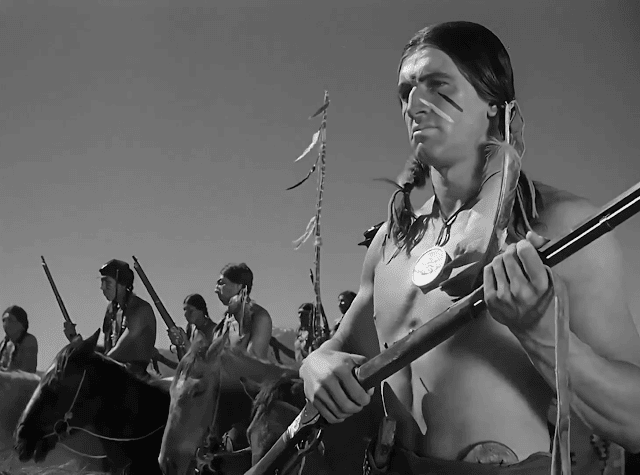
(Image from this site, which helpfully points out that while the movie has no composer, it has plenty of Universal stock music clips by the likes of Hans Salter, Frank Skinner, and Julius Styne… and it’s no worse than most movies of the era which DID have a composer writing an original score. Most scores back then sounded like stock music anyways. Most still do.)
Why did Young Bull get his hands on the rifle? Because he’s a duplicitous Indian, that’s why. Anthony Mann’s and James Stewart’s recent films about being nicer to Indians aside, we’re back to showing Native Americans as sneaky, untrustworthy, and at constant war with all honkies. The recent defeat of Custer at the Little Bighorn battlefield is mentioned several times, but that’s the Sioux up north; this story takes place in Kansas and points southward. Why would THEY be at war? Because it's a Western staple, that's why.
The whole thing with guys checking in their six-shooters when they enter Dodge City is just preposterous (it suggests that people were going around having gunfights all the time, when in the real West this was not close to true). Essentially the only woman we meet is a helpless damsel in distress who, of course, has a job entertaining patrons in a saloon.
(The marshal is played quite enjoyably by Will Geer, a serious lefty activist who’d be blacklisted for it and later had a major role on The Waltons. The damsel is the enormously talented Shelley Winters, doing her best with thin material. She later observed, about the shallowness of the part: “Here you've got all these men… running around to get their hands on this god***n rifle instead of going after a beautiful blonde like me. What does that tell you about the values of that picture?”)
That’s not to say this movie isn’t fun! I enjoyed it. Most fans of Westerns, or the better James Stewart movies, will probably like it, too. It’s just that imagining this represented the dawn of A Deep New Era for Westerns (and movies, and American culture) is kinda overstating the case.
The rest of the supporting cast is alright, including Millard Mitchell as Stewart’s vendetta buddy, old-time vaudevillian Jay C. Flippen as a crusty cavalry dude (he played a lot of comically crusty dudes), and Dan Duryea as the smarmy baddie Stewart roughs up. Charles Drake is a drip as the ostensible love interest “Steve Miller,” and you’re required to name titles of terrible Steve Miller Band songs whenever he’s called by name. Anthony Curtis is in one scene; he’d afterwards go by Tony Curtis. The cinematography’s by William H. Daniels, and it’s serviceable. Daniels had been in movies a LONG time, working on films directed by Von Stroheim and ones starring Greta Garbo; he was kinda her preferred photographer.
This was good enough that I think I’ll check out some more of these Mann/Stewart Westerns, without expecting them to teach me Dark Truths about the nature of the soul or anything like that. I’ve seen one of them, and I remember liking it, although I couldn’t possibly tell you what any of it’s about. This movie might not have been as profound as the critics who praise it think it is, yet it’s a dang sight better than almost all those John Wayne Westerns (some of which had decent scripts and/or direction, all of which had a star who wasn’t much of an actor).
And as to the subheadline above, that’s a little joke for people who’ve seen the very silly 1952 Rancho Notorious, whose re-donkulous theme song keeps mentioning “hate! Murder! And… revenge!” Which is to say, this kind of plot was going around a lot at the time, and wasn’t anything special. But this movie has some decent acting in it, and that one has… Mel Ferrer. You’re better off, in just about any instance, avoiding Mel Ferrer. But Miguel Ferrer was good! That’s ‘cuz he’s not related to Mel! He’s the son of José Ferrer and Rosemary Clooney! George is his cousin! Speaking of an actor who might be good in these kinda slightly grittier Westerns James Stewart was in… maybe George would be good in Westerns like them, too. If he needs the money. (He doesn’t need the money.)
I have a theory that in the late 80's and early 90's, the generation came up that wasn't raised on Westerns and started flexing their film criticism muscles and Westerns offered this huge target. Film school folk told each other certain things about the "genre", read the criticism, watched "The Searchers", and moved on with very concrete ideas about Westerns. And almost none of those ideas hold when you actually just watch westerns and stop thinking of Westerns as a sort of general idea. (Not for nothing, the same "they're all the same" notion used to color how the one in discussion is true of superhero/ comics-derived movies these days.)
The sort of shock and awe regarding seeing it's not just cartoon characters shooting at each other from behind rocks feels to me like it springs from a lack of exposure by folks who need to publish for their degree but would rather be discussing Breathless again, because that's where they're comfortable.
I love "Winchester '73". I think it's a solid picture - in context. But it also comes out during that post-war period where, yeah, movies got complicated enough to make a whole industry out of grubby crime movies that we'd come to call film noir. So to me, when critics suggest some "shocking violence" or whatever in a Jimmy Stewart movie, I'm like "yeah, well, Fuller is right there, and then Peckinpah is coming over the hill".