
Trapeze
Lancaster & Curtis again; this time in a better movie.

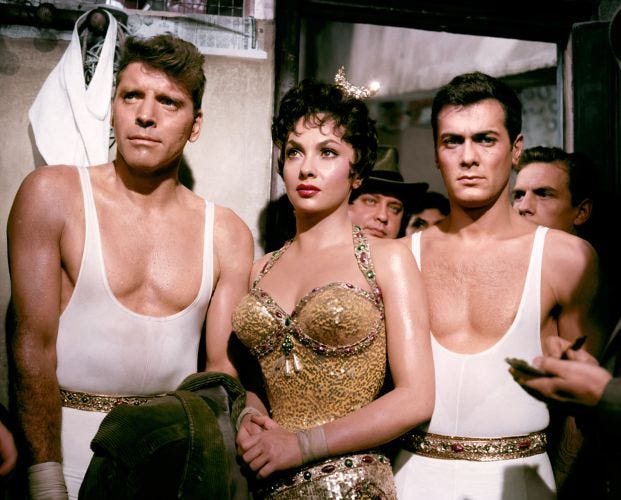
Trapeze (1956). Grade: B-
Oh boy, another Burt Lancaster movie! I can tell you’re already getting thrilled to hear about it. What massive amount of hammy overacting am I gonna start describing this time?
Listen, it’s not my fault, these things come in to the library when they do. I mean I’m the one who orders them, so sure, it’s kinda my fault, OK, blame me. But I when I watched the kinda bad Lancaster/Tony Curtis movie Sweet Smell of Success, it reminded me that I saw this one as a kid, and I liked it.
Guess what? I still like it. There’s two plots, one’s just OK and one is pretty bad. But this movie has quite a lot of nifty trapeze work. So it’s like a musical with a bad plot and good songs/dancing. Although I probably thought the plot was really involving when I was like, 10 years old or whatever.
Here’s the two plots, explained. One is that there’s a circus, and it’s shown as being run the same way Saturday Night Live is. Everybody’s trying to come up with an act that will be more popular with the audience than anybody else’s act. Once the Lorne Michaels of Italo-French circusing decides your act will please the most easily-pleased morons, he makes you the star. Go against him, he’ll ruin you. Meanwhile, everybody’s trying to graduate to the bigtime, the Ringling Brothers act in New York… and the Italo-French Lorne Michaels is trying to sign them to a longterm contract for peanuts before Ringling can offer them the big money.
That’s the OK plot. I don’t think circuses work like that IN ANY WAY, but maybe I’m wrong. Maybe they did. Or maybe we can just accept it for dramatic convenience. I’m not crazy about it, but it’s passable; again, this movie functions the same way a musical does, a certain amount of Plot Crappiness is acceptable. Now onto the Other Plot.
The Other Plot involves a love triangle between Lancaster, Curtis, and Italian sex bomb Gina Lollobrigida, who is basically built like Jessica Rabbit (and seems less human). Lollobrigida may have had the ability to act, I don’t know… but she sure ain’t doing so in this movie. She’s meant to represent Steamy Mediterranean Irresistible She-Devil Incarnate, and that’s just a bit too much silliness to lay on a character. (About the only time Lollobrigida seems lifelike is when she’s cussing Lancaster out in Italian.)
It’s a bad plotline. There’s also probably no way to get rid of it.
The way the two interact is as follows. Lancaster used to be the greatest trapeze artist in the world, until he was injured during a performance. Now he walks with a cane and does technical work for a second-rate circus in Paris. In walks Tony Curtis, the “young” (Curtis was 30) son of another legendary trapeze artist, whose dad told him, if you want to learn from the best in the world, it’s gotta be Lancaster. Lancaster shoos him off at first, but starts to warm to Curtis’s suggestion; that Lancaster teach him the secrets of the “triple somersault,” a feat so rare none have performed it since Lancaster’s injury. Lancaster can’t do it himself, but he could be the “catcher,” the guy who swings from his knees and grabs the other artist who’s flying through the air.
The only problem is scheming Lollobrigida, who Lancaster used to date until he realized she was using him to advance her own career. Now she’s trying to get her hooks into Curtis. She knows that the young, athletic Curtis is the real star of the Lancaster/Curtis act, and that if she can pry him away from Lancaster and insert herself in the act, they can Go Places. (Although she might be planning to betray him, too…)
While the oafish Thomas Gomez, our Lorne Michaels in this situation, is ignoring Lancaster’s pleas to keep the act “pure,” to have it just be the two men, one of whom can pull off the amazing “triple.” Gomez doesn’t see anything wrong with adding a skimpily-costumed beauty to the act, whether she’s got any trapeze talent or not. And there’s another “catcher” skulking in the background, waiting for Lancaster to be too old so he can swipe his job (and swipe Curtis).
Needless to say, this is all some overstuffed dramatic bullhonky, and the love triangle in particular is a real drag. But none of that matters too much, because for a good portion of the time we are watching real trapeze artists perform really exciting moves.
Lancaster himself had been first a stage then a circus acrobat with a partner he’d known since childhood, Nick “Cavat” Cuccia. Here’s the two of them together via the Federal Theatre Project sometime in the late 1930s:
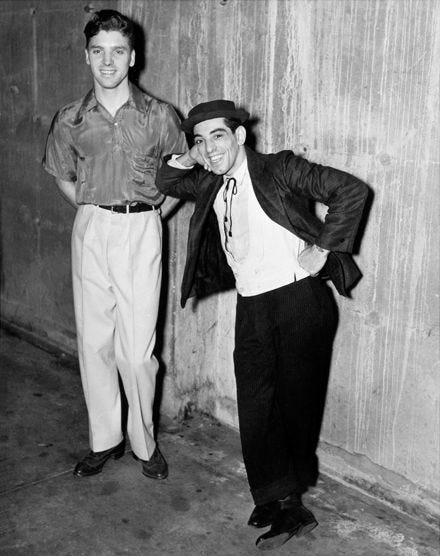
In 1939, a hand injury forced Lancaster to give up being an acrobat, although later when he became a movie star he’d help Cravat get small roles, usually stunt roles, in Lancaster’s movies and others. (He played the wing gremlin in the Twilight Zone episode “Nightmare at 20,000 Feet.”) He did some body/stunt double work for Lancaster here.
Lancaster always wanted to make a movie about circus life, and by 1956 he was a big enough star, with his own production company, to make it happen. And in the movie, at age 42, he does a considerable number of his own stunts! The most dangerous are performed by Eddie Ward of Ringling Brothers and a handful of other trapeze artists. Most of the long shots feature those folks. Curtis and Lollobrigida are doing far less of their own stunts, although Lollobrigida can hang off a rope alright and Curtis had some spryness to him.1 (Horribly, one of Lollobrigida’s stunt doubles fell 40 feet, broke her back, and died.)
Per Raquel Stecher at the OutofthePast blogsite, there was a good deal of Hollywood fighting over who was responsible for the story/script; there was a 1950 book by Max Catto called The Killing Frost (I haven’t read it), there were claims that Catto plagiarized the book from other people’s work, there were the credited James R. Webb and Liam O’Brien (brother of Blog Friend Edmond O’Brien), there was uncredited work by the likes of Ben Hecht and possible theft by the likes of producer Harols Hecht (no relation); check out the link for the details, if you like. (They’re also at the AFI Catalog site.) There’s also a 1931 German movie with a reasonably similar plot that might have been an influence and might not.
The director here is the very talented English filmmaker Carol Reed (The Stars Look Down, The Third Man), and he really keeps things zipping right along with the trapeze scenes. It was Reed’s first film shot in CinemaScope (extra widescreen), and Reed makes good use of it under the big top. While our main characters are in the air, the camera is either vertical below the safety netting or horizontal up by the roof, staring at the flipping and flying from one side of the screen to another. On the ground, the frame might be showing us trapeze activity in the background, or the wide variety of animal acts, or even some mice scurrying along the outside of the circus ring (as Mrs. twinsbrewer pointed out, “where there’s popcorn on the ground, there will be mice.”) Reed can’t do as much with the drippy love triangle plot, but then again I doubt anyone really could. It’s just some really bad writing.
I don’t know that anyone really misses the rather skeezy, sleazy kinds of circuses that we used to have when I was little; where the animals were trained via whip and the human performers frequently underpaid/put at risk, where you jostled for seating on wooden benches with overpriced concessions and everything smelled of elephant crap. You can go to a State Fair for the overpriced food and the odors, you can see jugglers/acrobats at Ren Fests, everybody hates clowns, and for a higher level of performance artistry, you could see Cirque du Soleil or one of its ripoffs. Ringling Bros. and Barnumn & Bailey had cheaper shows than Cirque du Soleil, so a little more democratic, but it wasn’t really worth the cost of animal and worker mistreatment.
In fact, the best act I ever saw at a Ringling Bros/Barnum & Bailey circus was one at the Target Center in the mid-2000s, where the best act was a brilliantly-trained poodle that would walk around in a circle as its trainer played a music box, and when the music box stopped, the poodle would slump over softly like a walking toy that needed to be rewound. So the trainer would pretend to wind up the music box, start playing again, the poodle would start walking again, etc. It was delightful and nothing you couldn’t train a smart dog to do using treats. Ringling Bros/Barnum and Bailey went on hiatus in 2017 and only returned to live shows in Louisiana in 2023. This time with no clowns, animals, or “master of ceremonies” creepy Lorne Michaels figure. Good luck to them; but do dog acts, those can be harmless and fun.
Trapeze makes effective use out of the fact that old-timey circuses WERE dangerous (although knowing somebody actually died puts a damper on the fun quite a bit). Those flying scenes are pretty thrilling (cinematography by Robert Krasker, who shot The Third Man and the opening scenes of Great Expectations; when he’s outside the circus, Krasker’s color work is just so-so). The music’s by Malcolm Arnold, although if you didn’t read the name you’d probably hear it from the overuse of ominous horns and cymbals.
The pairing of Curtis and Lancaster here (who are both “fine,” if playing silly characters) proved to be a huge success; it led to them teaming up again in Sweet Smell of Success, which every film critic and their cousin will tell you is a “classic.” It ain’t. It’s deeply unpleasant (with maybe only the photography by James Wong Howe worth looking at). This is a far easier and more entertaining watch. And there’s even some side performers you might get a kick out of; Johnny Puleo as a dwarf who’s worried about getting any taller, Sid James as a snake-handler (them’s real snakes, and they look bored), Katy Jurado as a horse rider nursing a flame for Lancaster (in the end, as he walks off into the sunset, a woman joins him, and it’s not supposed to be Jurado but thinking it is makes it a better ending).2
Again, this isn’t deep stuff; I enjoyed it at nine or so (on a little boxy black-and-white TV, it’s better in widescreen). It IS very like a musical, where the musical numbers are the real star of the show. And of course it’s horrible that a trapeze performer died… but stunt people were frequently killed in the movie, back then. Watch any scene where there’s a massive battle involving hundreds on horses and somebody likely got stomped to death. It’s still neat here to see those gifted stunt doubles soaring through the air, and to see how much athleticism Lancaster still had left in ‘im.
The vaunted “triple somersault?” Eh, it’s not as impressive as the movie thinks; a stunt where a “catcher” lets someone go and then catches another person immediately after is far more impressive. The whole “quest for triple” thing seemed silly to me here; it’s like when people watch Olympic diving or ice skating, and the TV announcers will tell us how many spins and flips the athletes are doing. We at home don’t tend to care. We just think it all looks cool.
In a later autobiography Curtis said that a scene where his character and Lancaster’s are both walking on their hands, it’s actually Curtis/Lancaster walking on their hands. Accept that if you like.
You might wonder where you recognize the guy playing “John Ringling North” from; well, if you saw The Jackie Robinson Story, Minor Watson played Branch Rickey, the kindly team owner who signed Robinson.