
The Ref
Leary, Davis, and Spacey team up for grouchy holiday fun.

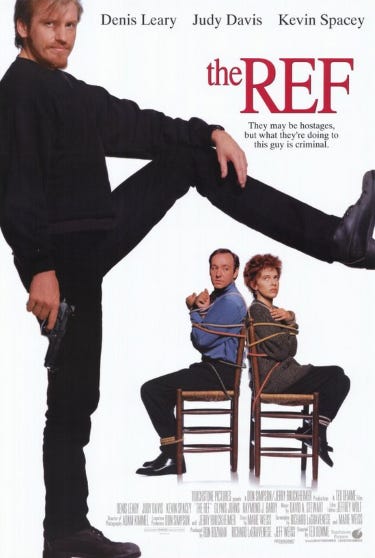
The Ref (1994). Grade: B-
The idea here came from Mary Weiss (per this fun article by Eric Walkuski). She’d just had an argument with her husband, and in most such arguments, both parties are talking over each other. So what if there was a neutral third party to moderate the debate?
As Walkuski points out, there are such people; they are marriage counselors. But a marriage counselor won’t say “you’re right and they’re dead wrong on A, they’re right and you’re dead wrong on B.” A marriage counselor facilitates communication in a neutral setting, they aren’t a judge or a Solomon.
However, if some guy’s holding you hostage, the hostage-taker isn’t under the same ethical/professional constraints a marriage counselor would be…
Enter Denis Leary, a expert cat burglar (that’s not someone who steals cats, enjoyable as that might sound… it’s someone who sneaks in as quietly as a cat, and steals precious jewelry, leaving without a trace). But Leary’s latest jewel heist has gone a bit wonky, and he’s on the run, on foot, in what looks to be Connecticut or Long Island or such, a place where the richie-riches live.
Leary takes unsuspecting shopper Judy Davis hostage, and then her husband Kevin Spacey, and just wants to hole up at their house until Leary’s loyal-but-unreliable buddy can work out an escape plan.
But while he waits for his buddy to call with the details, Leary is gonna have to listen to Davis and Spacey bicker. And bicker. And moan, and gripe, and bicker. Not with him! With each other.
Truly, the spirit of Christmas!
Maybe not in your family. But it sure was in mine! Something about the ideal of the holiday (the lovely music, the beautiful lights/decorations, the warmth of the religious message) always contrasted with “meeting family members you only saw on rare occasions and had longstanding disagreements with,” or “pressure to make everything perfect when actually everything at home is a barely-suppressed kettle of simmering misery.” So the worst blowups always happened at Christmas. Usually, with the screamed accusation aimed at somebody, “you’ve RUINED Christmas!”
So, this one works for me… and pretty much everybody I know. I don’t know the people with perfect families. If yours is, congratulations!
Sample dialogue. Judy Davis and Kevin Spacey are at a marriage counselor, early on. They’re arguing about their son, who has some behavioral issues.
Spacey: “In the ninth grade, we told him he could get a part-time job. You ready for what he did? He started an escort service for the football team, and he gave out my mother’s phone number!”
Davis: “And I still say, getting laid by an 18-year-old linebacker is JUST WHAT SHE NEEDS!”
Counselor: “Please! Let’s lower our voices!”
Davis & Spacey: “F**K YOU!”
Yeah, this is my kind of Christmas movie.
Notice the poster on top. Nothing Christmas about it. Disney was so stupid, they didn’t even market this as a Christmas movie! It’s got Santa in it, it’s got clips from It’s a Wonderful Life, it’s got a big family Christmas meal…
…and Disney released this in March, and didn’t promote it as a Christmas movie.
(Honestly. Studio execs are such incredibly brain-dead dingbats, it’s a shock it’s taken them this long to kill off movie theaters forever; and they’d still be doing better if not for a recent global pandemic. Get back to me later on the theory that COVID originated in a Netflix bioweapons lab. As of right now, I don’t quite believe it… but you know, in a few years, I might…)
Why would you not promote this as a Christmas movie? That’s the whole thing! See that crummy poster up top? That’s how this was marketed! Without any hint that it takes place at Christmas! Here’s a different example…
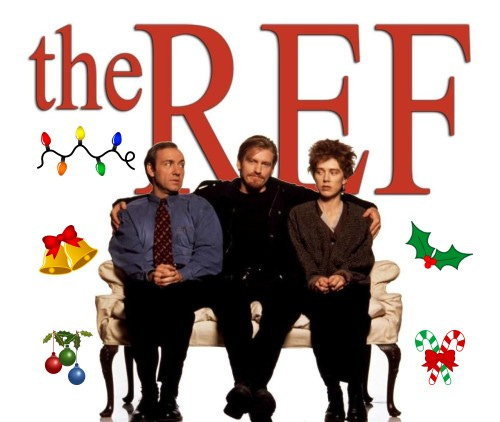
…which I did using clip art, and that’s already better! Fa-la-la-la-la!
Plus, this was DISNEY! (OK, “Touchstone,” but that was a Disney offshoot brand for movies with cusswords in ‘em.) Disney had (has?) a zillion top artists from Cal State Northridge or wherever that they sign at underpaid no-escape contracts at age 22, they could HAVE DONE BETTER than me!
Why didn’t they? Because studio execs are idiots.
Originally, this was Mary Weiss’s script; she got some advice and suggestions from her brother-in-law (perfect!), Richard LaGravenese. (He’d gotten attention for writing The Fisher King). When Weiss and LaGravenese pitched this to Disney, they liked the idea… but they had Notes. And they insisted LaGravenese do re-write after re-write, based on their Notes. Finally, LaGravenese got sick of it and refused to rewrite it any more.
Eventually, Denis Leary and Ted Demme got ahold of the script (Demme, director Jonathan Demme’s nephew, had directed Leary’s filmed stand-up shows and his ad spots for MTV & Nike). And they convinced Disney to make it as a Leary star vehicle (and convinced LaGravenese to get back on board — he’d also do rewrites during the shoot to better fit the personalities of the actors).
The problem with making it a Leary star vehicle — and structuring the whole ad campaign around Leary’s fast-talking acerbic persona — was that this persona didn’t fit well into the Christmas season. So that’s why Disney sat on the finished film until March, and didn’t market it as a Christmas movie at all.
This was obviously a blunder, and the movie didn’t do well at the box office. Partially because it was marketed wrong, partially because audiences were getting sick of Leary’s schtick.
But, guess what — so was he! Leary already had an interest in following the lines of Albert Brooks and Steve Martin and getting to play more serious parts. (Which he’d later write for himself in the TV series The Job and Rescue Me — both have great casts, but Rescue Me veers into melodramatic territory that’s very unpleasant).
And, frankly, the bits in The Ref where Leary is doing his fast-talking cussymouth insult-comic stuff are the worst things in the movie; he’s best when he’s sitting back and reacting incredulously to the craziness around him. (Like the line “oh my God, I’ve kidnapped… my parents.”)
So Disney advertising this as a Leary vehicle was doubly dumb; it didn’t take advantage of the Christmas setting, and it neglected to highlight what a fine ensemble comedy it is. With top work by Judy Davis, and fine contributions from Kevin Spacey, Christine Baranski, Robert J. Steinmiller Jr, and Glynis Johns (the fun Mrs. Banks in Mary Poppins, playing a total meanie here).
Davis is the real treasure and a real surprise. She’d already shown her serious acting chops multiple times, even if most Americans hadn’t seen My Brilliant Career or High Tide. This is her first outright comedy role, and she’s fantastic; it’s like if Alec Guinness got wasted at Christmas and just started unloading on everyone. She’s a joy.
So’s Kevin Spacey, in his way… and, yes, I know that in real life he is a rotten dude, and we’ve discussed this before when looking at L.A. Confidential — basically, I side with Claire Dederer’s book Monsters, where she isn’t willing to throw out all the quality work done by people who also were semi-to-very-rotten. (For example, the Beatles and Bowie certainly had sex with underage groupies.) And, for once, Spacey isn’t playing a know-it-all. He’s got some lip on him; would you want to see Kevin Spacey in a role where he isn’t a bit lippy? But for the most part, his problem is he’s too much of a wimp.
The couple’s main troubles are financial (it’s the #1 cause of divorce!), and specifically the way that they’re utterly dependent on Spacey’s mom. Davis blames Spacey for taking a loan from his mom (which she’s making him pay back with interest, and an adjustable-rate interest at that!). While Spacey blames Davis for pushing him into it, saying she wasn’t satisfied with their Bohemian New York apartment, not when all her college friends were making money.
So you can completely understand why Leary finds them both infuriating; they’ve got such Upper Middle Class complaints. Still, he tends to side with Davis a little bit more… especially when all their relatives come over and Davis is the only one willing to go tell Ma to stuff it. (It’s also fun that the hen-pecking mother-in-law is, for once, the husband’s mother and not the wife’s.) Glynis Johns is perfect sanctimonious ooze as the mom (and Christine Baranski a lot of fun as a snarling sister-in-law, to both Davis and Spacey).
Davis and Spacey have a kid, played by Robert J. Steinmiller Jr. (only 15 when this came out). He’s been packed away to proto-military school, and, yes, you used to see ads for these things in the back of The New York Times — boarding schools you could send your kid to at a pretty early age, and only have to see them at holidays until they graduated and left for college. Rich people who can tolerate their kids get nannies; ones who can’t send them to proto-military school.
Actually, in Steinmiller’s case, it’s in order to steer him away from his trend towards juvenile delinquency. When the town’s Baby Jesus statue goes missing from their nativity scene, who do you think stole it? And who do you think is blackmailing the headmaster at the military school with surreptitious photos of an affair? (The headmaster’s J.K. Simmons, in his first movie role — he actually looks like he has some hair, which is Weird.)
In the original filmed version, the ending had Leary turn himself in to teach the kid a lesson, that life on the run isn’t cool. It’s better that they changed it; this isn’t the sort of movie that would benefit from a “we all learned a special message” ending.
One of the subplots is just confusing as heck. After Leary commits the burglary, and everyone in town has heard about it, some local rich bigshots confront the sheriff about how come the police didn’t do a better job protecting rich people’s property. Then they manage to get the sheriff basically sacked. And then — that’s it, nothing comes of it. I wonder if, originally, the rich dingbats getting rid of the sheriff bit them on the butt in some way, actually hampered the search for Leary? Otherwise I don’t know why these scenes are here. (One of the richies is Robert Ridgely, who I mistook for Roger Corman; I made the same mistake watching Jonathan Demme’s Melvin and Howard.)
It’s not an elegantly-made movie; the adequate cinematography’s by Adam Kimmel. The music’s by David A. Stewart, and you hardly even notice it… which is a good thing, since most movie music stinks! You just wouldn’t guess from this score that Dave Stewart was half of Eurythmics.
Quite sadly, director Ted Demme would die eight years after this came out, at only age 38; he had been taking some dangerous drugs and playing basketball, which is hard on your system. This is the only film of his I’ve seen, but I’ll always be grateful for it, as for the “Streets of Philadelphia” video, which he directed; it’s a nice, simple one, which in 1993 was a nice relief from all the visual overkill on MTV.
This film ain’t any kind of masterpiece; it's utterly too commercial for that. But it’s probably one of the better Christmas movies ever made (because Christmas movies, on a whole, ain’t great). It’s the rare sort of movie about family where the family feels pretty believable — and the even rarer sort of movie, one about dysfunctional families that isn’t out to make you suffer. When everyone starts yelling at each other here, it’s not a tragic moment, it’s an occasion for Kevin Spacey to start making noise with a fireplace poker; and you will love the way he does so. It’s so Christmas-y!