
The Little Foxes
Bette Davis has a priceless moment in Southern gothic.

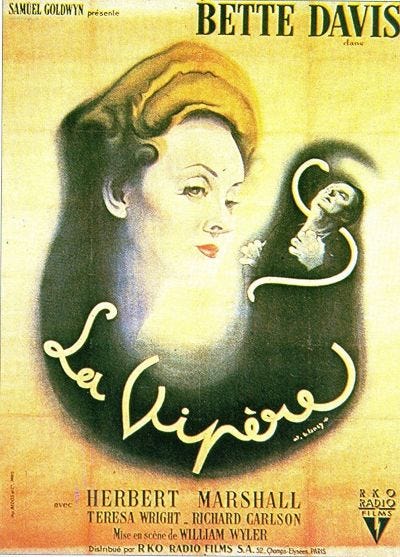
The Little Foxes (1941). Grade: C+
It’s more Bette Davis! That’s not on purpose, it’s just because we were doing some dogsitting, and the cute critters’ owners don’t have a DVD player. So, you’re limited to what’s on the various streamers, and when I typed in a few titles, this was one the streamer had. So this is the one we watched.
Davis and director William Wyler really got into it on this shoot, over multiple disagreements. A major one was Davis’s makeup, which she had personally designed for her by makeup expert Perc Westmore (members of the Westmore family still do makeup in Hollywood today). Wyler thought it made her look older; Davis WANTED to look older. Wyler said the makeup gave her a Kabuki theater appearance, David refused to change it. Who was right?
Both were right. The makeup DOES look kinda like a Kabuki mask, especially in the movie’s best moment (the only thing that makes this worth sitting through). But the look is GREAT — it’s wildly over-the-top, which is what the film needs. During that moment Davis’s face is utterly frozen into its mask-like pose, and it’s hilarious.
This is based on a 1939 play by Lillian Hellman, who adapted it herself; I haven’t read it. Per the back of an MGM DVD box I found when looking for images, “‘Hellman said that she wrote her “angry comedy” (Los Angeles Times) based on her own family’s biannual dinner at which people drew lots for the diamond that had been left in her great-grandmother’s estate.’”1 Per Wiki, it’s also inspired by Hellman’s in-laws who weren’t shy about bickering and insulting each other over money.
Davis is the de facto matriarch of a declining Southern family; her rich husband’s away for “health reasons” and she doesn’t seem to miss him much. She’s approached by her greedy brothers, Charles Dingle and Carl Benton Reid, who’ve got a business proposal. They want to invest in a new cotton mill that will take advantage of the area’s poverty to make a mint by paying people super-low wages. They just need her husband’s money.
Davis is all gung-ho on the idea. She can’t wait to get super-rich by any way she can, to leave this lousy backwater and live the city high life she’s always deserved. But, when her husband comes back from wherever-he-was (resting due to his heart condition), he’s not willing to go for it. It wouldn’t be honorable to take advantage of poor people that way.
Further complications ensue, ones Davis may/may not have inadvertently suggested herself. In the end, it looks like Davis sure is gonna be as rich as she wanted, although we’re given a shot of her looking sad (or constipated) because, in the process, she’s alienated every last member of her family and will have to live rich without love. The end.
There’s more than a few buckets of grits we’re being asked to swallow, here. First, that the South is full of rich families marked by Honor and Loyalty, and that Honor means they’d rather go broke than get rich by exploiting people.
Umm… isn’t that EXACTLY how EVERY rich Southern family got rich until 1865? By exploiting the hell out of people in the WORST way? (And, after 1865, doing everything they could do make their states non-union and as poor as possible so they could pay workers peanuts.)
Second, that rich people who get tons of money and piss off their families in the process feel really bad about it later. Sure. Right.
Hellman herself was a complicated cat. Born in Louisiana, she altered time with family in Louisiana and in New York, got married and divorced young, had a on-and-off relationship with crime fiction writer Dashiel Hammett for 30 years, and was a successful writer herself; her first Broadway hit, The Children’s Hour, came in 1934, and several others followed.
Hellman flirted with various forms of leftist ideologies. (She joined the screenwriters’ union, sensibly enough, because she was ticked about having had credit stolen on several movies.) This naturally ended up getting her in trouble in the 1950s, when the McCarthyite HUAC demanded she name names of people she’d known with socialist/communist sympathies. Hellman refused, and this got her blacklisted (although the blacklist applied to movie writing only, not playwriting, which she continued).
So I’m sure that Hellman’s loathing of exploitative capitalism was real. But what’s the point of dialogue like this? “There must be better ways of getting rich than building sweatshops and pounding the bones of the town to make dividends for you to spend. You'll wreck the town, you and your brothers. You'll wreck the country, you and your kind, if they let you.”
Sure! I agree! But nobody who disagrees is gonna be moved to change their minds by this sort of thing. (They’d happily explain to you instead the powers of “the invisible hand,” or whatever cliches they were using in the 30s/40s.) And the dialogue also doesn’t make sense from a dramatic perspective; is the other character supposed to respond, “oh my gosh! I’ve been so silly and bad! Thank you for teaching me the error of my ways”?
Actually, if it was a Shaw play, the character might have responded “precisely!” Then explained how doing the wrecking was such a fantastic idea that the original scold would switch sides and join the one they were scolding. But Shaw was a satirist, and this script is not satire.
It sure might be better as satire, though. I mean, the opening credits and establishing shots are so full of Dixie hokum it’s practically Song of the South shot in black-and-white. We see all kinds of poor rural shacks surrounded by Black people doing tedious farm chores while the music swells with psuedo-gospel-sounding gunk. I think we’re actually supposed to see this stuff and go, “how soulful and traditional and authentic,” and all you’ll probably think is “those people look really poor and really miserable.” And a scene where an idyllic young couple is out on the veranda at night (apparently, in 1900, when this was set, mosquitoes hadn’t been invented yet), with singing going on in the background. One character opines, “we have the pianos… but the darkies have the voices.” Good GRIEF.
(Music, such as it is, courtesy of one Meredith Willson… who wrote the words/music to The Music Man! A musical that made fun of small-town hokum and sentiment! But, come to think of it… beyond the two or three funny songs in The Music Man, there’s also some real gunk, so…)
That young couple out on the veranda is a problem, too, because their characters — who get a LOT of screen time — are real drips. The guy, Richard Carlson, is a complete non-entity, and would go on to be the square-jawed hero of such attractively-titled 50s low-budget sci-fi flix like It Came From Outer Space, The Creature From the Black Lagoon, and The Magnetic Monster. (C’mon, if you saw “The Magnetic Monster” late at night on old-timey cable listings, wouldn’t you click over and give it a look?)
The gal, Teresa Wright, was really excellent as a young girl who lost her illusions about her favorite relative in Shadow of a Doubt. But this character is written to be the embodiment of innocence and goodness and hope, and it’s a complete drag. I kept hoping one or both of them would run out in the street and get mowed down by one of them new-fangled automobiles. The gal’s in the play, but the guy’s not, and neither is this nauseating love story. Per the AFI Catalog website, producer Sam Goldwyn asked Lillian Hellman to add a love story/likable male character to give the audience someone less slimy than Davis/her brothers. Hellman tried, the studio had further suggestions, and then Hellman suggested some friends to do those rewrites. One of whom was the acerbic/cynical Dorothy Parker. Some of this “love plot” dialogue definitely sounds like something Parker typed up while snickering over a bourbon.
The Evil Brothers aren’t much better, although Charles Dingle has a little bit of fun with some of his lines at the end. The other Evil Brother has a son, Dan Duryea (effective as one of the baddies in Winchester ‘73), and he doesn’t seem to know if he’s supposed to be playing the character as dim-witted or “light in the loafers.” So Duryea does both, with a fair amount of sniveling cowardice thrown in there on top of a mild lisp. It’s an awful lot of acting “business” for such an insignificant part, yet the strangeness of this conception actually does kinda hold your interest a little. He’s certainly more lively than most of the rest of ‘em.
Patricia Collinge (also good in Shadow of a Doubt) has a little dignity as a despairing secret drunk, and so does Herbert Marshall as Davis’s long-suffering husband. (Marshall was English but his Southern accent is fine; the Brits can usually do good American accents but not vice versa.) Jessica Grayson as the “wise kindly large Black maid” has the most dignity of, all, despite her utterly insulting dialect dialogue. An accomplished contralto soloist in real life, Grayson got the part because the casting director was enthralled by her speaking voice.
But — make no bones about it — this is Bette Davis’s show. Here she is with that masklike visage as she’s very determined to let something very bad happen:
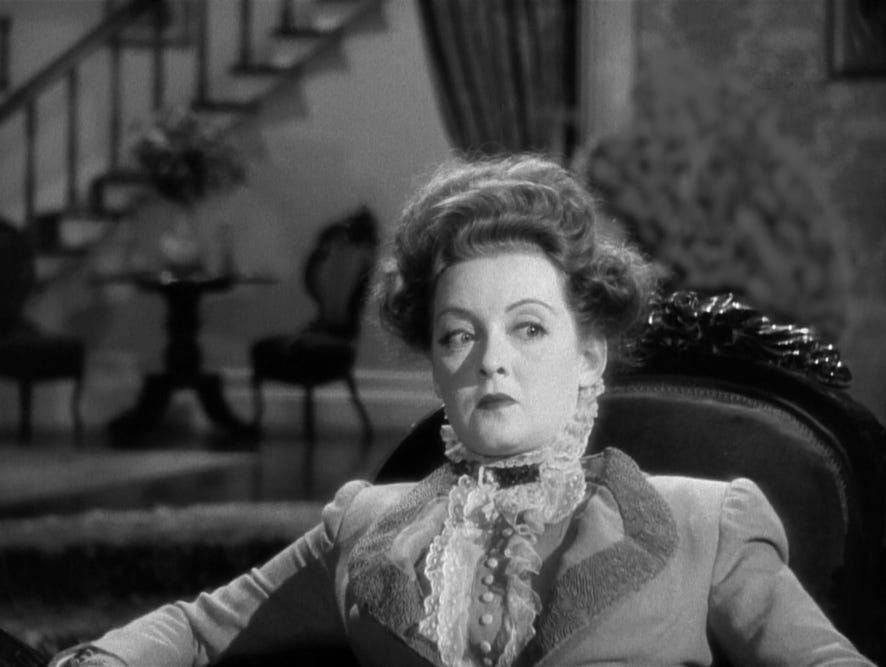
I actually was laughing my head off during this scene. It’s got camp elements to it, horror elements... it’s a blast. Davis is fine for the rest of the movie, but this is the part where she gets to be a real Bitch Goddess, and it’s the ONLY reason to see the movie. To set up this bit at the climax. It is so Kuul.
The rest of the time she’s mostly snapping off some really plainsville dialogue with a little panache to her delivery, or issuing icy stares, or turning the lights UP on a young couple to show them who’s the boss. The character, as written, is not particularly interesting, yet Davis is always fun to watch. She’s got the biggest hair in the movie — at times, it’s piled nearly twice as high as it is in that photo — and she wears that hair like the crown of some famed empress known as “Zisanter the Bloody” or such.
A curious side thing that’s going on in this movie; it slides through the cracks of the Hays Code. Crime’s not supposed to pay, remember? Well, Davis’s evil brothers and Dan Duryea definitely do commit a crime, although by the end of the movie there’s nobody who it directly harmed. (Except the low-wage workers who’ll be screwed over by the new cotton mill, but that’s legal.)
And while Davis doesn’t commit a crime, she definitely doesn’t lift a finger as a Bad Thing Happens. Yet, again, technically: not a crime. Plus, there’s also the “punishment” of having her family hate her, which, I suppose, is the reason mean ol’ Mr. Potter is allowed to get away with swiping thousands of dollars in It’s a Wonderful Life. You see, he’s not as happy as George Bailey is at the end, he’s so much LONELIER! I don’t think Mr. Potter cares, and the character Davis plays here wouldn’t really care either. (Davis is directed, by William Wyler, to end with a Sad Look, but I ain’t buying it.)
Wyler was no great shakes as a director — his contemporary and commercial equal, Michael Curtiz, had a much better visual imagination — but at least he’s not the rank dullard Joseph Mankiewicz was, so this is an easier watch than All About Eve. It’s got that film’s flaw of being too long, but that’s Sam Goldwyn’s fault; you could excise the love plot completely here and it wouldn’t hurt the movie at all. (It would probably help Teresa Wright’s performance a LOT.)
The cinematography’s by the great Gregg Tolnad, although you really wouldn’t know it. (Until some of the shots near the end where there’s interesting stuff going on in the deep background of the image.)
This was the third and last time Wyler and Davis worked together; per Margarita Lanazuri at TCM, the director never asked Davis to be in another one of his movies, because he was so ticked by her stubbornness here. (It wasn’t just the makeup; Wyler wanted a lighter, sexier performance and Davis wanted to play it mean.) It’s too bad that people in Hollywood tend to think they’re doing something as important as curing polio, because they could have compromised here; staying true to each’s “vision” of the original material didn’t matter. (The original material doesn’t seem that hot to me.) Let Davis have her masklike makeup (it sure helps the end), and let the character be a little funnier too. (That never hurts anything.)
Of the other two Wyler/Davis films, one sounds pretty interesting; 1940’s The Letter, where Davis (per this site) “has never been more unsympathetic.” Cool! The other is 1938’s Jezebel, where Davis is “a headstrong Southern belle who loses her beau due to her bratty behavior.” Eh, I’m not too interested in movies about Southern belles, especially not ones we’re asked to feel sorry for (which I suppose we would be if she loses her boyfriend). Who’s the “beau” she loses?
Henry Fonda. Henry Fonda as “Preston Dillard,” presumably also a Southerner. Fonda trying to do a Southern accent sounds almost silly enough to be worth checking out… but there’s all kinds of other silly movies I’d rather try out first, thank you very much.
Hellman’s various accounts of her own life may/may not be 100% accurate. Famously, writer Mary McCarthy said of Hellman, "every word she writes is a lie, including 'and' and 'the'."