
The Last Detail
Good script and good director = good Jack. (The reverse has also always been true.)

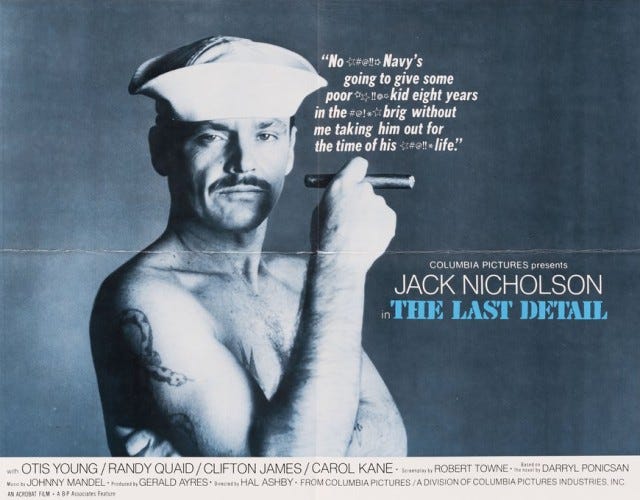
The Last Detail (1973). Grade: B
Three sailors walk into a bar. There’s Jack Nicholson, very young Randy Quaid, and very Black Otis Young. Nicholson orders beers all around. The bartender snipes, “the law says I have to serve him” (Young), “I can’t serve him” (Quaid). Nicholson snipes back a little bit, causing the bartender to tell him quit it or he’ll call the Shore Patrol. Then Nicholson explodes, slamming his sidearm on the bar. “I AM the motherf***ing shore patrol, motherf***er!”
Your typical Jack-goes-manic scene, right? We’ve seen him play this kind of thing a zillion times. What makes this different is the way Nicholson laughs about it with the others outside. “Did you see that cracker a**hole?”
Of course they saw it. But Nicholson needs the validation; he needs an audience for his “badass” behavior. Without the attention, there wouldn’t be any point. It’s a funny scene, sure. (The clip was included in A Decade Under the Influence, an overview of seminal ‘70s movies.) But what makes it is the pathetic need for approval afterwards.
Nicholson had been acting in small roles throughout the 1960s — and not being especially good at it — when he appeared as a straightlaced lawyer-turned rebel in 1969’s Easy Rider and a hard-living hardhat rebelling against his privileged background in 1970’s Five Easy Pieces. Practice in those earlier small roles had improved his acting tremendously; the turn of the decade gave him the right parts to play. Nicholson could never have been convincing as a flower child or typical ambitious young man. He needed to be the outsider, and by 1969 movies were more willing to depict those kinda of characters.
Director Hal Ashby was an outsider, too, an overaged hippie who’d moved to Hollywood in his mid-30s and improbably landed a job as a film editor with virtually no prior experience. He got to direct his first film, The Landlord, in 1970, and from that point on had one of the most remarkable directing stretches in movie history; Harold and Maude, The Last Detail, Shampoo, Bound For Glory, Coming Home, and 1979’s Being There. The first three films are the most daring, the last three the most conventional, but all seven are well worth watching. That’s a helluva decade. (The 80s weren’t as kind to Ashby.)
And writer Robert Towne was another weirdo, who’d made his way into filmmaking after a stint in the Army and at odd jobs like tuna fisherman. He’d acted in and written Roger Corman movies, and by 1973 was a well known “script doctor,” someone who patches up bad bits in other peoples’ screenplays for no credit but a enviable chuck of money; this was the first serious script Towne ever sold.
It’s based on a 1970 novel of the same name by Darryl Ponicsan, a teacher-turned-Navy sailor-turned social worker. I haven’t read the book, but this CinephiliaBeyond article says the script is fairly close except for the Nicholson character. In the book, he’s an educated, literary sailor (so, like Ponicsan), and dies at the end, wracked with guilt over what he’s done.
Nobody dies in the movie. As to the guilt… well, here’s yer plot:
Randy Quaid has been caught stealing $40 from his naval base’s polio relief fund. A bad thing, to be sure! But, what’s worse (for him), the polio fund is the favorite charity of the base commander’s wife.
So, Quaid had the book thrown at him. He’s been tried, and sentenced. To eight years in military jail (way worse than regular jail). Eight years for stealing $40.
Somebody’s gotta transport Quaid from Virginia to the Portsmouth Naval Prison (just across the border between New Hampshire and Maine). That job’s been assigned to long-time enlisted men Otis Young and Nicholson. They’re not eager to take a 20-year-old to jail for eight years, but there’s no getting out of the job, the “detail.”1
What Nicholson decides is he’s gonna make a fun little vacation out of the trip. They’ve been given more time than they need to get to Portsmouth, they’re getting a generous per diem, so why not make the trip last as long as they can and max out that budget money. Have a good time; maybe show the kid a good time as well.
Where the guilt comes in is when, during the course of the vacation, they come to really like the kid. It’d be the easiest thing in the world to let him “escape.” But if they do, then Young and Nicholson will be in deep doo-doo; they’ll be the ones headed to military jail for dereliction of duty.
The movie starts off a bit slow, and the sarcastic / mock military music by Johnny Mandel grates on your ears. But as it goes along, Hal Ashby’s feel for the characters and the quality of the acting starts to make this both genuinely charming and genuinely sad. (Ashby intentionally shot this in sequence, so that the very inexperienced Quaid could find how he wanted to play the role.)
The Otis Young part was written with Nicholson’s friend Rupert Crosse in mind, although, awfully, Crosse became terminally ill with cancer. Young is the movie’s rock. He’s got just as much “screw this unfair sentence” feeling as Nicholson, and he’s got his own resentments about how racism hinders promotion in the Navy, so he enjoys bending the rules a little. On the other hand, though, he’s happy with the choice he made to join up. He’s getting close to (what was in 1973) a very nice lifelong pension coming due; while he doesn’t like the system, he’s made it work for him.
Young’s satisfaction with the Navy begins to seem like it’s showing Nicholson everything he can’t be and can’t have. When he gets out — if he behaves well enough long enough to get a pension, which seems iffy — he’s not going to have any idea how to live on it, the way Young will. He’ll be a man pushing middle age who’s never had a conventional job, who seemingly has no friends or family. If the Navy’s a dysfunctional family for Young, it’s a flophouse for Nicholson. It’s marking time on a journey to noplace special at all.
At Sense of Cinema, Richard Armstrong writes that “Few films have such a sense of time running out.” The more fun the guys have, the sadder it is knowing the clock stops at midnight. The more Quaid learns from his Cool Evil Uncle figure Nicholson, the more he realizes just what he’s going to be losing for eight years. Earlier, when Nicholson tried to convince Young that prison was the best thing for Quaid, how he was too much of a vulnerable simpleton to make it in the harsh, real world, you could almost agree with him. Not by the end of the movie, you can’t.
Quaid, who’s unfortunately been beset by major mental problems the last few decades, really is sweet here. Bud Cort (from Harold and Maude) lobbied hard for the role, and would have been fine in it. In fact, Towne’s script called for a shorter actor (like Cort). But when Ashby said he’d found the 6’4” Quaid, Towne loved the idea; instead of a little helpless kittycat of a guy, it’s a big helpless kittycat of a guy, and that makes the character more poignant. Quaid has a shot near the end, a little ways off in a park, where he’s using his arms to communicate, and it’s both very sad and very hilarious (for my money, it’s the moment that makes the movie as good as it is). The big guy silently expressing his regrets. It’s priceless.
It’s strange that Nicholson was so good in the 1970s, and so willing to slip into self-parody in the years that followed. I won’t call it lazy, the way I would some actors who started repeating themselves for audience/critical praise. Since I don’t think Nicholson gave a s**t about either. He was willing to appear in increasingly silly movies which required a minimal amount of effort and paid well; that’s his business.
But maybe the 70s were a prime period for Nicholson because they were a prime period for the kind of movies he did well in; independent-minded, anti-establishment films. He could be the lost rebel in this and One Flew Over the Cuckoo’s Nest because it was an era that made movies about lost rebels and an audience that was willing to see them. Within ten years you went from the military misfits here to Joe Cocker singing the abominable “Up Where We Belong” in An Officer and a Gentleman. That’s just not a movie for Nicholson in so many ways, and it was increasingly not a time for Nicholson either. Not for what he could do at his best. (Amusingly, he turned down the Robert Redford part in The Sting to do this one.)
Other Making Of film facts? Well, Towne had actually written this in 1970, but the studio was nervous about the language. He later recalled, “‘I remember talking to an executive who told me “Bob, wouldn't 20 ‘motherf***er’s be more dramatic than 40 ‘motherf***er’s?” And I said, “No, they wouldn't.” The whole point of the swearing in The Last Detail is that it's not an expression by characters who are about to act. It's an expression of powerlessness.’”
Towne refused to change the screenplay, and in the meantime worked on his “script doctoring” job (including a scene in The Godfather) and on his own script for Chinatown. Idiot studio executive Peter Guber wanted to go ahead with a script revised by someone else and starring Burt Reynolds / David Cassidy, but producer / book rights holder Gerry Ayers stuck to his guns. Once the increasingly-popular Nicholson became available, the studio went with Towne’s script as it was.
This was the first movie with Michael Chapman as cinematographer; he’d been an assistant on Ashby’s The Landlord and Ashby hired him for the top job when neither Gordon Willis nor Haskell Wexler were available. (Chapman would go on to shoot Taxi Driver and The White Dawn, among others; he’s better here outdoors than in.) You can read quite a bit of Chapman’s reminiscing about the film (mostly how scared he was and how much fun he had regardless) at CinephilaBeyond, which also has fun production/publicity photos:
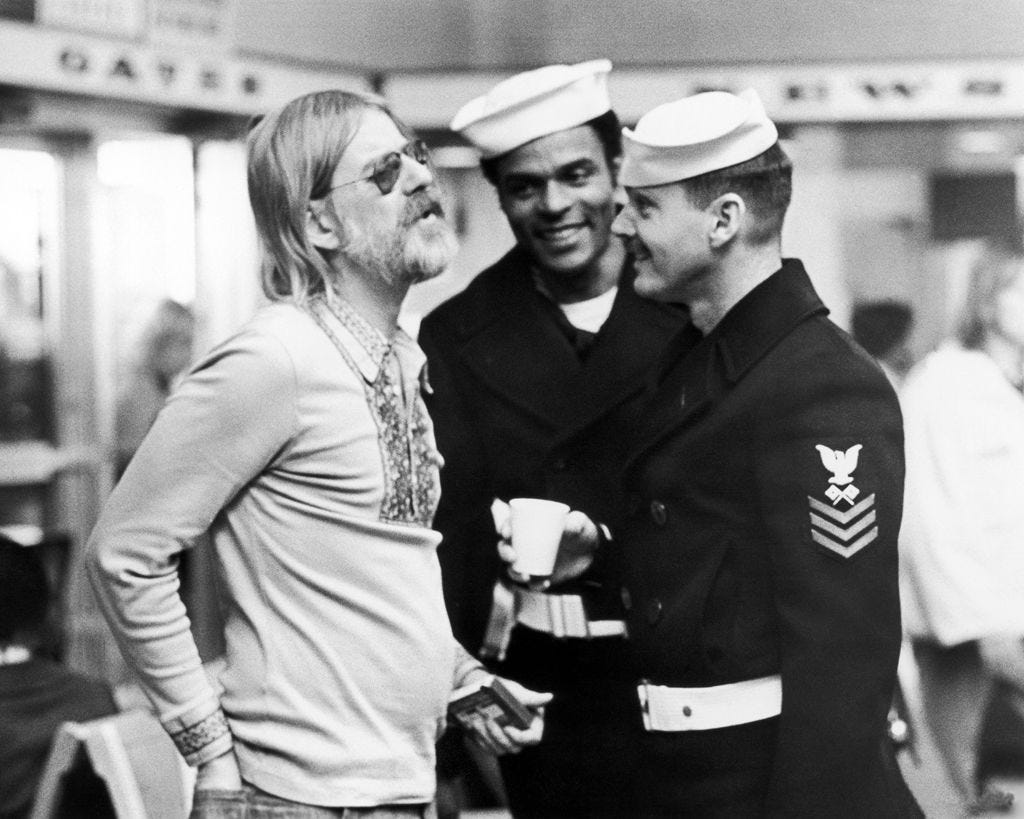
Hal Ashby was busted for weed possession during location scouting in Canada; the opening base scenes and the late scene with a picnic in a park were filmed in the Toronto area. Everything else was in the place where the characters are. The filmmakers had wanted to shoot a scene of the characters drunk on the steps of the Supreme Court but Chief Justice Warren Burger refused, possibly because of Nicholson’s public criticism of Nixon; they shot in front of the National Archives instead.
When the boys visit a New Age group of transcendental chanters, keep your eyes out for Gilda Radner among them. You won’t have to squint so hard to catch Carol Kane, in one of her first roles. The jovial naval officer who sends Nicholson/Young on their “detail” at the start is Clifton James from Eight Men Out and Lone Star.
As post-production started, Ashby had to fire the editor who’d done the first rough cut, as it wasn’t even close to what he’d asked for. He brought in Robert T. Jones, who had a reputation for working fast, since by starting the editing over they were behind schedule. As the process went longer, and the studio started grumbling, Jones/Ashby worked on the editing at Ashby’s house, so the studio couldn’t take the film away and cut it themselves, which they threatened to. The final cut had the most f-words of any movie yet released, although Jones took them all out later for a TV-friendly version. That TV network, ABC, allowed one mild cussword; Nicholson’s character could still be nicknamed “Bad Ass.”
If you liked any of Nicholson’s 1970s work and you haven’t seen this one, you should really give it a try. Stick with it; it gets much better as it goes along.2 If you haven’t seen the 1970s movies of Hal Ashby, this is a great introduction; I might like Shampoo a little better and others might like Harold and Maude, but you can’t go far wrong with any of the three. And it just so happened that when the library DVD froze up with five minutes to go (rare, but it does occur), we found a perfectly-good print on YouTube, for as long as that’s allowed to remain. (I even cued it up to the bar scene for you, but you can go back after that scene and start it from the beginning.)
Robert Towne, when he was on his game, could really really write. This movie would be nominated for an Oscar, as if that mattered to Towne; but it wouldn’t be his last nomination. He’d get more for Chinatown and Shampoo. Towne also, sort of, received a nomination for the script of Greystoke: The Legend of Tarzan, which Towne had hoped to direct himself and had to give up control of. When he saw the changes that the producers/director made to his script, he was appalled and took his name off the movie.
So, when it was nominated, the nomination went to P.H. Vazak, who didn’t win. It’s doubtful Vazak minded not winning; Vazak was Towne’s dog. No dog had been nominated for a screenwriting Oscar before, and none would be again, unless you count Paul Thomas Anderson’s movies, which I do.
The Navy has all kinds of terms for things which aren’t the terms we landlubbers use. A window is a “porthole,” a floor is a “deck,” an assignment’s a “detail,” etc. They like to be Different that way.
Not everyone likes it, of course. This contemporary review from Jump Cut magazine finds flaws with the movie from a Marxist perspective! I don’t agree, but it’s at least an interesting point of view. By the way, that publication still seems to be around, or at least it was in 2025.