
The Grifters
Angelica Huston's a powerhouse in this twisted tale of deception.

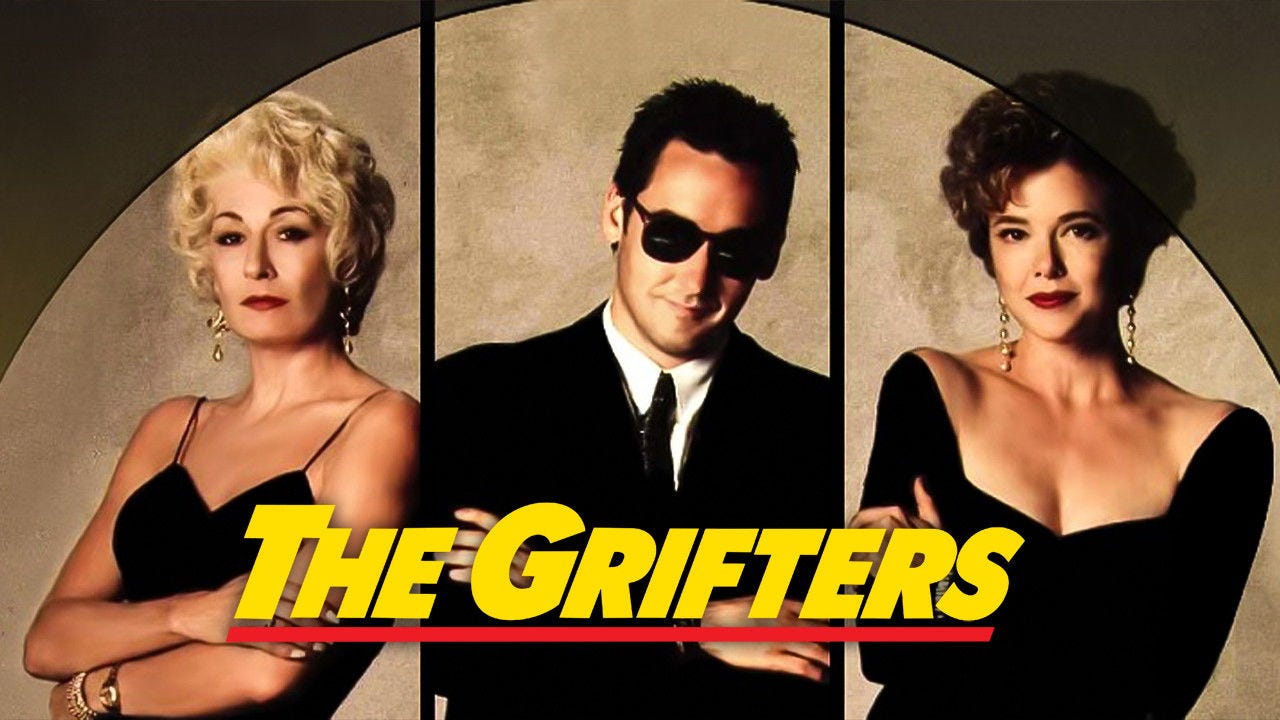
The Grifters (1990). Grade: A-
Hey, who doesn’t love a cool story about pulling a con? Like The Sting, or Dirty Rotten Scoundrels, or The Music Man? All in good fun, right? I mean, as long as Matt Damon or Andrew Scott aren’t in Italy, then things can get a bit darker.
Well, the problem with a con is the same problem faced by spies in John le Carré novels. The essence of being a spy or a con is getting people to trust you, and then betraying that trust. It’s using your best side to feed your worst. For the spymasters in le Carré novels, it’s just part of the game; for the spies themselves, it slowly sucks out their souls. The Grifters says it’s like that for cons, too; and it’s about what happens when they learn this a little too late.
It’s from a 1963 novel by Jim Thompson (I haven’t read it), and adapted by fellow crime novelist Donald E. Westlake, a guy so prolific he had over 15 different pseudonyms!1 Westlake thought the book was just too grim, but Frears convinced him to see it as a story about a tough character who always finds a way to survive. It certainly is that.
Although the book was set in its time, the movie takes place today (when 1990 was today). Anjelica Huston works for a mob boss; she places strategic bets at the track to rig the odds. To keep from being identified, she’s frequently on the move, and one of her “assignments” takes her to Southern California. Where her son John Cusack lives. She hasn’t seen him in eight years; not since he left home at age 17. (She had him when she was 15, and pretended he was her baby brother.)
Cusack has been pretending to be a hardware salesman; he’s actually a small-time con artist. Passing off $10s as $20s, that sort of thing. One time, when a scam fails, a bar goon jabs Cusack with a baseball bat in the stomach. A little later, during his icy reunion with Huston, Cusack doubles over in pain; he’s hemorrhaging. Huston gets him to the hospital in time, but the incident causes Huston to tell Cusack he’s gotta quit “the life.” Get off the grift, she tells him: “you don’t have the stomach for it.”
At the hospital, Huston meets Cusack’s girlfriend, a seemingly-ditzy sex kitten played by Annette Bening. Huston takes an instant dislike to Bening, more than a typical “parent doesn’t like the new person you’re dating” dislike.
And we in the audience know why. Neither Huston or Cusack know it, but Bening’s a con artist herself. In her first scene, she’s trying to pass off some fake jewelry as real. The jeweler spots the fake, but an apologetic Bening locks the front door and proposes they come to some OTHER kind of arrangement. (The jeweler is the always-amusing Stephen Tobolowsky.)
So that’s why Huston immediately distrusts Bening; she’s got a sixth sense for knowing when someone’s lying, and can tell that Bening’s “dumb tootsie” bit is an act. She doesn’t know what Bening’s game is, but she’s sure Bening’s up to something. While Cusack probably doesn’t trust either of them completely, but he’s sure he can handle himself; nobody’s gonna pull a fast one on him. (If only he’d seen Treasure of the Sierra Madre and realized that “nobody pulls one over on Fred C. Dobbs” doesn’t generally end well for Fred C. Dobbs!)
Director Stephen Frears, with wonderful movies like The Hit, My Beautiful Laundrette, Dangerous Liasons, and High Fidelity to his credit, was never venerated the way boring directors who repeat themselves are; that’s how to make critics worship you as an “auteur.” But there is a common thread to many of his best films, which is the way our emotions can jerk us around; even when we’ve put up walls to keep them from getting to us. (Maybe they get to us even harder when we try to put up those walls.)
Cusack sheds any of the babyish-ness he had in movies like The Sure Thing and Say Anything; he comes across as someone who’s been forced to become too jaded too early on. (But he’s still got the sex drive of a very young adult; he phones Bening to come over for a bootie call right after the bar goon’s beaten him in the stomach!) Cusack had actually read the book on his own and wanted to make it into a movie before finding out about this project. And this was a major breakout part for Bening, too, who said that she didn’t find the nudity in the film objectifying at all (yet she felt a little bad for her dad, a conservative Republican; he got over it).
But the movie belongs to Huston; what a role! She genuinely feels bad over having been a bad teenage mom (what teenage mom is good at it)? And she’s got sincere protective momma bear energy towards Cusack, in her own way; when he goes to the hospital, she tells the mob doctor “my son is gonna be alright. Or I’ll have you killed.” She’s not above major guilt tripping, though; when it helps, she’ll remind Cusack she called the ambulance and that she’s now given him his life twice.
Huston’s not as invincible as she’d like to be, though. Her mob boss, Pat Hingle, is no fu***ng around. When Hingle thinks Huston’s been making deals with the other mobsters, he’s got ways of terrifying her which might make some viewers want to fast-forward through the scene. (Don’t; the worst that you imagine doesn’t happen, and the smaller way he does punish her becomes crucial as a plot point.) It’s a great small role for Hingle, who mostly worked in theater and in little parts for film/TV. (He was Commissioner Gordon in the Tim Burton Batman movies; and you can see him in a weird little promo film for GE playing Thomas Edison here.)
When Huston’s at her most frightened in the Hingle scene, she does a trembly voice that shows you how vulnerable she is when her defenses are down; it’s a preview of her final scene, where she has to blow you out of the water. And she does. (Huston was so shaken by that last scene that she left the set for the day.)
Critic Pauline Kael pointed out that one of the last shots in John Huston’s The Maltese Falcon showed the face of Mary Astor descending in an elevator; here, one of the last shots is John’s daughter Angelica descending in an elevator. And that one of the last things Angelica does might remind you of John Huston in Chinatown.
Speaking of Chinatown, there’s a primary reason that’s a highly-regarded classic and this isn’t; that movie has one of the greatest film scores ever written, and this, well, does not. It’s by, sigh, Elmer Bernstein. It’s not as bad as Bernstein’s worst, but it’s not classic-level stuff; it’s twinkly when it tries to be cutesy and way too throwbacky in an obvious way during the “things are getting tense” scenes. This doesn’t have as complexly-layered a script as Chinatown, either. But with Huston doing what she does here, it’s got an even more stunning ending.
That’s what’s most amazing about this movie; like Dangerous Liasons, you think you’re seeing a half-comedy of characters all having insignificant grudges against each other. And then things turn. They REALLY turn. Once Cusack realizes he’s not as in control of things as he thought; that his rules for never letting anyone get to him aren’t working.
The film was ostensibly produced by Martin Scorsese, who somehow had the good sense to have Frears direct (maybe Scorsese had seen The Hit). After getting Frears on board, Scorsese basically went back to working on his own projects; everybody knew Frears, a veteran of British television, could get things done on time and on budget. (A slightly bigger budget; there’s more crane shots in the first two minutes of this than the one crane shot they could afford for Mr Beautiful Laundrette.) Scorsese didn’t go completely AWOL; you can hear his voice in about 15 seconds of narration at the beginning.
Per the AFI, an early cast included Geena Davis and Melanie Griffith; no insult to either, who I enjoy a lot, but nobody else could do what Huston does here. And she didn’t even want the part, turning it down at first! She wasn’t willing to do it until Frears told her she could do it in a blonde fright wig.
The fine cinematography by Oliver Stapleton and production design by Dennis Gassner put the characters in their seedy settings, but blessedly, this avoids the cliches of “film noir.” (There’s one shot of window-blinds shadows in the hospital which comes off like a “noir” parody shot.) Rightly, this movie is more a part of the “scuzzy L.A. criminal world” we saw in The Late Show and Night Moves, just updated by a few years.
We’ve even got a Charles Napier and a J.T. Walsh sighting; Walsh, who always played baddies, gets a small role as a con man here, and why didn’t anyone ever cast him as one before! He’s spot-on perfect. So many of the small roles are, like Henry Jones as the idiot know-it-all desk clerk.
Really, if you like twisty movies, you should see this one; and if you’ve ever enjoyed Anjelica Huston in anything at all, you HAVE to see this one. Sometimes, all too often, nepotism does exist in Hollywood; but there’s no way that Huston wouldn’t have become great, at least on stage, even if her last name was Dingleberry.
Kael wrote that Huston here “is willing to be taken as monstrous; she contains this possibility as part of who she is.” If that’s true, no wonder she walked off the set afterwards! Myself, I just think she deserved to take the day off early. Not too many actors have ever put in this kind of performance in a career, much less one scene! Take the day, ma’am.
A scene in the film takes place at the firm of “Stark, Coe and Fellows.” Westlake wrote as Richard Stark, as Tucker Coe, and as many other “fellows.”