
Reflections on Cinematography
Cinematographer Roger Deakins' neat memoir about life & art.

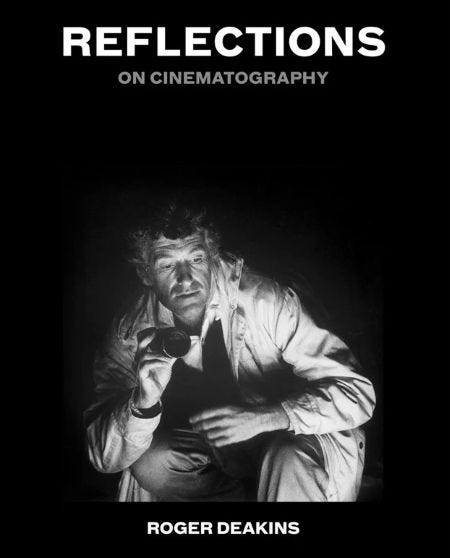
Roger Deakins begins this book with a story. On one of his earliest film jobs, a documentary shot in rural southern Ireland, Deakins found himself quite lost. He came across “a fishing shack, blacked with tar in a vain attempt to protect it from the weather,” and nearby “was an equally weather-beaten man and his dog.” Deakins told the man he was lost. And so the man puffed his pipe and began to speak.
“‘What followed was the story of his life and what a rich life it had been; his wayward youth, his adventures in the merchant navy, meeting the love of his life in a strip club in London’s Soho, and so much more. Finally, he emptied his pipe and gestured towards the fishing shack. “My parents lived here. I was born here, and I will die here. I can’t help you get where you are going but I wish you well. Drop by if you are this way again.”
Deakins means the story as being close to his own; like the sailor, he too wandered aimlessly until he ended up where he wanted to be all along. It also fits his professional career. Plan; but be willing to adjust on the fly for the unexpected things you will run across. You never know where life can take you, for good or ill.
Deakins’s mother died when he was very young, and only as an adult did he learn that she had been an aspiring actress with a few roles to her credit before she had children. Later, he would learn that she had been in a very famous 1938 documentary photo, taken when she was 21. Just someone enjoying life, before it became sad:
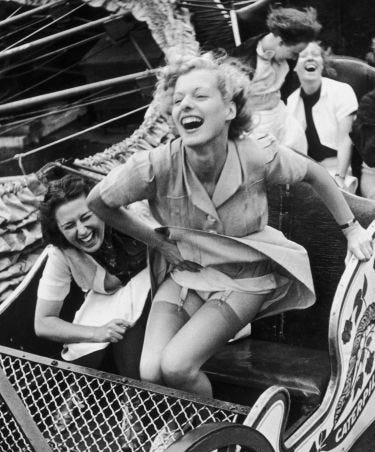
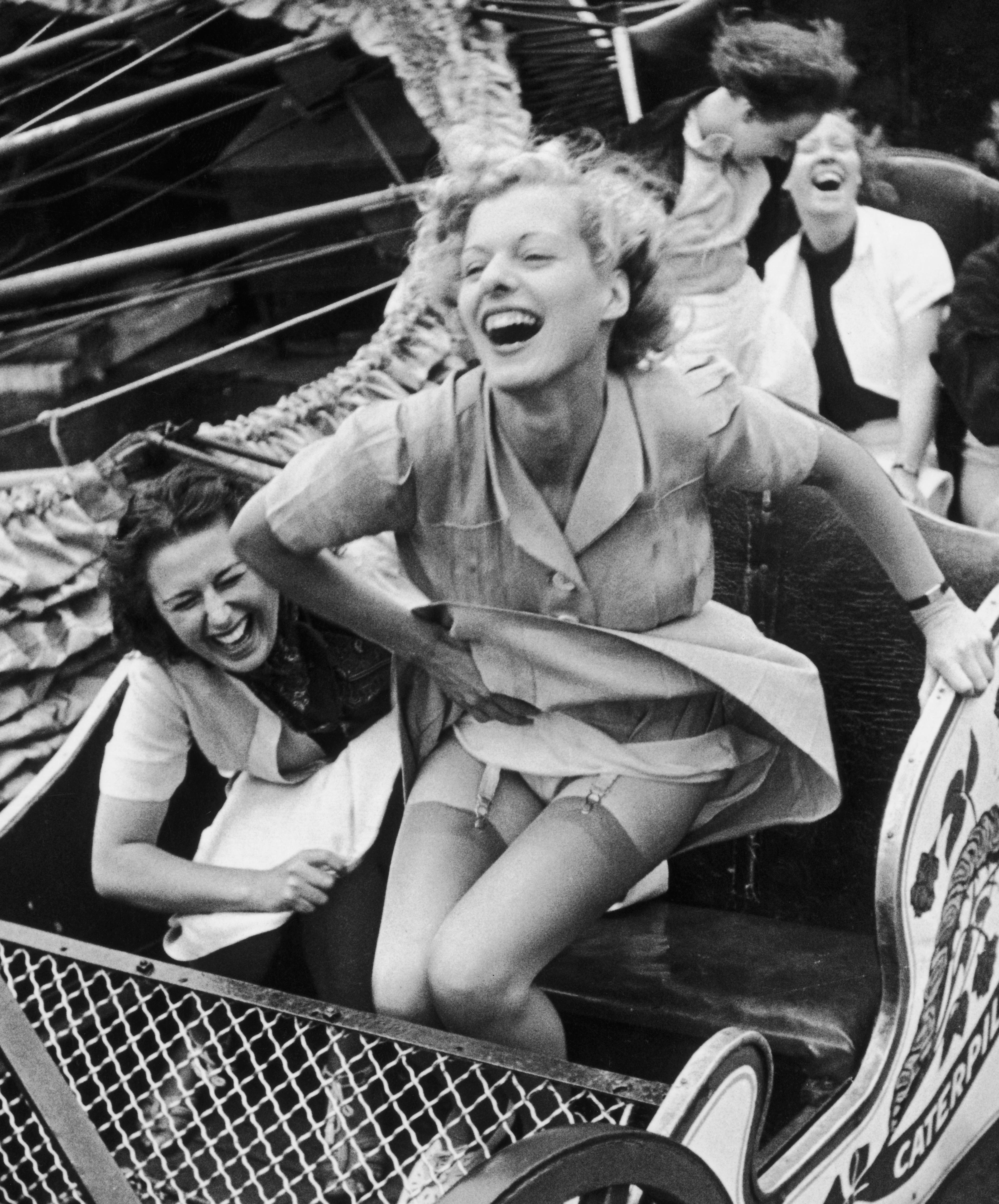
Apparently, Deakins still sees that picture of Josephine popping up all over the place in random locations, like a Santa Monica shopping mall or a pub in Scotland where he was shooting 1917.
After his mother’s death, his father remarried; the new wife did not like the kids. Deakins found himself growing apart from his family, and more restless in his seaside town of Torquay. He didn’t do well in school, but he was introduced to world cinema and documentaries at a local arthouse theater; it gave him the Film Bug.
Deakins attended Bath Art College, where he was being trained to do graphic design; he didn’t have any interest in that. A fellow student steered Deakins to the National Film and Television School in London, where Deakins was eventually able to get experience on his own and fellow students’ film projects. He writes that upon graduating in 1975:
“A governor of the school suggested I seek work as a production assistant in Plymouth, at the local television station closest to Torquay. With luck and hard work, he suggested, I might make my way up to camera operator in seven or eight years. Whether this was a serious suggestion or a deliberate attempt to rile me up I have no idea, but within a decade, I’d worked as cinematographer on a film the governor in question produced. Whether is was intentionally motivational or not, to this day I am indebted to David Puttnam for giving me such uninspiring advice. Instead of Plymouth I decided to try my luck in London.”
(Puttnam became the Oscar-winning producer of such movies as Chariots of Fire; the 1985 movie that Puttnam produced and Deakins shot was Defense of the Realm.)
That’s one of the many charms about Reflections on Cinematography. In between the technical and personal stories, Deakins has no compunction about dishing the dirt on people he found to be rude or unprofessional. Filming 1992’s Thunderheart with Val Kilmer, Kilmer announced that someone was “in his eyeline.” Everyone in the crew who could removed themselves from his eyeline. It turned out Kilmer was taking about a sight “way, way out on the horizon you could just barely see a kid on the back of a pickup truck, the child of a rancher who was probably out looking for his cows.” So a production assistant was duly sent to pay off the offending eyesore to move their truck. A camera assistant whispered to Deakins, “does Val ever act in the theater? Does he have the audience turn their backs on the stage?”
Or another instance where the (not good) director Roger Spottiswoode was s**-talking Deakins’s work on the (bad movie) Air America. Some other filmmakers had asked Spottiswoode for a report card on Deakins. Spottiswoode delivered a “scathingly bad report,” saying Deakins “liked to operate the camera myself, was not a fan of second units,1 that I did not like shooting with multiple cameras or with zoom lenses, and that I preferred working out the shots in a scene before the day’s shooting began.” That was “exactly what the brothers had wanted to hear.”
“The brothers,” of course, being the Coen brothers, with whom Deakins would shoot 12 movies, including Barton Fink, The Big Lebowski, O Brother Where Art Thou?, A Serious Man, and No Country for Old Men.
Deakins has also shot several movies I think look great, but few have seen, such as The Assassination of Jesse James by the Coward Robert Ford (it DOES look amazing; it’s also 160 minutes long, so viewer beware). He goes into detail on movies he shot for Sam Mendes and Denis Villeneuve, two directors I don’t care for.
So there is a mild problem with the book; when chapters go into great detail on how a particular movie was shot, but you either haven’t seen it or didn't like it (because of the directors, not Deakins). It doesn’t make those chapters bad, just something you’re more likely to skim for the writing that catches your eye.
I loved learning how the “camera follows bowling ball” shots were done in Big Lebowski; Mitch Lillian and Bruce Hamme just put the camera on a felt pad and it was pushed behind the ball on a 40-foot pole. That the motel flames in Barton Fink were the real deal (and they were hot, but carefully safe). And how after shooting The Hudsucker Proxy in Chicago, in the winter, Deakins thought nothing could possibly be so unpleasant, weather-wise. Nothing could be THAT cold.
Then the chapter on Fargo is titled “Twenty Below.”
I had some more notes on the book from the first time I checked it out; but I lost them. (On a piece of paper, no less! See, it’s not just computer files that can get lost.) So I don’t have chapter/page citations for these (I wrote ‘em down!), but, believe me, they’re all in here:
How Deakins has nothing against digital photography per se; it’s just another tool in the toolbox. His thought is that a lot of movies shot with digital cameras look bland because the directors aren’t familiar with how lighting can be used. It’s often possible for digital cameras to record usable images without any additional lighting at all, and so some newer directors might feel they don’t need to light shots for dramatic emphasis, even when it could help the movie.
The unspoken corollary to this is that directors used to ASK experienced cinematographers what they think could/should be done to express something within a shot. If they’re not asking now, it’s because they’re too dumb to realize what the material they’re directing is actually about. Granted, most old-time Hollywood directors were idiots, too. Some things never change. (Deakins mentions that some directors don’t want to worry about shot selection at all, focusing on the actors instead, and letting the cinematographer select the shots. He doesn’t deride that, and neither do I; it’s a perfectly valid way of approaching a film.)
When directors/choreographers DO bounce ideas off each other, the results can be terrific. Deakins mentions several times when the idea for a shot came from him, or from one of the crew. So, shot-by-shot analysis film scholars, go ahead and PROVE that each shot in a work by a Master Auteur expresses their inner turmoil. Sometimes it’s the boom mike guy saying “it’ll work a lot better if we do it this way.”
Along those lines, Deakins mentions how part of a cinematographer’s job is to help the director realize their vision, no matter how elaborate it might be, visually… but, also, help the director and the production team be realistic. Let them know what is doable with the money and the time available. (While Deakins will work with directors like the Coens who storyboard a whole script beforehand, he prefers to work out shots each morning. And, the Coens ended up being very flexible in welcoming creative collaboration.)
So, even though there are some films here you just won’t be curious about, there’s useful and almost always engaging writing for anyone who wants to learn more about the ways movies are actually made. Sure, there’s more details about fill lights than I needed, but you can just skim that stuff easily.
There’s a great bit where Deakins is invited to Pixar during the making of WALL-E to demonstrate what the art of cinematography is. And he gives a short presentation on a mockup of a movie set. “Using a traditional blend of key lights, fill lights, kickers, and backlights with multiple flags to shape the light and patterns of light on the walls.” This continues. “After about twenty-five minutes, I started to wonder if I’d taken the exercise too far… it was becoming harder and harder to move around the set!”
Then Deakins told them, you might think that’s what I do… but it’s not what I do. He pointed everyone’s attention to a single light bulb illuminating an electrician’s face in an interesting way, and said, “This is what I do.” Use whatever technology serves the image you want to show, and no more than is necessary. It’s a concept Deakins returns to several times.
This book is VERY worth a library checkout. The suggested retail price is $45 USD, which is steep for my budget, but those of you with a bit more cash and serious movie-buff friends might consider this as a gift item. $45 is actually cheap given the normal price for books this handsomely printed, at 400 8”x10” pages, most illustrated with wonderful photographs/production sketches. Be warned, however — the copy I checked out from the library already showed some fraying binding issues, which isn’t ideal for a book not even a year old. So purchasers should know and gift-recievers should be informed that this is probably a read-upright-in-armchair-or-on-sofa book; it doesn’t seem stitched/glued together well enough to withstand being read flat on a table.
You can check out this brief interview with Roger and James Deakins (James is Roger’s wife/filmmaking partner) at Film Review Daily. Interestingly, it says that Keith Phipps, “a writer from Chicago,” helped shape the book and collate some of the material. Those who remember when The A.V. Club was a really terrific publication will remember Phipps, a longtime writer/editor there.2
Serious cinematography buffs, especially those who work at the craft themselves, can also look at Deakins’s official website. There are forums for solving lighting problems and such.
Those who aren’t quite as technically-inclined will still find much to enjoy in the book. On the set of Kundun, James Deakins would try naming interesting movies that director Martin Scorsese3 hadn’t seen. You simply don’t play stump-the-film-nerd with Scorsese; he’s seen everything. In return he would ask the staff to get videotapes of interesting movies he thought Deakins would enjoy watching, since there wasn’t a heckuva lot else to do after hours on the remote location. And then this happened:
“‘Every time Marty asked for a movie, the staff had to find someone in Italy to hand-carry it through Moroccan customs as, if sent on its own, a VHS tape would never have made it. Those in the production office were not so fond of the “name a movie” game that Marty and James played!’”
I’ll bet!
It's good behind-the-scenes stuff, it's good technical stuff, and great personal memories. A very cool book, from one of the greatest-ever at his craft.
“Second unit” is where a separate camera crew is sent to capture external shots in different places than the main shoot is happening, or to go find pretty pictures from a helicopter shot or whatever.
Phipps parted ways when The A.V. Club’s parent company insisted the Chicago-based staff all relocate to L.A., to be closer to “the movie industry” and pointless “access” to celebrities and press agents, etc. This was pretty much EXACTLY when The A.V. Club went from really fun to typical internet bilge.
Scorsese appears to be a director who does NOT enjoy collaborating with the cinematographer. “In the mornings he would leave it to me to ready the shot and only come to the set when called for by our AD, Scott Harris. Whether intentionally or not, if what I had set up deviated at all from what Marty had in his mind’s eye, I was in trouble.”