
Persepolis
Great animated film about growing up during/after the Iranian revolution.

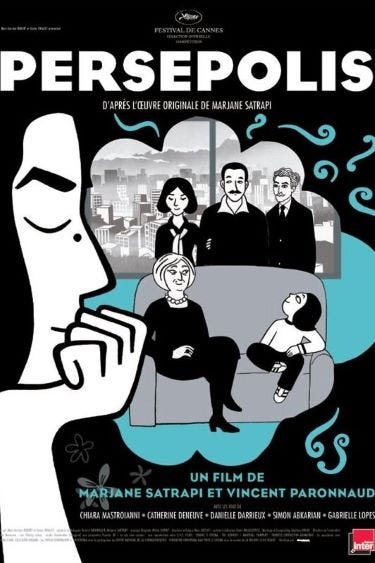
Persepolis (2007). Grade: B+
Like any sensible child, young Marjane assumes that all the good people in the world know one another. So when she finds that a relative has been to Europe, she wants to know who the relative saw there. After all, Europe is part of the West, and the West is where her hero lives. So, she asks her relative, “did you meet Bruce Lee?”
Persepolis1 is based on a series of “graphic novels” by Marjane Satrapi, published between 2000-2003. (Satrapi herself dislikes the term “graphic novel,” writing “‘People are so afraid to say the word “comic”… No: it's all comics.’”) These were later collected and published as two books; one describes Satrapi’s childhood in Iran, the second her teenage years in Vienna and eventual return to Iran.
When Satrapi was just under ten years old, the Iranian Revolution overthrew the corrupt and tyrannical government of Iran, replacing it with… the even more corrupt and tyrannical government that’s been in power ever since. Since young Marjane was a natural rebel given to questioning authority, Iran became a very dangerous place for her to live — so her parents managed to get her enrolled in a school in Vienna.
Some history is in order. (The film doesn’t quite describe it.) During a period in the post-WWII years, Iran had been transitioning from a monarchy to a democracy. In 1951, the democratically-elected Prime Minister, Mohammad Mosaddegh, attempted to nationalize Iran’s oil industry. Taking it away from the British, who were getting most of the oil money. This DID NOT please the Anglo-Iranian Oil Company (now known as BP.)
So the British government asked the American one, “can you help us out with this? We’d really like for BP to keep that sweet oil money, please.” And the American government said, “sure! That’s what our brand-new C.I.A. was invented for!” So the C.I.A. plotted a nice little coup. The night before the coup was to begin, the key plotters — led by Kermit Roosevelt, grandson of Teddy — had a fun cocktail party to celebrate their efforts. Their favorite tune being played that night was a recording of “Luck be a Lady” from Guys and Dolls. (Read all about it in All the Shah’s Men, by journalist Steven Kinzer.)
The coup was successful, and Mosaddegh confined to house arrest for the rest of his life. The coup re-installed the Shah, Mohammad Reza Pahlavi, who maintained control through suppression of dissent, collecting a slew of political prisoners along the way. Eventually a coalition of reformers and religious radicals overthrew the Shah in the revolution that ended in 1979. The religious radicals took over, and silenced the reformers.
What Persepolis shows — what I didn’t know when I first saw it — was how many people who supported the revolution thought it was going to make life in Iran more democratic and open. We see Marjane’s beloved uncle, a leftist intellectual, expressing hope all through the turbulent period that, when things settled down, the resulting system would be fair and just and free. So of course the new government kills him. (We do not see any actual violence in this film, but there are snippets which hint at it — a hand poking out from underneath bombed-out rubble, for instance. It is not a movie suitable for children.)
The movie does a fine job mixing in these adult perspectives while keeping the story told from young Marjane’s point of view. They’re trying to do things like get a travel visa for a sick relative; she’s trying to do things like buy illicit cassette tapes of Iron Maiden albums. The voice acting is very good, and has a real feeling of family connection. French legend Catherine Deneuve is the voice of Marjane’s mother; Marjane is voiced by Chiara Mastroianni, Deneuve’s daughter. Danielle Darrieux, no relation to either of those two, voices Marjane’s worldwise and hilariously sane grandmother, and she’s got the best lines in the whole film.
No matter how sad this story gets, it’s always funny; Marjane Satrapi definitely inherited her grandmother’s wry, direct sense of humor. In an article she wrote about making the film, she said one of the worst things about working on the movie was “‘I hate to say this but I'm not nice in the morning. I wake up as if I was bitten by 55 snakes: I have the poison in my veins. You have to be there at 8am, which I don't like, then everyone says “Hi” and so you have to be nice back to them. Every morning I was thinking, “Oh God, who the f**k are they? Kill them all!’”
Sometimes, authors who work on, or have a voice in, the film adaptations of their books have no idea how movies work. Anne Rice famously opposed Tom Cruise being cast in Interview With the Vampire, then decided Cruise was brilliant. She was absolutely WRONG, he’s terrible in it. (Antonio Banderas is brilliant, though, and him + Kirsten Dunst almost make the movie worth watching.) Tom Clancy hated The Hunt For Red October and demanded more input into subsequent film adaptations; he was absolutely WRONG, Red October is the only decent Clancy movie.
You have to realize that a movie is NOT going to be what your book was. (When Nick Hornby wrote the screenplay for Fever Pitch, he turned a wide-ranging, chatty memoir into a simple relationship story, and it worked wonderfully — in the British version, not the crummy American remake.)
Satrapi co-wrote and co-directed this adaptation with French comic artist/filmmaker Vincent Paronnaud (the original comics are all in French, it’s where Satrapi lives now). And she understood that her book had to be altered for the movie. It’s got most of the same characters and plot, but visually, it’s much more elaborate, in a good way. The original was in a very basic, very evocative style. Here’s a sample (you don’t need to read French to get the gist):
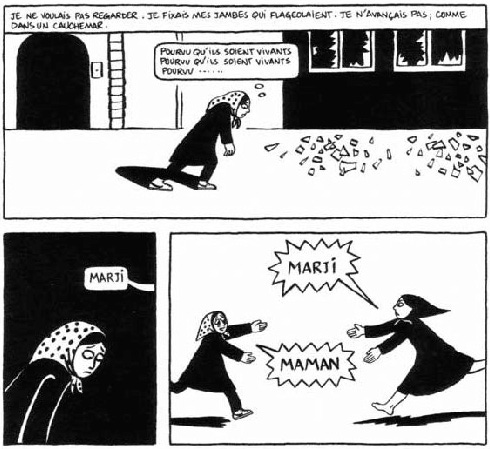
The film version keeps the same black-and-white as the comics (except for brief moments set in the present day), but there’s much more gray shading, much more detail in the backgrounds. The images have terrific depth, and the “camera” is frequently moving around. It’s a great-looking movie.
And it’s got great points to make, too, especially about the nature of repressive regimes. How incompetent sycophants are given positions of authority and screw up everything they touch; how those obsessed with sexual “purity” are actually only interested in subjugating women. Oh, and banning books, that’s always fun for them. Some dingbats in — you know it, Texas — tried getting the books of Persepolis banned for their “Islamic content.” They failed, but they’re not the only dingbats around.
If I had any criticism of the movie, it’s that it ends too abruptly. The story just stops. Not that the ending is bad — it’s hopeful and very sad all at once — but it’s not dramatically satisfying. The story could have used a coda, a sense of what life was like for Marjane and her family afterwards.
Of course, one answer to that is making the movie itself. What happened later? Well, to Marjane at least, she became a filmmaker. The DVD has a very nice feature, “The Hidden Side of Persepolis,” that shows Satrapi at work, directing the animators and the actors. And the sound-effects people, lugging around their crates full of assorted junk from which they can invent the sound of anything. (I always love watching those folks work.)
There is an English-language version of the film available on the DVD — SKIP IT. It’s amusing for a few seconds to hear Sean Penn as the dad and Iggy Pop (Iggy Pop!) as the uncle. Satrapi did direct the English-speaking actors, herself, and speaks English (and Swedish, German, Italian…). But those actors don’t have the same warmth together as the French-speaking ones. Just because you can speak/read a language does not necessarily mean you have a feel for directing it, yet!
In one of the DVD making-of feature’s best moments, Satrapi is demonstrating exactly how she wants voice actor Mastroianni to mangle the French pronunciation of the lyrics to “Eye of the Tiger.” Because it’s for a scene in the movie, and it's a scene I promise you’ll enjoy.
The name comes from a 2600-year-old historic site in southern Iran, a location possibly used for ceremonial purposes. It looks like it’s very cool.