
Nasrin
Fine documentary about a gutsy-as-hell human-rights lawyer in Iran.

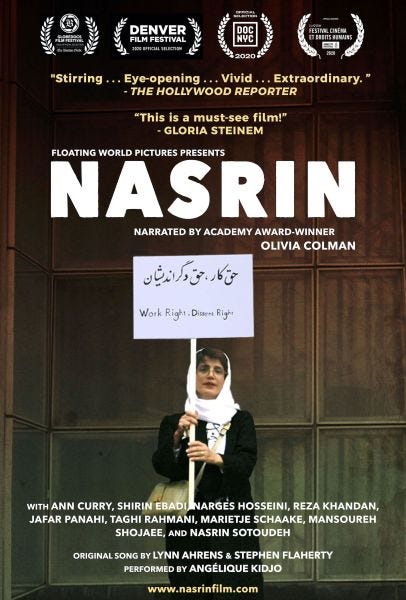
Nasrin (2020). Grade: B-
The movie begins with some interesting historical facts on the screen. How in 530 BC, Persian women had the right to an education, to own property, and to choose who they married. How by 224 AD, those rights were gone. How those rights have come and gone, been granted and taken away, by subsequent ruling powers in Persia (now Iran) since.
And, as human rights lawyer Nasrin Sotoudeh explains later on in the movie, this is why having rights “given” to women is never enough. Those rights must be preserved and held BY women, they must have an equal say in who has political power. Otherwise, they are never, really, rights at all.
There’s another historical fact which the movie refers to — briefly — and it’s one that most Americans aren’t aware of. How Iran was a somewhat democratic society from 1950-1953. (Women still couldn't vote.)
Under the leadership of prime minister Mohammad Mosaddegh, Iran decided it would nationalize its oil supply. Most oil contracts in the region had been signed decades before it was clear that the world would (for now) run on oil. Before countries knew how truly valuable those oil holdings were. (The great promoter of American democracy, Thomas Paine, enjoyed lighting natural oil springs on fire to watch ‘em burn, cause boys like lighting things on fire, and nobody thought there was much more you could do with petroleum back in the day.)
Well, if Iran nationalized its oil supply — if it processed and sold the oil itself, with the profits going to the people of Iran through social services — that would mean a BIG money loss for the company which had previously done the processing/selling. That was the Anglo-Iranian Oil Company. You know it today as BP.
BP didn’t like this, so it begged the British government to DO something, and the Brits called their buddies the USA. We just happened to have a pretty brand spanking new agency called the CIA, which was eager for doing some international shenanigans. And shenanigans we did, overthrowing the government and putting the former monarchical ruler “Shah” Reza Pahlavi back in charge, a guy so heinous that ever nice Jimmy Carter was hesitant to let him into the US for medical treatment decades later.
(Jimmy, a devout Baptist, was so ticked when Henry Kissinger leaned on him to let the Shah go to the Mayo Clinic, that he hung up the phone after Kissinger’s call and yelled, “f**k the Shah!” That wasn’t, generally, the language Carter used.)
Eventually, the Shah was overthrown by radical revolutionaries in 1979, and replaced with the rotten, authoritarian Islamic Republic that still rules the country today. (A great many Iranian liberals supported the revolution, believing that nobody could be worse than the Shah. You can see some of this in the outstanding movie Persepolis, directed by Marjane Satrapi and based on her books/comics of the same name.)
The current authoritarians in Iran have sharply restricted women’s rights; most things like independent travel or employment are illegal without a father or husband’s permission. (It’s still a marginally better country for women to live in than our longtime ally, Saudia Arabia.)
Yet even though Nasrin Sotoudeh’s parents were traditional and religious, they supported their daughter’s wish to follow her own goals, and eventually Sotoudeh became a lawyer. And what she’s been doing, ever since, has been trying to work within the flawed, corrupt Iranian legal system to gain some rights for women, and for unjustly sentenced prisoners. When she’s not a prisoner herself.
Sotoudeh has been jailed multiple times, on utterly ridiculous charges. Some are described to us in the movie; she’s accused of being a Western spy, and wanting to promote prostitution. (That prostitution one comes up a lot when I see Iranian movies; whenever women ask to be given any freedom, the authorities love to accuse them of wanting to be prostitutes or promote prostitution.)
The most heartbreaking thing in the movie is when Sotoudeh is in the infamous Evin Prison, and we hear audio of her phone calls with her family. It reminds you that Sotoudeh isn’t someone being jailed because she likes scoring publicity points that way; she’s a damn mom who’d prefer to be with her family. (In one phone call she’s trying to cheer up her son by asking him about the latest puzzle game he’s downloaded on his IPad.) It’s also heartbreaking because it appears that, in Iran, it’s easier for prisoners to call their families than it is in many American prisons. (Just as in Iran a woman with permission from her father/husband has an easier time obtaining an abortion than one in Texas.)
Sotoudeh’s most recent jail stint began in April of this year, following American & Israeli attacks on Iran’s dangerous weapons, such as a girls’ elementary school. As basically anyone could have predicted, the Iranian government responded to the attacks by cracking down on dissenters, social reform advocates, and artists. This time, Sotoudeh was only allowed one phone call, and her family was enormously worried. Fortunately, she was released on medical leave on May 13. Unfortunately, her husband, Reza Khandan, is still in jail. He’s been there since December 2024. On the grounds of being Sotoudeh’s husband, essentially.
We meet Reza Khandan in this movie, and Reza/Nasrin’s smart, determined daughter, Mehraveh Khandan (who is now studying in Amsterdam). We meet several fellow activists / reformers as well; about 75% of the documentary was clandestinely filmed in Iran, by Iranian camera crews. The footage was assembled and narration written by American documentary filmmaker Jeff Kaufman and producer Marcia Ross over the course of four years.
The 25% of footage that’s NOT shot in Iran is from news reports. One imagines it’s CNN Europe, because you sure won’t see much mention of Nasrin Sotoudeh in American media. At one point, when Sotoudeh is on a hunger strike in prison, the movie shows us people protesting for her realease in Canada, in Brussels, in Amsterdam, and more. In America? Somebody rented a truck that had Sotoudeh’s face painted on it and drove it around NYC. That’s about it.
It’s not like Americans, by their nature, don’t care about these things. In the 1980s, everybody in my high school knew who Nelson Mandela was. Many people know who Chinese artist/dissident Ai Weiwei is. But our media has no interest in covering virtually anything outside the scope of American politics, these days. The people who’d like to learn about activists like Sotoudeh aren’t given the opportunity. I’d never heard of her before we saw Jafar Panahi’s Taxi a month ago. Where Panahi pretends to be a taxi driver in Tehran, and meets people with views all over the political spectrum. At one point, Panahi’s young daughter, who’s riding in the taxi, happily exclaims, “there’s the flower lady!” It’s Sotoudeh.1
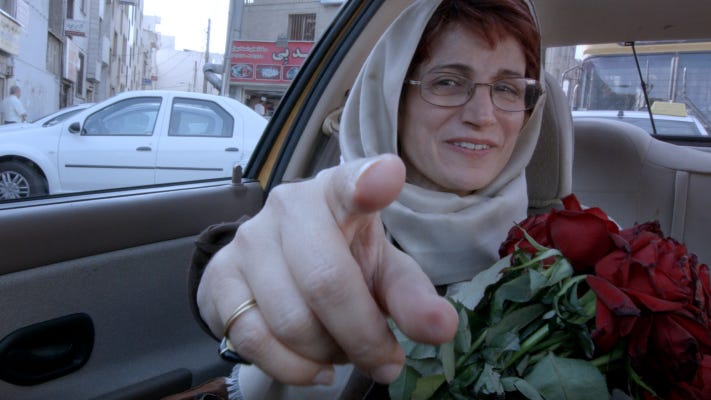
Another thing that’s mentioned in Taxi are the harsh prison sentences, particularly of young people, juveniles, sometimes for minor property crimes. Those are among the cases Sotoudeh works in in this film, trying to get the sentences reduced. Sometimes she’s successful; sometimes she’s not. Including one case where she was trying to save a teen from execution. It’s not an easy thing to shrug off, and she sure doesn’t.
A different case is when Sotoudeh represents one of the “Girls of Revolution Street,” women who stood on pedestals, removed their hijabs (head scarves) and held the hijabs aloft on poles or stucks, as a sort of flag of freedom. (Hijabs are mandatory for all women traveling outdoors, and have been since 1979. Sotoudeh doesn’t wear one in her office.) In this case Sotoudeh IS able to get the girl out on bail, helpfully provided by a local businessman.
And at one point, she’s not trying to make a case at all, she’s just calmly asking a man to show some empathy. The father of two young men who stabbed a 63-year-old to death simply because he was a member of the Baháʼí Faith, a religion of about 7.5 million worldwide that teaches the equality of all faith traditions. (Shudder!) The two young men were released after only two months in jail. All Sotoudeh wants is for the killers’ father to feel bad for the families of the victim. And he’ll say he’s appalled by the act — but that’s about it.
At times you may feel frustrated by the movie’s lack of a clear narrative. It doesn’t, like Yung Chang’s fine documentary about the late journalist Robert Fisk, tell the story of Sotoudeh’s entire career; mostly, what we see are snippets of her various efforts today. But that frustration is a way of representing the frustration Sotoudeh faces as she tries to beat back the same barricades, over and over. This isn’t an Erin Brokovich-style story of one gutsy activist’s inspiring victory; it’s a story of one (among many) gutsy activists trying to hold their ground against a system that’s trying to crush their hopes.
Near the end we see Sotoudeh in the audience for a performance of Ariel Dorfman’s play Death and the Maiden, about people trying to get justice for the years of abuse suffered under an authoritarian regime. (One dissident, Nazanin Deyhimi, put on a performance of the play in Evin Prison; Sotodeh still has one of the props. Deyhimi died at age 29.) They’re hoping for the day where they, too, can seek justice. And now the attacks on Iran by two striving-to-be authoritarian regimes have probably pushed back any chance of that happening for years and years.
This isn’t a feel-good movie that’s gonna give you hope for the future. Yet it’s not a stone-cold bummer, either. Sotoudeh, a woman so gutsy she once went on a prison hunger strike and wouldn’t even drink water (that can kill you in a few days!), is frequently shown as frustrated or disappointed, yet she’s not a quitter. She isn’t despairing. In her shoes, I sure would be! But she’s a tougher soul than I am — well, that’s not a major compliment. She’s tougher than most of us, I think. This is simply a movie that can tell you something of what life in Iran is like, and what some people are trying to do about it. If that’s the kind of thing you’re ever interested in reading or learning about, here’s a chance to do that. And, for now, it is free on the TubeYous. Take a look.
(Site note: there will be no post tomorrow. Thanks as always for reading, and we'll be back to your regularly-scheduled programming on Monday.)
Panahi makes a brief appearance in the movie, asking Sotoudeh for help on trying to get his ban from making films reduced. (It wasn't, but he still makes ‘em anyways!)