
Mrs. Soffel
Diane Keaton ministers to Mel Gibson in jail... then much more.

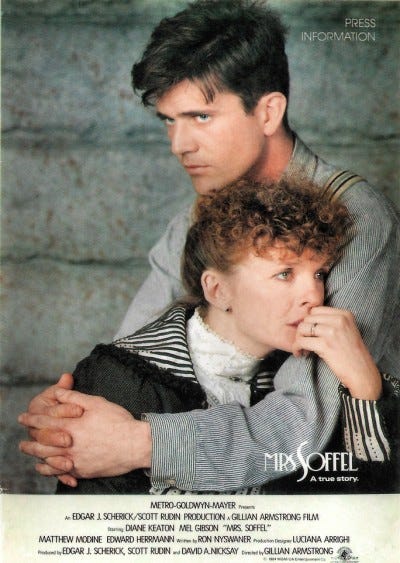
Mrs. Soffel (1984). Grade: B-
There used to be these things called “Choose Your Own Adventure” books for kids in the 1980s. They’re written in the second person, and feature spy story plots, fantasy plots, sci-fi, you name it. Here’s a sample I found on Internet Archive, involving Solving a Mystery:
“You know that Dr. Hans Klein is a key man in the case. Perhaps you should visit him first. On the other hand, the scientists at the Center For Marine Studies surely have been following DuMont’s work closely.”
Which do you visit first? If it’s Dr. Klein, turn to page 4. If it’s the Center For Marine Studies, turn to page 6.
The books go on in this fashion, and each has multiple endings (as few as seven, as many as 44!) You might win the day and solve the case, save the planet of Altair VI, etc. You might get gobbled by hungry sharks. Every choice you make alters what the ending is.
In the case of Mrs. Soffel, here’s your two choices: stay in a confining, constricting marriage that’s literally killing you (at least, you feel like it is). Or: fall in love with a cute prisoner and seriously consider helping him stage a daring jailbreak.
Now I wouldn’t choose to do either of those things! And, in fact, this is what eventually made kids grow out of the Choose Your Own Adventure series; being frustrated that the choices offered were not especially good or imaginative ones. (So you switched to real books written by real authors that had real plots.)1
Mrs. Soffel is a real movie, by a real director, with real actors, based on a real story. The choices made here may frustrate you; at least the choices by the characters. But it’s not a bad choice by the actors to be in this one. And not a bad choice for you to watch it, either.
There seems to be a public fascination with women who fall for men in prison; that fascination seems to be of the self-congratulatory variety (“ha ha look at those crazy women I’m smarter than that!”) There’s tons of podcasts and cheap docudramas on various streamers along these lines.
What these sordid idiocies ignore are the instances when women become engaged in the injustice of a prisoner who’s wrongfully convicted, or given far too harsh & long a sentence, THEN fall for the person who’s suffered this injustice.
For example, take Maya Moore, one of the very greatest WNBA players ever, and winner of four championships. At age 29, she essentially retired from basketball to focus on the fight against injustice she believed her religious faith called her to perform. Moore became aware of the case of one Jonathan Irons, who’d been convicted of murder when he was 16 and given a 50-year sentence on the basis of very shaky evidence. Moore and others worked constantly to get his conviction overturned; in 2020, it was. And the two of them were married.
Now, the character in Mrs. Soffel is not doing anything as indisputably great as fighting to get an unjust conviction overturned. And, in fact, the real person might have been a little bit of a dope. We don’t know; it was a long time ago. But Diane Keaton was never gonna play someone who came off as a dope, and she doesn’t, here.
Let’s take a look at the real story, first. (So, mild spoilers; but you didn’t think a movie where a jailbreak starts being discussed halfway through was gonna end with everyone living happily ever after, did you?) We’ll begin with some pictures:
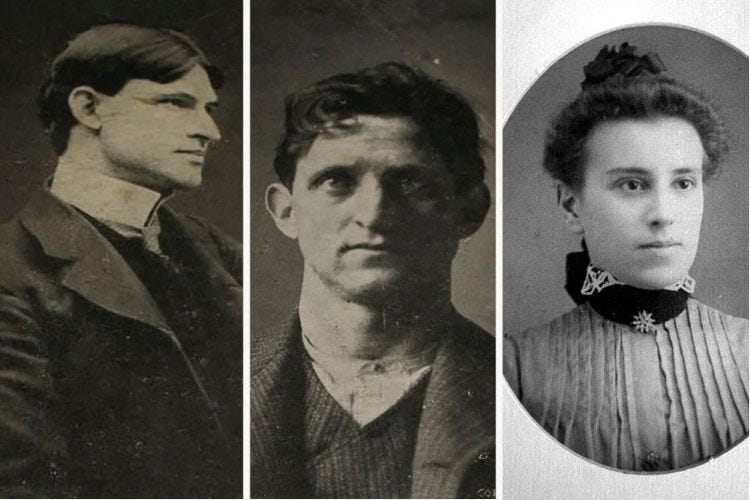
That’s Ed Biddle (Mel Gibson in the movie), Jack Biddle (Matthew Modine), and Kate Dietrich Soffel (Keaton). At the time of the central events in this movie, Ed was 25, Jack 30, and Kate 34. The Biddles’ mother had died young; their father was highly abusive and neglectful (per this 1902 Philadelphia Times article). The Canadian boys often had to steal food from nearby farms in order to eat. Eventually, they made their way to America, and finally ended up in Pittsburgh.
In Pittsburgh, the Biddle brothers had been part of an outfit known as the “Choloform Gang,” knocking out shopkeepers and the like and robbing them. During one robbery, a grocer was shot and killed. When police caught up with the gang, during the arrest, a policeman was shot and killed. The Biddles always claimed they hadn’t done any shooting, saying it was their partners, Ed Dorman and Jennie Seiber, who pulled the triggers. (The Biddles’ professed reasoning was that simple robbery would get them a jail sentence, and jails are not escape-proof; hanging is.) Dorman and Seiber did not receive any prison sentences as a reward for turning state’s evidence. The Biddles were sentenced to death in June 1901, and placed in Pittsburgh’s Allegheny County Jail.
The warden of the jail was one Peter Soffel. His wife, Kate Soffel, rarely visited the jail or its prisoners (per that 1902 article), yet she did take an interest in the Biddles, and convinced a “Sister Inez” of a local Catholic charity to collect funds for a possible new trial; the governor issued a few stays of execution to see how the legal efforts would pan out. They didn’t pan out; the hanging was scheduled for February. Kate Soffel was seen visiting the Biddles often, particularly Ed, and said to describe how regrettable it was that such a handsome fellow with such a nice disposition was going to be hanged.
On January 30th, the brothers broke out, having sawed through their prison bars and obtained handguns. Kate Soffel came with them. First they rode the trolleyway to the end of the line, then they stole a sleigh and some horses from a nearby farm. They made it north about 40 or 50 miles, possibly hoping to head for Canada, before they were caught on January 31st. In the shootout, all three of the fugitives probably shot themselves; Jack died in the evening of February 1st, and Ed a few hours later. Kate Soffel survived.
Supposedly, before dying, Ed told a minister “It's a lead pipe cinch that we would have escaped, but we could not let that poor woman go by herself. She did all she could with us — betrayed her husband, deserted her family, all to help us out, and we would have been a great deal worse than we are thought to be if we had thrown her down.”
Well, the movie does differ from that story a little bit. It’s quite likely everyone involved was a lot crazier and a lot dumber than the movie portrays. But writer Ron Nyswaner and director Gillian Armstrong have made it about that supposed Ed Biddle statement. He doesn’t say it in the movie, yet that’s implied; how he felt loyalty to her. And that loyalty was what drew in THIS Mrs. Soffel, what made her willing to give up her family; she wasn’t taken for granted the way she was at home.
When the movie begins, Keaton’s living in a (rather nice) house adjacent to the jail; her four children all seem happy, yet also very much underfoot. (She married right after high school.) Keaton’s been sick with some kind of wasting disease; you suspect it’s the same one Betty Friedan described in The Feminine Mystique and The Rolling Stones in “Mother’s Little Helper.” So to escape the confinements of the home, Keaton enters the confinements of the prison; she sets about daily delivering Bibles and saying prayers with prisoners. It’s the daily orders of a non-Catholic nun.
When she meets Gibson, he mocks her faith, dares her to prove its worth. He knows what he’s doing; he’s trying to convince Keaton to fall in love with him (and even admits as much to his brother when she’s not around). By undermining her faith, he’s undermining the one thing keeping Keaton from escaping her home life, that sense of duty to an oath she swore as a teenager. Yet the way Keaton plays this, she’s no airhead who’s fooled by a hot youngster (she was 38 and Gibson 28 when this came out); she’s someone longing for adventure, for whom only a really daring, crazy idea could motivate her to make a change. (Like, say, joining a nursing staff in a different city a few hundred miles away and working at a hospital under a new name. That’s so sensible it’s nowhere near inspiring enough to try.)
Gillian Armstrong showed she had a master’s gift for showing how scenery and location can be characters in their own right in My Brilliant Career and High Tide; here, the opening establishing shots of Pittsburgh from a distance and the outer wall of the prison have that same power. (We also see young women picketing for Gibson to get a new trial; there were newspaper photos that made the real Biddle out to be quite the dreamboat.)
So it’s a shame when we’re stuck inside for so much of the movie. I realize it can’t be helped, it’s a movie about a relationship that begins in prison, and prisons are never fun places for movie viewers unless we’re seeing something like handsome George Clooney scamming Albert Brooks in Out of Sight. Still, being trapped indoors so long robs Armstrong of one of her skills. It’s a delight when the movie gets back outdoors, even if we all suspect it’s not going to end well.
“Young and passionate” was probably the strongest character that Mel Gibson could play; he’s fine here, as he was in The Year of Living Dangerously or Gallipoli. By 2000, when Gibson appeared in a bad joke of a movie called What Women Want, the answer was certainly “not this guy”; he is a sexy-eyed little charmer here, and one who proves to have a heart, too. Matthew Modine plays the almost hero-worshippy younger brother well; he’s not as clever as Mel, yet he’s no dope in his own right.
(The actual Jack was the older Biddle brother, and so bright that when on the run, at an inn hosting a church group party, he bought sandwiches/whiskey and tried stuffing them in his pockets; when they didn’t fit, he took his gun out to make room and everybody saw it.)
Dana Wheeler-Nicholson has a nice little role as Modine’s angry-yet-supportive girlfriend on the outside; Edward Herrmann is appropriately arrogant as Keaton’s husband. (Oddly, Herrmann played FDR in both a 1976 TV miniseries and in the dreadful 1982 disaster Annie. Go figure.)
But it’s Keaton’s movie, overall. This is one of the few times she ever got to play someone who wasn’t Woody Allen’s comic muse or a high powered yuppie or a grandma; even if she’s trapped under a hideous period hairdo for the entire first half, it’s a character who’s coming alive for the first (maybe the only) time in her life, and she’s incredibly winning in the role. When she’s on the run with the boys, it’s like she’s in a Christmas adventure (and hey, there is a big Christmas gift-giving scene in this one, so IT’S A CHRISTMAS MOVIE!). A doomed sleigh ride she knows is gonna stop someday, but it’s the most fun she’s ever had.
When the inevitable ending comes, it has something of a Sam Peckinpah feel to it, without Bloody Sam’s overt gore. You see men writhing in the snow for one more inch of freedom and it feels incredibly right. (The nice cinematography’s by Russell Boyd, who would shoot High Tide; his name’s also associated with Peter Weir, Ron Shelton, Norman Jewison… and Crocodile Dundee. Well, cinematographers gotta put their kids through college, too, you know. The unobtrusive music’s by Mark Isham.)
The script here is by Ron Nyswaner, and subtlety is not his forte; when Denzel Washington in Philadelphia says “explain it to me like I’m a five-year-old,” you could be decribing most of Nyswaner’s scripts (like Philadelphia). Still, his direct, get-to-the-point style can work sometimes; it does here, even if it means that the actors and director are providing more of the characters’ depth than the script is.
So, the final flight as shown in the movie is a lot longer and more exciting than the real-life one; that’s fine, it gives us more time with the fantastic outdoor imagery. So the real brothers were probably a lot more criminal and a lot more dim than the characters in the movie; that’s fine, too. This is a movie made 82 years after the original events. I’d say that passes the statute of limitations for accuracy. This film isn’t depicting the real Mrs. Soffel (who died of typhoid in 1909, aged 42). It’s depicting Diane Keaton’s and Gillian Armstrong’s impression of what could drive a woman to such a rash act.
The real Mrs. Soffel was released from prison in late 1903, and, by then divorced, became a seamstress. Some accounts say she tried performing in a stage show, as herself, about these events, but the authorities wouldn’t permit it. Other accounts say she did perform in a traveling version of the show, just not in Pittsburgh.
One thing the movie definitely does get wrong is on the real Biddle brothers’ tombstone. The tombstone was put in the cemetery by MGM, in 1983, at the request of Rob Nyswaner (a native Pennsylvanian). Originally, since at least Ed had died from self-inflicted wounds (Jack also had been shot by the arresting officers), they couldn’t have a tombstone; it was in a Catholic cemetery, and Catholic dogma considers suicide a very bad sin.
It’s a poem that Ed Biddle wrote; in the movie, Gibson reads it to Keaton. The poem goes: Just a little violet / From across the way / Came to cheer a prisoner / In his cell one day. Just a little flower / Sent by loving hand / Has a kindly meaning / That true hearts understand. Just a little violet / Plucked with tender care / God has smiled upon it / And the sender fair. So now that little token / Wrapped tight in paper neat / Rests quietly within a grave / O’er which a heart does beat.
Yes, Ed Biddle did write it. But not for Mrs. Soffel. For the 13-year-old daughter of his “spiritual advisor,” the Rev. F.N. Foster, who visited him in jail several times before Mrs. Soffel started drawing more of his attention. The daughter sent Ed books, including one with a flower in it, and he sent one book back with that poem inside. They never met, so it probably was just a trying to be nice to a kid who sent you books sort of thing. Probably.
Now, if he read it to Mrs. Soffel, too, as the movie depicts, well, that’s a different matter! Because, honestly? It’s a poem a 13-year-old might like, but someone over 30? Puh-leeeze. And heck… even 13 might be a little too old for that dreck. Still, if you've heard the popular music of the era, dreck was all the rage back then!
Which was also the frustrating thing about that “Choose Your Own Adventure”-style Black Mirror episode.