
Modern Romance
Film about love and dissatisfaction and being a putz; sometimes quite funny.

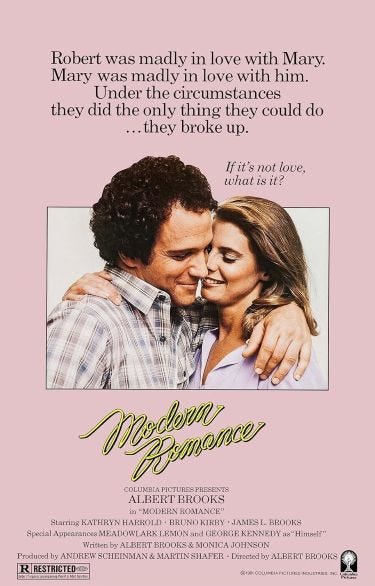
Modern Romance (1981). Grade: B-
Albert Brooks is a guy who should be perfectly thrilled with his life. He’s got a nice bachelor pad in L.A., he’s got a good-paying job as a film editor, and he’s got a loving, gorgeous girlfriend in Kathryn Harrold. So, naturally, he immediately breaks up with her. Harrold tells him “can we have this conversation after dinner” and groans about how it’s going “this time.” They’re been through this scene several times before.
I remember in the 80s and 90s reading that Albert Brooks was sort of the poor man’s Woody Allen. That his character had all the neurosis and self-obsession of the Allen characters in Manhattan or Hannah and her Sisters, but that the films weren’t as intellectually challenging.
Hogwash. They’re better. They’re better because Allen always demanded to be the star/hero of his dramatic movies. (The ones he appeared in, at any rate). Brooks is the star, but he’s not afraid of playing a putz. Allen, in the end, always wanted you to feel sorry for him. Brooks wants you to laugh at what a self-centered dweeb this guy can be.
Brooks was born in 1947, the son of actor Thelma Leeds and radio comedian Harry Einstein (so Brooks’s given name was Albert Einstein). He went to Beverly Hills High School with the likes of Richard Dreyfuss and Rob Reiner; then to Carnegie Mellon University with Michael McKean and David L. Lander (“Lenny and Squiggy,” among many other things), but dropped out at 19 to pursue a comedy career. By the end of the decade he was regularly getting spots on national variety/talk shows.
After those appearances and several short films that appeared on PBS and Saturday Night Live, Brooks got the chance to co-write and direct a feature film, Real Life, a parody of a 1973 reality series about an “average” American family in Santa Barbara. Real Life pointed out how a documentary filmmaker invading a family’s space for a long stretch would inevitably alter the way people were going to behave, and how such a project would easily become about the filmmakers themselves. It was very deadpan, very hit-and-miss with the comedy, and it flopped; a different studio was willing to give Brooks another shot.
It’s a good thing they did, because this is a big improvement over Real Life. It’s still very much a sketch comedy, and some of the sketches don’t play out as well as some others. But when it zings, it’s howlingly funny, and when it’s cringe comedy, it really does make you roll your eyes with astonishment at just HOW schmucky this guy can be.
It helps to have a good supporting cast. Brooks, by himself, isn’t always funny during a Quaalude-high scene (although a bit with a record player is pretty good). During his scenes with Bruno Kirby (as an assistant editor) and Albert Henderson (as a sound mixer), things pick up quite a bit. And a high-pressure jogging-gear salesman had me absolutely howling. That’s Bob Einstein as the salesman, egging on his younger brother Albert; Bob Einstein also did his “Super Save Osbourne” failed-Evel Knievel character for 40 years and had recurring roles on Curb Your Enthusiasm and Arrested Development.
The main “straight man” here is Kathryn Harrold as the patient on-again, off again girlfriend. Patient up to a point. I mean she is gorgeous, she is in her early 30s, she’s got a job that pays very well — she’s only going to put up with the flakiness of Brooks for so long. Harrold’s main job is to react to Brooks, and she’s good at it; when she’s ticked, you’re completely on her side.1 This guy would irritate anybody.
As Jay Carr writes at TCM, “he's funny and horrible at the same time.” “The number [Bob Einstein] does on him is nothing compared to the number he does on himself and can’t stop doing. Modern Romance is Brooks's Portrait of the Artist as a Young Mess. A very specific mess, a Hollywood mess, a finicky, funny, obsessive compulsive who just can't leave anything alone.” Brooks is not playing Everyman, but he’s playing someone whose pettiness everyone might recognize a wee bit in themselves. Brooks later told a story about a test screening of this that didn’t go well; he was cheered up by a phone call from Stanley Kubrick, who asked how Brooks did such an effective job showing jealousy, a subject Kubrick wanted to make a movie about himself. (Do yourself a favor, and if you’re ever tempted to watch Eyes Wide Shut, watch this instead.)
This doesn’t have quite the kick that Defending Your Life and Lost in America later would; Defending has a more consistently creative script, and Lost has that great visual of Brooks and Julie Hagerty as rebels across America in… their Winnebago. (It also has Hagerty herself, the funniest performer Brooks ever set himself off against.) But this has Lost’s co-writer, Monica Johnson. She worked in TV/movies during three different decades after her brother, a writer for The Odd Couple, convinced Johnson to give up dental assistants’ school.2
The cinematography’s by veteran low-budget filmmaker Eric Saarinen (who, yes, is related to the architect Eero Sarinen). It looks fine. The music’s all a mixture of existing tunes, mostly popular ones from the period; there’s a funny Michael Jackson deep cut and that dang Disco Beethoven number you could no more ignore in the era than you could Disco Star Wars.
Mostly, this is Brooks doing self-abasing cringe comedy, and while you might want a little more consistency, this won’t bore or frustrate you. The funny moments really work. This movie is a good answer to the “perfect young people who have it all yet feel unsatisfied” movies of recent vintage, things like The Worst Person in the World. You’re generally supposed to sympathize with those characters’ strivings, how they are always looking to Get More out of Life. Well, here’s a guy who’s always looking to Get More out of Life, and it shows you what a lazy chickens**t he really is. I thought I was King of the Whiners; I ain’t got nothing on this dude. Granted, one should not exactly take that as a self-confidence booster.
Incidentally, Harrold mostly worked in television after 1987. She married television broadcaster Laurence O’Donnell in 1994; they divorced in 2013, the year Harrold turned 53. After which Harrold went back to school and became a successful licensed family/marriage therapist with her own practice.
Not that there ain’t terrific dental assistants out there; the ones at my current dentist have provided more helpful advice than any other dental professionals I’ve ever met. But I think writing regularly for Hollywood pays better.