

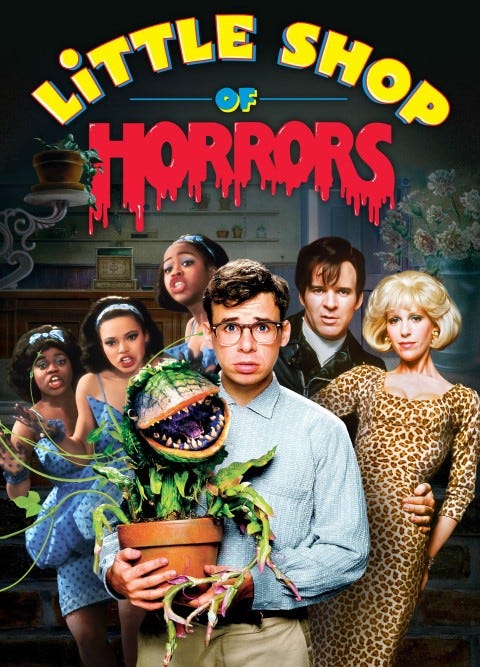
Little Shop of Horrors (1986). Grade: B-
The backstory to this is wild! It all began in 1959, when Roger Corman had a few days and a few thousand lying around…
Corman was a weirdo who made ultra-low-budget movies that usually turned a profit. (Corman later, briefly, did some higher-budget movies loosely based on Edgar Allan Poe works, then, much later, mostly ripped people off.) Here, he’d finished production on his cheapo A Bucket of Blood a few days early, and hadn’t spent the whole budget yet.
So a bunch of people got drunk and wrote a script, essentially, overnight, and filmed it in less than three days. For (sources vary) anywhere between $15,000 and $34,000. (That would be two or three hundred grand today; you can make an OK indie film on that money, but NOT in three days with a script you wrote overnight.)
Oh, and it’s also likely that Corman wanted to get one last movie made under old rules that allowed him to not pay actors any residuals when the movie was seen in re-runs and such. The man was a real cheapskate… but to his credit, he gave some very good filmmakers their first working experience.
Anyhoo, the movie came out in September of 1960, and eventually developed a cult following as part of a double feature with Italian vamp horror Black Sunday. Even more so once it started showing up on late-nite TV reruns (which is how I saw it at 12 or so).
It’s kinda funny (and now in the public domain, so you can watch it all on Wiki for free). Part of the humor is, the movie KNOWS it’s super-quickie junk, it’s not trying its hardest to hide it (like The Blob did). Jack Nicholson has a small part (which one of the guest stars has in the 1986 movie). Jack really wasn’t good at acting yet in 1960!
One of the people who saw it on late-nite TV was playwright/lyricist Howard Ashman. He saw it as a teenager, and it stuck in the back of his mind.
In the 70s, Ashman had a couple of relatively unsuccessful plays under his belt. In 1979, he worked on a musical version of a Kurt Vonnegut novel with composer Alan Mencken; it did pretty well, until they tried moving it from off-Broadway to the bigger theaters. Ashman was eager to work with Mencken again, and he remembered that old cheesy movie; it turned up on cable, they watched it together, and Mencken enjoyed it. “Alan liked it,” Ashman said later, “because it immediately gave him musical ideas. It reeked of the 1960s.”
Those musical ideas are, BY FAR, the best thing in the movie. Ashman/Mencken’s genius with these songs is to do them in a very specific style — that of 50s/60s girl groups, doo-wop and soul music. (There’s songs with a more traditional Broadway feel, too, but the movie has that 50s/60s sound at its core.)
The stage musical was an off-Broadway smash. It featured Sesame Street’s Martin P. Robinson operating the Murder Plant (he’d been one of the guys playing “Mr. Snuffleupagus”), and musical theater veteran Ron Taylor providing the voice.
Here’s a color version of the 1982 playbook’s cover art (you can also see what’s inside the playbook at this link):
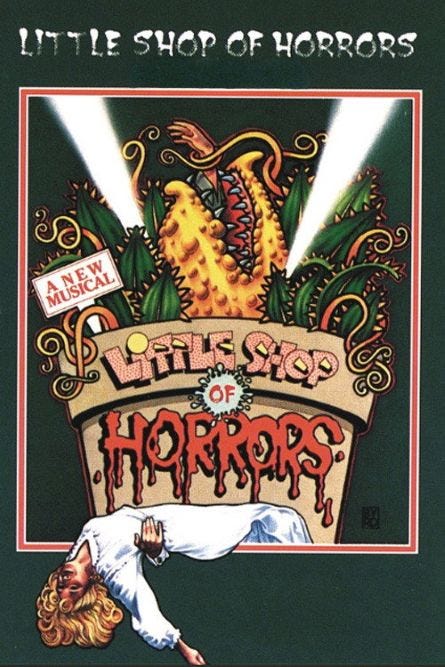
Strangely, the musical also became a favorite when done by community theater and high schools and such! I don’t know how you’d do the Murder Plant on a high school production budget, but I’ve been told by people who were in a high school version that when you order the licensed scripts that are given to actors, the scripts come with detailed instructions on how to build the Murder Plant pretty cheap. (Here’s the licensing company’s site.)
Frank Oz, famed for his performing/voicing Miss Piggy, Cookie Monster, and Yoda, among many others, directed the movie version. Oz wasn’t overly excited about doing another movie with puppets (he’d directed a few Muppet films and co-directed The Dark Crystal), but he liked the technical challenge of making the plant elaborate for the movie. The studio wanted Cyndi Lauper to play Audrey, the main damsel-in-distress; she wasn’t available, and Ellen Greene reprised her stage role instead.
You can read all the production details you like on Wiki. Short version: the Murder Plant, designed by Lyle Conway (who’d also worked on The Dark Crystal) IS impressive. The way it moves around, including realistic lip movements, is a major technical feat.
Does it help the movie? That’s debatable. Since the main fun is Levi Stubbs’s fantastic vocal performance, you could argue that all the technical wizardry gets in the way of simply enjoying Stubbs’s funny mixture of seductive and brash.
As, I think, do the many guest stars — I won’t list them all, in case their appearance is a fun surprise for you. The only one I really love now is seeing C.G. — he’s only in it for a few seconds, but it’s always fun seeing C.G. (Who I didn’t recognize when I was 14 and saw this for the first time.) Steve Martin has the biggest guest star role, and it’s very schticky (the others are mostly doing their schtick as well). This post by Karli Ray says Tim Curry was also considered for the Martin role, and I think he would have played it a little better. (Or maybe he might have been a little TOO scary.)
When I was 14, I ADORED the Martin bit, and I was so-so on the songs. Like most 14-year-olds, I hated anything that sounded “old-fashioned,” which most of the songs deliberately do. I didn’t like the music in Hairspray for the same reason, and now I think that music is fantastic! Well, I love the old-fashioned songs in this one, too. The three teenagers here who act like a Greek chorus (and sing like the Marvelettes/Vandellas, etc.) are Tichina Arnold, Tisha Campbell, and Michelle Weeks; the stunning-voiced lady who starts off “Downtown” is Bertice Reading.
The big star, though, is Levi Stubbs. If you’ve never heard a Levi Stubbs song, you’re gonna get dazzled. But I think you HAVE heard his Four Tops songs, even if you don’t recognize his name. “Baby I Need Your Loving,” “It’s the Same Old Song,” “I Can’t Help Myself (Sugar Pie, Honey Bunch)“, and what might be my favorite-ever Motown song (although you could pick 25 others and I wouldn’t complain one bit), ”Reach Out I’ll Be There.”
Oz’s direction, as always, is spotty at best. He’s simply not terrific at directing humans. The way he shoves cameras in the faces of angry-looking or odd-looking people in “Downtown” shows poor taste. Still, he doesn’t overly chop up the musical numbers, so even if you aren’t getting great staging, what you are getting doesn’t hurt the performers much.
Rick Moranis, who was directed by idiot Ivan Reitman to overplay his “nerd” bit in the Ghostbusters movies, comes across much more likably here; he’s also got a surprisingly decent singing voice. He can nail the comedy verses like “I keep asking God what I’m for” / “‘And he tells me, “Gee, I’m not sure’” — then be really gentle on “lift up your head, wash off that mascara.” And Ellen Greene is really a wowzer, it’s no surprise she got top listing in that 1982 playbook. She’s got a speaking voice that sounds like Judy Holliday or Melanie Griffith (which is a compliment), then when she starts belting a number, she can BELT it.
We don’t get anything as inspired in the whole movie as Joan Cusack’s Rage Face in Oz’s In & Out, but there’s few performers as inspired as Joan Cusack! What Greene/Moranis bring to their roles is sweet and kind, which is what you want.
Both Oz and Howard Ashman (who wrote the screenplay) wanted the original ending from the stage version, where the plants take over the world. In Ashman’s case, that made sense — the stage version’s ending used a scare for a joke. (I never saw it, yet I understand it had plant tendrils that would surprise the audience by dropping down from the ceiling. That’s a great William Castle-style idea.)
But Oz mangled the ending. He did it too literally, with giant plants fighting off tanks and what-not. It goes on FOREVER, and just features more and more of a harsh Stubbs laugh being played and re-played. It’s tiresome mayhem. You can watch it at YouTube; I’ve cued up the ending here to where the “director’s cut” veers from the theatrical version.
Preview audiences rightfully hated it (it’s almost entirely humorless), and Oz was forced to shoot a simpler ending where Greene/Moranis survive. With a cute little finish that suggests “hmm, maybe?” and is a lot funnier than the mayhem version.
Incredibly, one DVD release ONLY has the “director’s cut” version! The bad one! Why the heck would you do that? In this day and age, it’s incredibly simple to include both and let people watch the one they want to watch. (The theatrical version is currently available on Archive if your library doesn’t have it.)
The movie did well enough to make its money back, and got the attention of the people at Disney. If you don’t remember how new Disney animated features were doing at the time, the short version is “not well.” Disney hired Ashman and, at his insistence, Mencken to write the songs for their adaptation of The Little Mermaid. It was a smash. (And basically recycles one song from Little Shop; “Somewhere That’s Green” becomes “Part of Your World.”) Ashman/Mencken would also write the songs for Beauty and the Beast and part of Aladdin (Ashman tragically died from AIDS at the age of 40, and Tim Rice wrote the rest of the movie’s lyrics).
So it was funny when right-wingers were screaming that Disney was too welcoming to gay people at their theme parks, or too nice to their gay employees. Uh, folks, a lot of the songs your kids love from Disney musicals were co-written by one of them Scary Gay Guys.
(If you didn’t care for those Ashman/Mencken Disney musicals, don’t write THIS movie off — these songs are a lot peppier and have more bite than anything in those movies, except maybe the Sea Witch’s fun number in Mermaid.)
Anyhoo! If you love musicals with good songs, catch this one for sure. There’s little dancing, alas, but that’s the case with a lot of good musicals — Anna and The Apocalypse also has only a little dancing, and Hedwig and the Angry Inch basically none. This doesn’t have the heart that those movies do, but it’s got the best singer imaginable in Levi Stubbs. Who’s a heckuva puppet spoken vocalist, too! You’ll never forget the way he says “DOES this look inanimate to you, punk?”
And it all began with cheap-a** Roger Corman wanting to squeeze a few more dollars outta moviegoers. Well, truly, sometimes you can made treasure from trash. If you’re as clever as Ashman/Mencken are. And give the original a look sometime, you might get a giggle or two. You do owe it to yourself to understand where the line “feed me” comes from.
There's a great documentary on Howard Ashman on Disney+. Solidly recommend it.
The thing that I think gets lost in our modern era is that LSoH was not just a fun, comedy period piece - which now seems the consensus. It was part of hipster Boomers' po-mo winking at the 50's and early 60's ("Grease" has suffered the same fate. Read up on the history of Grease. It's fascinating how castrated the movie is compared to the original play that ran in Chicago.). As an example - seeing YouTube reactions makes it clear - Millennials and younger (and some Gen-X'ers who have forgotten the context) flatly do not get the joke of "Somewhere That's Green". They take it completely earnestly because that's how Greene sings it and they likely never lived in a world where Better Homes and Gardens was a highly influential and aspirational lifestyle publication. And I'm not sure The Kids even really get the creature-feature boom of the era. The musical was intended as an off-Broadway thing to play to hipsters who got the joke that they turned a Corman movie into a musical, and that was inherently funny.
And then they start with a killer song like "Skid Row" so I get how it gets taken how it does. The songs are not all obviously cheeky.
I had an astounding crush on Audrey (1, not 2) when I saw this in the theater as a kid. It's a whole thing.