
It Happened One Night
In which Clark Gable makes a star out of carrots and bare chests.

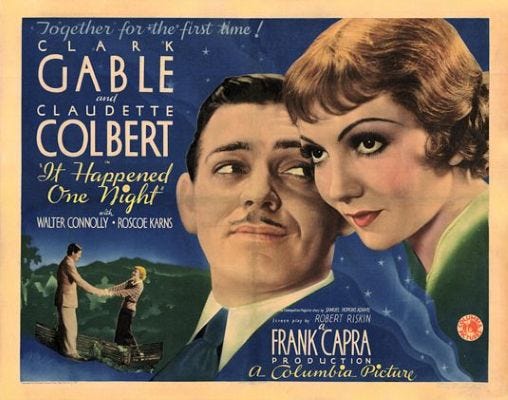
It Happened One Night (1934). Grade: B (?)
This is an odd one to write about. It’s a certified movie classic, and I chuckled at a few bits, and liked one of the settings. It’s very well done. But something about it just left me feeling… I dunno, a bit off. The same way I generally do at Frank Capra movies.
Maybe the reason can be summed up with a few choice Wiki quotes. From the page about Claudette Colbert: “top-paid actress” … “this period marked the height of her earning power” … “highest-grossing picture.” From the Gable page: “most consistently bankable stars” … “will outdraw every other star” … “top of the box office.” Etc.
And you can see the above ad image: “together for the first time!” It feels — every Capra movie feels — like the purest commercial calculation. Like every modern product that manufactures interest by putting the most popular stars together.
Now, you might say — and you’d be absolutely right to do so — that basically ANY movie ever made is “purest commercial calculation.” Or, close enough to it that the specks and flecks of genuine artistry that slip through are something of a statistical blip. Subtract “money” and/or “craving critical adulation” from the history of movies, and how many movies would you have left? Honestly, off the top of my head, I can’t think of too many.
But the movies it’s easiest for me to enjoy are the ones where, if the point is money, there’s nothing else crammed in there. Say, the best Billy Wilder movies. Clearly, Some Like it Hot was nothing more than a naked cash grab; but it doesn’t pretend to be anything more. With Capra films, there’s always some moralizing, some sermonizing, that deadens part of the fun for me.
There’s a famous (and pretty likeable) scene where Gable and Colbert are riding the bus (she’s on the run from a rich, controlling dad), and the various collection of characters on the bus start singing “The Daring Young Man on the Flying Trapeze.”1 The whole vibe is “Americana,” the reg’lar jus’ plain folks enjoying their shared time together on a bus. Not, you know, what riding a Greyhound is actually remotely LIKE. You wonder if the writers had ever experienced anything like it; you suspect that Capra had never even been on a bus. (Per the Criterion essay, Colbert only started liking the movie “‘when she spotted her maid’s enthralled reaction to the filming of the “Man on the Flying Trapeze” scene.’”)
That essay’s by Farran Smith Nehme, and she’s written multiple really good essays for Criterion, so I’ll stop talking about why I’m iffy over this film, and let a professional critic mention why it appealed so much to audiences. Nehme focuses on some of the Depression themes. Early in the film, Colbert throws a fancy meal out a ship’s window; that would appall audiences of the day. You don’t throw away free food! Gable gets drunk and tells his boss off. Well, it’s the Depression, you don’t throw away a paying job! It makes both the characters seem a bit screwy… and this is generally considered one of the seminal “screwball” comedies. (A genre in which there’s usually a mixture of social classes through romantic mixups, and everybody involved is acting pretty irrationally, and it all works out in the end.)
Nehme also mentions how Clark Gable revealing that he wore no undershirt helped torpedo undershirt sales; she adds, “one wonders if that was because average American men were delusional enough to think they’d look like Gable or if they merely realized that the King had demonstrated a new way to scrimp on wardrobe spending.” (Few of us look like Gable, but it is somewhat charming to see a guy pull off his top and look rather untoned — any such scene in a movie today would have to reveal a perfect gym bod underneath.)
Then, in my favorite piece of writing, Nehme desbribes Colbert/Gable’s first (chaste) night together in a motel; “when the lights are shut off and the full beauty of Joseph Walker’s cinematography takes hold. The rain outside makes the windows sparkle, and the light from them outlines Colbert’s form as she stands there in her slip, trying to calm her nerves. It’s a shot that, at the time, could have revealed more of Colbert’s state of undress, and indeed that’s how Capra had planned it. But Colbert objected, and Capra later said the scene was sexier in the near dark. It Happened One Night made the sexual longing unmistakable, but did it in a way that showed future filmmakers how to stay on the right side of the censors.”
That’s wonderfully put, and I loved the lighting, too. And Colbert’s acting. She had something of a set type — the tough-talking gal who’s really a big blubbery heart beneath — and in most hands, that sort of role would be just insufferable. She could generally pull it off. And Gable’s fairly easy to tolerate, too. Whenever he was “smoldering lover,” he bored me, yet he’s pretty fun when he’s allowing us to laugh at him having his ego deflated. (It’s never going to be a permanent deflation.)
Nehme also points out that this was really a toss-off for almost everyone making it. Gable was, at the time, under contract to MGM, but was chirping about wanting more money; so the studio sent him to make this one for Columbia as a punishment. Back in the day, stars under contract were like athletes under contract; they had to play, and they played for wherever they were sent to.
While Colbert was one of the few actors in Hollywood who had, essentially, free-agent status; she took a little less money in order to stay independent. (She was making A LOT of money, so taking a little less didn’t hurt.) When the movie finished shooting, Colbert told a friend it was “the worst picture in the world.” The studio didn’t promote it much. (So much for my original thought that this movie was “too commercial” — basically everyone involved thought it would flop.)
Well, they were wrong — this was a massive hit. When I mentioned that to Mrs. twinsbrewer, she wondered aloud, “why?” (She’d enjoyed it, as I had — but it doesn’t feel like anything mind-blowing.) I think it was a hit because screenwriter Robert Riskin had sort of perfected a new formula. Generally, movies that showed extreme wealth also showed how corrupting and immoral great wealth could be (true enough). In this, and multiple movies that followed, wealth was shown as something that made you less evil than eccentric. At the end, Colbert’s scheduled to get married to a total rich bore; he pilots himself to the wedding on an “autogyro” (one-seater helicopter). That’s a stupid waste of money, but it’s not strictly evil. So, instead of enjoying watching people bask in luxury while tut-tutting at their wicked ways, audiences could dream of luxury while laughing at how silly the rich were.
The story — rich heiress runs from her rich dad and goes into hiding on a cross-country bus, then just happens to meet a reporter who tags along to provide the gossip scoop of the year — is lifted from a short story by Samuel Hopkins Adams, a fiction writer and actual hard-nosed journalist. His most famous reporting was on “patent medicines,” junk sold by quacks that actually made people sick (the kind of quacks who run all our health agencies now). But his biggest moneymakers were racy novels; he published those under the pseudonym Warner Fabian, and they had titles like Flaming Youth and Unforbidden Fruit.
The hints of naughtiness that never actually get naughty are probably another reason this became a hit, too. This came in just a few months before the Hays code came down hard on naughty movies; the whole thing has a “will they or won’t they” vibe that always kind of bored me, but it was starting to come into fashion. There’s a famous scene where Colbert flashes some leg at a passing car; per Margarita Landazuri’s TCM article, Colbert didn’t want to do it. Once Capra called for a body double, Colbert relented, saying “get her out of here, I’ll do it -- that’s not my leg!” There’s a running gag about Gable hanging up a bedsheet on a clothesline in the motel room to separate the two beds; he calls it the “walls of Jericho.” (If I remember my Bible correctly, once the walls of Jericho were breached, the invaders basically slaughtered everyone inside.)
There’s some things that are genuinely pretty enjoyable, without that whiff of “Americana” about them. Roscoe Karns as a sleazy masher on the bus, and Alan Hale as a boisterously singing oaf who gives Colbert/Gable a lift (and then tries to rob them). Colbert going to get a shower at the motel’s community shower facility and finding out how long the line is (and the fine tracking shot following her to it). These things actually feel what traveling on the cheap would be like; long lines, dirty kids hollering everywhere, various dirtbags trying to hit on you or rip you off. (It’s was like that in my cheap travel days, and those weren’t even during the Depression.) And in these scenes, for once, Capra isn’t doing any heavy moralizing; the various cons and hardships are just taken for granted.
The ending’s a bit odd. Colbert’s dad, so eager to prevent her marriage to a gold-digger at the beginning, meets the guy and decides he’s just the right kind of dependably dull to join the family. But then Colbert tells her dad she’s really in love with Gable. So he helps it all end out well in the end. (Spoiler, it’s a romantic comedy, it all ends out well in the end.) It just feels weird having dad be the major plot mover who leads to the “walls of Jericho” falling down.
I guess this really deserves credit for being something of a pioneer in the romantic comedy genre. Except, I’ve never hugely cared for the genre? I think I prefer it when it goes a little off the rails; Jimmy Stewart getting stewed in The Philadelphia Story, whatever that weird “monkey act” was in My Man Godfrey, that bizarre rich “Wienie King” who keeps popping up in The Palm Beach Story (another fine Colbert role in that one). This one doesn’t quite feel weird enough to wow me.
But, as Nehme pointed out, the irresponsible behavior of the two leads would have felt crazily weird at the time. And it certainly has had a major cultural effect since, and not just in romantic comedies.
One of the more amusing plot bits is Colbert complaining about how hungry she is, but refusing to snack on the carrots Gable is carrying around. Well, it’s generally thought that the reason Bugs Bunny eats carrots is because of this movie. There’s a 1940 Bugs Bunny cartoon, “A Wild Hare,” that has him munching carrots, and has a reference to Carole Lombard, Gable’s then-wife.2 So, you know, if you’re eager to see the next iteration of Space Jam, you can (partially) thank this movie. Or, if the thought of the newest Warner cartoon product gives you hives since they’re turding on the original greats, you can (partially) blame this movie.
A song about/inspired by 19th-century circus performer Jules Léotard. Yes, the style of clothing is named after him.
Who very sadly died in a plane crash two years after the cartoon came out, and so a different name was dubbed into the cartoon.
This is one of my all-time favorite films. Gable is at his best here. I'm generally not that fond of him. I like Colbert more and she is great here. But she didn't want to do the film. I don't know quite how anyone missed that this was a great script. And Capra had a good reputation even then.
The biggest problem with the film (and it makes me uncomfortable even now) is the way that Colbert's character is -- because she is a woman -- infantilized. But this is largely made up for by the fact that Gable is, in his own way, a little boy.
It is *totally* unfair to compare moralizing in a 1934 film to the lack of moralizing in a 1959 film! You really couldn't make a film like this in 1934 without at least acknowledging the Great Depression!
But I'm with you about Capra. This and "Arsenic and Old Lace" are about the only films of his I can stomach. I absolutely hate "Mr Smith Goes to Washington" and "It's a Wonderful Life" for this reason. Of course, it doesn't help (actually, it hurts -- a lot) that they both star James Stewart. I challenge anyone to provide a film that was better with him in it. I'm not saying he always made films worse; sometimes, he was a wash.
Speaking of which, I have "The Philadelphia Story" poster on my wall. But I hate the film. Stewart is the main reason. But he has a thankless job playing one of the most annoying characters in film history. And I love Grant and Hepburn. It's gone out of fashion, but I love "Bringing Up Baby." Wisdom for the world: Just because someone comes up with a term ("manic pixie dream girl") does not mean that all films the term can be applied to are bad -- especially when it is effectively the *first* film!
Okay, where was I? I think buses *were* a lot like that back then. I say that because I was on a long bus ride in Mexico and it was a lot like that. I think at a time when most people took buses, there was more of this. Now people on the bus are careful because they think a high percentage of the others on the bus are insane!
"It Happened One Night" was arguably the first road picture. And that matters because it had a lot of different locations. A lot of films of that time seem so constrained. As a result, I think people felt like *they* had gone on a journey. And it was a journey with two kooky kids (they were both about 30). What's not to like?!
One interesting thing I don't recall ever seeing in a romantic comedy: they never reunite. She runs away from the wedding and then we get a short dialogue scene with the motel owners. It's a bit of a disappointment but bringing the principals back might have also been.
You made no mention of BY FAR my favorite scene, "I'm a little screwy myself!"
https://www.youtube.com/watch?v=yFrdbHNEams
One final thought on the politics. These movies always pandered to the poor. And they always featured horrible rich people. But they also always featured the good rich. Here it is the father. And I like him a lot more than I do similar roles in other films.
Also, although no one really believes me, I think "French Kiss" is a remake of this film. And it fixes most of the problems in this film. It is by far the best modern romantic comedy I've seen. But like you, that isn't a genre I especially like.