
High and Low
Kurosawa's crime thriller/social commentary set in 1960s Japan.

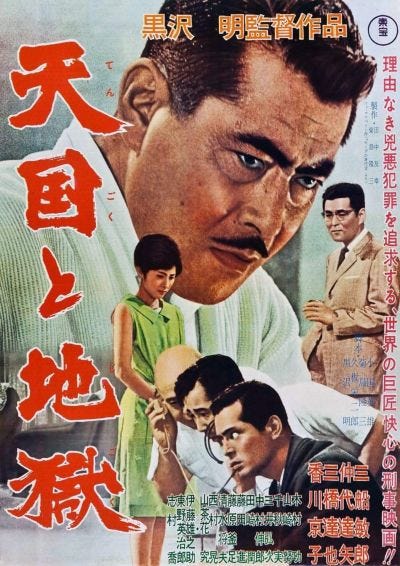
?file=High_and_Low_poster.jpeg)
High and Low (1963). Grade: B
I love a good double-meaning title! Like Hobson’s Choice, which both refers to the imperious, egotistical character, Henry Hobson — and to the old British saying, “a Hobson’s choice,” which is to say, no choice at all; take it or leave it.
Well, in High and Low, there’s actually three meanings to the title. The story’s about the gulf between rich and poor. It’s also about a kidnapping, so police are looking high and low for the kidnappers. And the rich guy who’s a victim of the kidnapping lives in a fancy stylish house, on a hill overlooking the whole city. He is high; they are low. He’s about to be brought down a notch.
Now, this article says that High and Low is actually a poor translation of the original title, Tengoku to jigoku, meaning “heaven and hell.” But to heck with that! That’s not even two meanings. This title has three. It’s better.
Akira Kurosawa is one of those great directors who I find easy to admire, but hard to get into. I can appreciate the tremendous technical accomplishments and stylistic innovations of a Rashomon or a Seven Samurai, yet I find myself at a huge emotional/intellectual distance from the characters. I simply don’t get the sexual notions of purity and honor in Rashomon, even when they’re explained to me in writing. It’s simply too foreign a time/place/culture for me to begin to understand. I suppose the same might be said of things like The Pilgrim’s Progress to someone who wasn’t raised in that cultural tradition.
So I have an easier time with Kurosawa movies set in the present day (or Kurosawa’s day); things like Drunken Angel and Ikiru. And so when I saw there was a Hollywood remake of High and Low, I thought I’d check out the original. When something is remade, 90% of the time, the original will be better.
Kurosawa regular Toshiro Mifune plays a tough, shrewd Yokohama businessman, a high-level exec at a shoe company. He started in the company as a lowly shoemaker; he, literally, pulled himself up by his bootstraps (assuming the company made any boots). But some other executives have a proposal Mifune hates. They say that the company’s shoes are too well-made, that they’ll get higher profits by churning out slick-looking shoes which fall apart in a year. Mifune says Hell No. He thinks what gives the company its reputation is the quality of their work. That if they sacrifice quality, they’ll just be one of a zillion companies churning out identical crummy shoes.
Well, the other execs decide, they’re gonna force Mifune out. They’ve got enough shares to win a shareholders’ vote, and then they can install a new CEO. But what they don’t know is, Mifune has a secret plan. He’s mortgaging his fancy house, he’s cashing in all his investments, to buy up a controlling share of the stock. He’s willing to bet it all on the craftsmanship of the company he helped build.
But then he gets a phone call. It’s someone who says they’ve nabbed Mifune’s son. And they’re demanding a huge ransom. All the money Mifune’s got, the money he was gonna buy those company shares with, will be needed to pay the ransom. Because there’s no question about it, he’ll do anything to save his son.
Wait, though… his son is fine. So what’s going on? The kidnappers grabbed the wrong kid! Mifune’s son and the son of his chauffeur were playing together, and the kidnappers got the two mixed up. Now, Mifune’s not so sure he should pay. It might be better to let the police handle it, after all.
See, that’s a few plot points which wouldn’t translate to America, right there. If an American rich guy had one of his servants’ kids kidnapped, he wouldn’t even debate paying the ransom. He’d just fire the servant to save him the embarrassment of looking at the guy. Now, if you kidnapped an American rich guy’s kid, they might pay. Then again, they might not. J. Paul Getty didn’t.
And then the way this debate is resolved; Mifune’s wife, Kyōko Kagawa, simply insists he pay the ransom for the chauffeur’s kid. Or she’s gonna leave him, right there and then. And Mifune, ashamed of his original hesitation, agrees. This is another thing that’d never happen in America. Some rich guy’s wife says “you pay, or I’m leaving you,” he’d simply think “oh good I was looking to marry someone 20 years younger anyways.”
They do get the police involved, though. It’s on the sly, the police manage to keep the kidnapper from knowing they’re listening. And their advice is you pay, but we’ll put clues with the money to make the kidnappers easier to find. And then we’ll get your money back. Or, we’ll try to, at any rate.
The plot’s from an American hardboiled crime novel, King’s Ransom, by Ed McBain (who also wrote the screenplays to Blackboard Jungle and The Birds, under a different name). I haven’t read the book. But Criterion essayist Geoffrey O’Brien has, and says it’s “a good, swift read.” Incidentally, in the American book, the rich guy won’t pay to save no servant’s kid! It just works out alright, anyways.1
The first hour of the movie all takes place inside Mifune’s hilltop house, and there’s actually two versions of it that they filmed; one, a set that really was on a hill overlooking the real Yokohama, for the daytime shots; and another, built in a studio, with minature buildings and thousands of little electric lights, for the night shots. Some of them even moved, to suggest trains and cars. In one twilight scene, Kurosawa had rented a fleet of like 30 cars to be seen crossing a bridge far below, and when he gave the radio order for them to drive, the cars were stopped at a red light. He told them to just go through it. (They didn’t.)
The whole opening sequence is tense and tightly filmed, using a lot of very long takes, and careful blocking of actors and cameras, especially once the police arrive. You’ve got four detectives, Mifune, Kyōko Kagawa, the chauffeur (Yutaka Sada), and Mifune’s kid, all moving around in what isn’t a huge space.
Then we get to the ransom dropoff itself, superbly staged on an actual fast-moving train (a regular passenger train, although one chartered by the studio, they didn’t just have an entire cast and crew hop in at the previous stop). The filmmakers had only one chance to get this sequence, so, again, it was all carefully planned and executed with ten cameras on the train. It turned out, one of the cameras jammed! But that was was just getting some reaction shots of characters against a moving background, so they were able to get that much simpler footage on a different day.
After that train scene, though, Mifune all-but-disappears from the movie, aside from a few short scenes (and a terrific ending one). And with Mifune goes a lot of the film’s energy. It doesn’t get tiresome, not even at 140 minutes plus, it just lacks some of the earlier drama. Some of that’s actually in a good way; the thing you feared the most appears to be resolved.
We enter police procedural territory. The first half might be used as an instructional film for kidnappers; it lays out an almost foolproof plan for avoiding police detection. The second half is an instructional film for how to catch the kidnappers; there’s some clever methods and some less clever ones (these cops seem really bad at tailing a suspect), and one that’s seriously a moral “huh?”
The police learn who the kidnapper is. They’re got his identity and all the proof they need. But, they don’t want to nail him for just kidnapping; that carries a sentence of 15 years in jail, max. They want to get him for murder, too; two of his associates were found dead of a drug overdose, and the police highly suspect the ringleader gave them highly pure heroin, intending to have them die. Alas, the police can’t prove it.
So the cops ask the local media not to report the two deaths.2 Since, that way, the ringleader might be worried they survived. And might try killing them again, with even purer heroin.
It’s hard not to agree with Robin Syversen at JapaneseCinemaArchives who believes this to be a form of entrapment. What’s worse, to test the heroin’s potency, the ringleader goes to Skid Row, finds a junkie suffering from terrible withdrawal symptoms, and gives her some of the heroin. She dies.
Now, clearly, the police are responsible for her death. And it’s possible, as Syversen points out, that Kurosawa intended this as a subtle criticism of reckless police methods. Yet the camera never shows us the dead lady's body (which would indicate sympathy). And the visual disgust that Kurosawa seems to express for the Skid Row residents seems to be saying, “the junkies deserve it.” (So does the protracted “heroin withdrawal” bit from the actor earlier, a Drugs Are Dangerous bit of overacting which belongs right up there with Vincent Price’s Acid Trip Scene in The Tingler.)
The whole sequence where the cops are tailing the ringleader waiting for him to buy the heroin has some neat urban life bustle, yet it’s not exactly clear at all times what’s going on and why. For someone who was an acclaimed director of battle scenes, Kurosawa hadn’t mastered that simplest and oldest of action forms; the chase scene.
This movie would end up being a disappointment with the latter half falling well short of the first — until the last scene, which redeems the ending in a HUGE way. We have the head kidnapper, Tsutomu Yamakazi, now in jail. He’s talking to an emotionally exhausted (yet still compassionate) Mifune. Yamakazi knocks it right out of the park; it’s a terrific finish. (For those of you who see Yamakazi’s square jaw and think, I KNOW I’ve seen that before… are you a Juzo Itami fan? Because Yamakazi is the excellent antagonist to Nobuko Miyamoto’s tax detective in A Taxing Woman, and was also in the very popular Tampopo.)
Acclaimed modern filmmaker Takashi Miike tells us in his nice, personal essay that the original ending simply had Mifune and a police detective doing a walk-and-talk. And how they filmed that ending first. Yet aftrr filming completed on this scene, Yamakazi’s performance (it’s that good) impressed Kurosawa so much that he junked his original ending and ended the film after this scene instead. For a guy who was a major stylistic perfectionist, being responsive to what actors bring is the sign of a smart director.
The rest of the cast is solid, too, especially Yutaka Sada as the desperate, servile chauffeur, Tatsuya Mihashi as Mifune’s turncoat #2 guy in the company, and Kenjiro Ishiyama as the working-class, bald police detective. Who definitely wants to save the kid, but in terms of the kidnapping ruining Mifune’s career? Eh, that’s Mifune’s problem, Ishiyama seems to believe. (And it really does do a number on Mifune’s career, and on his personal worth; he’ll land on his feet, yet there’s no reward for making the moral choice, as there would be in a standard Hollywood movie.)
The effective and mostly pinpoint cinematography’s by Asakazu Nakai and Takao Saitō, with (I’m guessing) one doing the outdoor scenes, the other doing the ones on sets. The music’s by Masaru Satō, and it’s primarily source music; coming from bars, radios, etc. It shows a vibrant multi-cultural side to 1960s Japan, after the hardships of the postwar years; the only Americans we see are dancing at clubs, not handing out food rations. Yet, of course, all this vibrant nightlife was only available to those who could afford it; part of the point is showing you the world that others are deprived of. (Although it turns out the lead kidnapper, while poor, is a medical intern; you imagine that if he finished his internship, he’d make a pretty decent income! Easier than kidnapping!)
Even if the last half here isn’t up to the quality of the first, that beginning hour alone makes the movie well worth seeing. I could watch it again right now for the technical aspects of the long takes alone. And the rest won’t disappoint you; you’ll want to see how they catch the bad guy, even if it takes a while (and involves one very iffy piece of police procedure). This was a massive hit in Japan, and it’s not hard to see why. Interpersonal drama mixed with a tense crime story — that’s never gonna be a bad formula, if you do it well enough. Which High and Low certainly does.
The book’s part of the “87th Precinct” series by McBain, and that book series became a TV series in 1961-1962 (it only ran one season). The episode “King’s Ransom” aired February 19, 1962. There’s an awful-quality copy of it on YouTube, if you’re curious. It appears to be from the point of view of the kidnappers, and the son they steal is a young man, not a child. I only watched a few minutes.
Making a token appearance in this scene is major Kurosawa mainstay Takashi Shimura, from The Seven Samurai and Ikiru and many others. He was also in Godzilla. Kurosawa did not direct Godzilla, but it’s still fun.