
Crossing Delancey
Charming romantic comedy you can actually believe, for once.

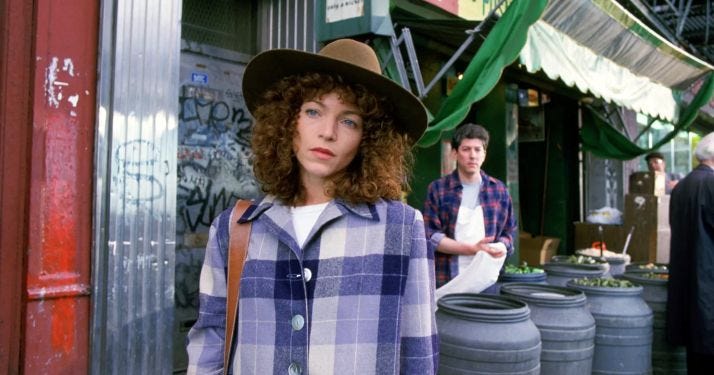
Crossing Delancey (1988). Grade: B
When Amy Irving first tries on that hat you see above, it may jog your memory a bit… and, then, a few minutes later, she wears it to her workplace, and one of the co-workers mutters, “my God, it’s the return of Annie Hall.”
That’s it! That’s what it reminds you of. Except that this movie is everything Annie Hall wasn’t. In that movie, you basically dislike all the characters except Diane Keaton, and none of them (besides Keaton) seem like actual people you’ve met or could meet; they’re all archetypes. Here, you like most of ‘em, and most of ‘em seem real.
Also, in Annie Hall, overt New York Jewishness is the thing Woody Allen hates and wants to be rid of. Here, it’s embraced. It may be corny, it may be old-fashioned, but it’s harmless, and it’s got its lovable aspects. It’s nothing to be ashamed of.
Neither is selling pickles.
In the image up on top, Irving has received that Annie Hall hat from Peter Riegert in the mail; he’s trying to woo her. And she loves the hat, she loves how it looks on her. She goes to where he works, at a pickle-canning/selling place on the Lower East Side. Where she sees Riegert chatting with customers and serving them by… jamming his arm in a big vat of pickles and pulling out the ones he’ll put into a jar for them.
Irving can’t help it — she’s repulsed. She thinks he’s a decent enough guy, and he’s not unattractive… she just can’t see herself as dating a man who jabs his arm into a big vat of pickles for a living. Although, as her Bubbe (Reizl Bozyk) says about selling pickles, “somebody has to.”
Bozyk as the Bubbe is so warm and full of earthy wisdom, and Peter Riegert so calm and confident, that you basically think you’ll know in 30 minutes where this story is going. And… you do. It’s a romantic comedy, alright? You know what you want from a romantic comedy, and you will get it here. But it’s the way the movie delivers which surprises. As Eli Brau put it, this “is the kind of romantic comedy that remembers what adulthood feels like.” It’s a romantic movie for actual grownups. (Most rom-coms make the characters into adult versions of teenagers.)
It’s adapted by Susan Sandler from her 1985 play of the same name; I haven’t read it, but you can read a New York Times review here. The reviewer says the dialogue is “funny and real” and the play “tells its unpretentious story believably, rarely trying to make its gag lines, of which there are many, upstage its narration or outshine its heart.”
That’s about the same as the movie version, directed by Joan Micklin Silver. Except that the movie version doesn’t come across as having funny lines so much as funny situations, some baked into the plot, some tossed in for good measure. Like having Irving about to enter an apartment building, except she has to wait for the 7-8 hugely pregnant women on their way out of a Lamaze class. There’s nothing essentially funny about pregnant ladies, but there is something funny about all the odd sights you see every day in NYC. Silver keeps making visual jokes about the little details of living in the city, like trying not to bump into a vendor on the sidewalk, or helping an old lady clean the outside of her upstairs windows. They don’t “mean” anything, they just add color and good-natured humor, and give you the sense of a real place and a real time.1 (There’s a reason Nora Ephron could move her formula rom-coms from New York to Seattle without changing a beat; those characters lived in Imaginary Land, which could be anyplace.)
Your plot, essentially, is that Amy Irving’s being set up by Reizl Bozyk to meet a matchmaker, Sylvia Miles. Irving’s in her mid-30s and not dating anyone (although she has an ex she sleeps with on occasion). Bozyk considers Irving’s being “alone” a tragedy, and she keeps pressuring and pressuring her to meet the matchmaker. Irving’s a successful, modern gal; she wants nothing to do with such an archaic dating system. But, sometimes, when your old relatives just won’t give up about you trying something, you try it, just to humor them.
So she tries it, and the matchmaker introduces her to pickle man Peter Riegert. Riegert seems a little standoffish about the whole thing, and Irving misreads that as how he expects her to accept him without even trying for it.
Until Riegert sends her that hat…
Which leads to one of the funniest and most uncomfortable scenes in the movie. Irving comes up with the bright idea of setting Riegert up with one of her single friends, Suzzy Roche. Yet she doesn’t want Riegert to know she’s foisting him off on somebody else. So she arranges to go out on a “date” with Riegert and have Roche just accidentally-on-purpose “show up” when she gives Roche the secret cue. But then she gets so absorbed in the conversation she’s having with Riegert that she forgets to give Roche the cue.
Pretty soon, Riegert’s figured out that Irving was trying to get rid of him… and Roche is ticked that she’s been sitting all alone waiting for a cue that never came. It was such a foolproof plan, and Irving’s completely bolloxed it up by being so selfish. (And telling your friend "he’s not good enough for me, but he might be for you” isn’t such a nice move to begin with.) Irving said that she’s seen the movie with audiences who yell at her character for being so self-centered, and she agrees with them; “I feel the same way too.”
Criterion essayist Rachel Syme writes that the show Sex and the City was a natural progression from this movie. Let’s just leave that annoying program out of this discussion, OK? (It should have been called Sex For Snobs With Money.) Syme gives us the more helpful information that director Joan Micklin Silver didn’t turn to filmmaking until she was in her late 30s,2 and while some studios were interested in her scripts, nobody was interested in having a first-time female director. (The famed “golden age” of Hollywood giving artists bigger control over their movies didn’t extend to women.) Finally, Silver’s first film, Hester Street, was financed mostly through her husband’s efforts. It received good reviews, and led to further movies… which the studios either trashed or didn’t advertise at all.
Silver had been sitting on this script for awhile and getting no interest when she saw Amy Irving in a movie theater tossing popcorn into the air to catch with her mouth. She managed to get a copy of the script to Irving (through the usual channels, she wasn’t carrying it around when she went to the movies), and both Irving and her then-husband, Steven Spielberg, loved it. When Silver mentioned the trouble she had getting financing, Spielberg said he’d talk to Warners. And so the movie got made.
Finding Irving was a stroke of luck; finding Reizl Bozyk was trickier. Bozyk had never been in a movie before, but was a legend in the NYC Yiddish theater world. She didn’t have much interest in being in the movies; Silver’s agent talked her into auditioning. Once Bozyk met Irving, the two hit it off wonderfully; the main roles were all set. (Silver already knew Peter Riegert.)
Irving is so wonderful here, such a great, open, sensual presence (despite her character’s flaws), that you wonder why she didn’t become a huge star in Hollywood? After all, Carrie had been a big hit and The Fury, where Irving had a bigger role, didn’t do badly at the box office either. Well, Irving said in 2023, “I didn’t open films.” (Meaning her name didn’t guarantee big box office.) Mostly, though, Irving just preferred the stage. (Bad for movie fans, good for her.) Crossing Delancey was one of the few roles that interested her because it was written and directed by women, and because of its setting in NYC, where Irving had lived.
The title is both a story Riegert tells — about a man who had his life changed when the wind blew his hat off on Delancey Street — and a symbol of crossing into different worlds. (Riegert said last year that the phrase “crossing Delancey” was neighborhood slang for people who had left the area for a richer part of the city; it’s like saying “when did you become a big shot?”) Irving’s got her upscale independent bookstore job and her apartment on one side of Delancey, and her Bubbe / background on the other side.
Representing the dream life for Irving is the chic, bestselling Dutch-American author Jeroen Krabbé, who oozes charm and seductiveness. Anyone who remembers Krabbé from movies like The Living Daylights or The 4th Man knows that “oozes” is the right word. But you expect you know what’s gonna happen to make Irving pick the “right” guy instead, and you’ll probably be very surprised by how it actually goes down.
That’s the thing about this movie; there’s so many scenes where the cliched thing doesn’t happen and the one that’s surprisingly genuine does. Like a moment when Irving’s ex-with-benefits runs into Riegert. You expect them to bump chests, and that’s not what happens. These people do act like grownups; not perfect ones, necessarily, but believable ones. It’s what makes the inevitable happy ending feel earned. (In fact, you want it to go on longer — it ends far too abruptly.)
It’s not a perfect movie. While the main theme, a cover of “Come Softly To Me” by the Roches, is really sweet and wonderful, some of the composed score by Paul Chihara is either bad (like peak-80s synth-and-drum-machines) or atrocious (in a scene where Reizl Bozyk is practicing self-defense techniques). Bozyk’s fine in the scene, she hardly hits a wrong note in the whole movie, it’s just that the scene is badly imagined in the first place. While Bozyk hardly hits wrong notes, Sylvia Miles as the matchmaker hardly hits right ones. She’s oppressively too much of an ethnic stereotype (compared to Bozyk and Riegert singing together in Yiddish, which is fantastic).
This would be an ideal movie for somebody you know who says “I don’t like movies anymore with all the sex and the violence these days.” (They’re guaranteed not to be reading this site; yesterday’s post was ALL about sex and violence.) There’s exactly one cussword, a-hole. The only near-nudity is women changing clothes briefly in a locker room. (Maybe a twist on Carrie, which had a long slo-mo locker-room-nudie scene; this is just women being comfortable around other women, nothing prurient about it.) Yes, it’s implied that characters can sleep together without being married, but if the person you know is so hung up about movies that they’re bothered by THAT, you need to send them back to the weird fundie compound you found them at.
Even if you aren’t bothered by sex and violence and cussing in modern movies (and I’m obviously not, if they’re used properly), this feels old-fashioned in another kind of way. The story’s a good one; the characters are interesting. That’s not what old movies used to be (most of them were terrible Hollywood formula junk), but it’s what the ones we remember are, like The Shop Around the Corner. This is a heckuva lot closer to what that movie is than it is to You’ve Got Mail.
TheMovieDB images page even had a poster that’s kind of old-timey for this one:
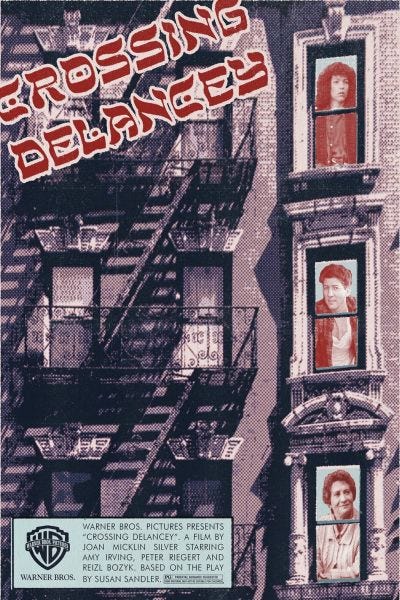
I didn’t say it was a GOOD poster. The window cutouts are bad! But the text-box in the corner is very old-school, and I do love the “faux Hebrew” font of the title.
It’s likely that most people have never heard of this movie; the cast is terrific, but it isn’t exactly full of stars. Yet it’s one I really, strongly encourage people to try. Like in Riegert’s story about his friend who lost his hat crossing Delancey, sometimes you have to give something different a try to really see what’s good in it. Give this a try and a movie with zero “stars” might end up really charming the hat off you.
The moment where a random person just starts singing “Some Enchanted Evening” in a hotdog shop actually happened once to playwriter Susan Sandler. That’s from this good interview with her/Irving/Riegert by Marya E. Gates at RogerEbert.com. There’s also good interviews with all three separately by Mark Asch of Filmmaker magazine. Irving here, Riegert here, Sandler here. Essential reading for fans of the movie, especially the Marya E. Gates interview.
It's likely one of the things that makes this such a grownup movie; Silver started filmmaking as a grownup.