
Bubba Ho-Tep
Bruce Campbell is fun as an aging Elvis fighting Evil.

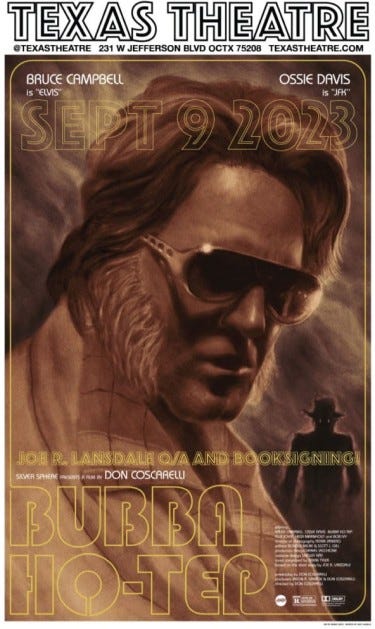
Bubba Ho-Tep (2002). Grade: C+
Elvis never died. He got tired of all the fame, all the fakeness of his persona, so he switched with a top Elvis impersonator. He had fun playing an Elvis impersonator for a while, but then he got badly and permanently injured. Now he’s in an old folks’ home.
President Kennedy is in the home, too. Played by Ossie Davis. And they’re both up against a soulsucking ancient mummy.
We were interested in seeing this one after learning the sad news that its star, Bruce Campbell, has what he’s said is a “treatable but incurable” form of cancer. Even so, Campbell hopes to promote a new movie he wrote and directed, called Ernie & Emma, about a guy on a road trip across Southern Oregon with the ashes of his late wife.
Campbell is well known to cult movie fans for his performances as “Ash,” the chainsaw-wielding hero of Sam Raimi’s Evil Dead trilogy, and the TV series Ash vs. Evil Dead that ran for three seasons in the mid-2010s. He’s also got fans for his roles in The Adventures of Brisco County, Jr., Xena: Warrior Princess, and Burn Notice. Campbell is one of those very handsome actors, like George Clooney, who has no problem with letting himself look ridiculous; he’s terrific at it and very funny.
The idea for this came from horror author Joe R. Lansdale. Veteran horror director Don Coscarelli (of the Phantasm series, among others) was looking for a new project to work on when he stopped into a Southern California genre bookstore. The clerk said he should try Lansdale because “Lansdale always has a high body count.”
(All this information on the making of the film is from this page on the official Bubba Ho-Tep blog/website; fans of the film should check out the whole “Complete History” page and have a poke around the site, it’s well-done.)
Coscarelli and Lansdale struck up a relationship and wanted to make a movie together; in 1994, Lansdale published Bubba Ho-Tep in an anthology book called The King is Dead. Coscarelli was determined to make this into a movie, but no studio would touch a script about two old guys in a nursing home. So Coscarelli raised the miniscule budget (around a million) himself.
He cast Bruce Campbell as Elvis on the suggestion of his friend Sam Raimi. He’d always visualized the great Black actor/activist Ossie Davis in the role of J.F.K, but Davis’s agent wouldn’t pass along the script. Through another friend who’d worked with Davis, Coscarelli got a personal meeting with the actor; Davis liked the role and took it despite his agent’s objections. (He was right to like it; Davis is even funnier than Campbell here.)
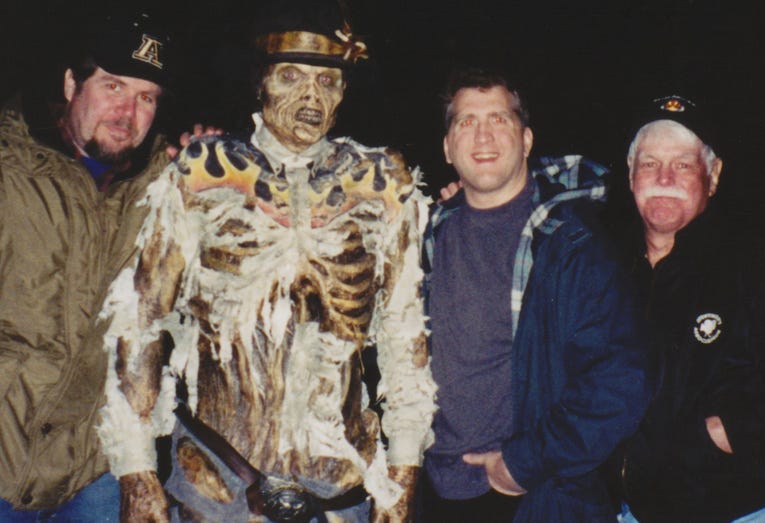
They shot the movie at the Rancho Los Amigos rehabilitation center in L.A. County; the site had been a “poor farm” and a polio ward, among other things that would leave ghosts if ghosts were real. (It was abandoned at the time they shot the movie and has since been rebuilt.) The shot was three months long, which is UNHEARD OF for a low-budget production; they used a bare-bones cast and crew. Super-experienced stuntman Bob Ivy went on a crash diet to fit into the mummy costume.
To put Campbell in an Elvis costume for flashback scenes, they actually had to get permission from the company that owns the copyright on the Elvis “look”; amazingly, the company read the script and agreed to help. (And didn’t soak the low-budget film team for a tone of money, either, the first time anyone associated with Elvis has ever turned down a chance to make the most possible profit.)
Even after the completed film was a hit on the festival circuit, no studio wanted it; so Coscarelli handled the film’s printing and release himself, booking special screenings at independent theaters which the cast would frequently attend. It did well enough to make its money back, and when MGM put out a DVD in 2004, it was a pretty big success. (The DVD has some very funny booklet insights by Campbell and a ton of behind-the-scenes footage.)
How is this, as a movie? Well, like a lot of “cult classics” (Ganja & Hess, Dark Star, The Adventures of Buckaroo Banzai), the joy’s more in the concept than in the execution. Coscarelli is a perfectly inventive director; he makes this look halfway decent, which is a near-miracle given the budget and the effects (besides a mummy suit, they blow a large RV trailer all to hell, and it’s not CGI). But Coscarelli’s sense of humor is frequently on the juvenile side; one of the first recurring gags is about a pus-filled growth on Campbell’s penis. (We don’t see it, but it’s referenced many times.)
Worse, Coscarelli’s pacing is just about glacial. It’s probably just a function of the era he started making movies, the late 70s/early 80s. If horror movies now are far too reliant on “jump scares,” horror movies of the earlier period often used prolonged sequences of little happening to try and create an atmosphere of dread. (It’s what’s done to comic effect in Barton Fink.) Neither jump scares or prolonged “dread” do a damn thing for me, and in general, when horror movies are trying to be scary, I find myself bored, annoyed, or asleep.
That said, the concept is fun, and Campbell/Davis are great together. The movie really picks up steam whenever Davis is around. We can halfway accept/buy the “Elvis is still alive but under a different name in a nursing home” story; we’re a lot less sure with “J.F.K. is still alive and to hide him completely, they turned him Black” story. (Campbell tells his own story, in flashback; Davis only tells us to Campbell/us verbally.) Is Davis a little off his rocker? Probably. But Campbell’s Elvis still respects him anyways, and calls him “Jack.” Of course you gotta respect Ossie Davis!
(Apparently Davis enjoyed working with Campbell a lot; Coscarelli said Davis would always light up when Capmbell appeared on set. That’s from this 2002 interview with Campbell, Coscarelli, and Lansdale, and it’s very amusing. Another thing fans of this film HAVE to check out; they should save a copy of the interview on a word processor for future reference. You never know when a resource like that page about an “old” movie is going to go away!)
The music’s by just-starting out composer Brian Tyner; it’s way too repetitive, but the main theme is a good, elegiac one (it suggests old spaghetti westerns rather than horror movies). Tyler’s gone on to be a big composer for Marvel movies and such, so it’s too bad he didn’t switch to professional juggling after this one. The cinematography’s by Adam Janeiro, and it’s about competence, not excellence; the goal is to have the film look professional, not artistic, and it succeeds wonderfully given the limited resources.
This can be a slow one to get through, but I pretty much promise you’ll find the ending very satisfying. Davis and Campbell are terrific fun together, and there’s a little extra likable energy coming from Ella Joyce as a exceedingly patient nurse. And you gotta respect this for being so super-original; in an era of cookie-cutter “found footage” or “meta horror” films, Coscarelli/Lansdale/Campbell/Davis did a movie unlike any ever made before, and one with some genuine feeling at the core of it. That’s pretty impressive; and to do it on this budget and for Coscarelli to distribute it himself was a real labor of love. You gotta salute that level of commitment, for sure.